Strips and the Diagonal Plait
Days one through three: split and cut equal strips, work out how many and how long, weave a square base on the diagonal, raise the walls from the same strips, fold over the rim for a double wall, and finish with a flap and toggle, after Finnish salt bottles and backpacks.
- 3 min
- 7 steps
- 1 question
- Lesson 197 of 204
In this lesson
- Split and cut
- How many strips
- Weave the base
- Raise the walls
- The double wall
- Finish
- Try it
Picking up where you left off.
Split and cut
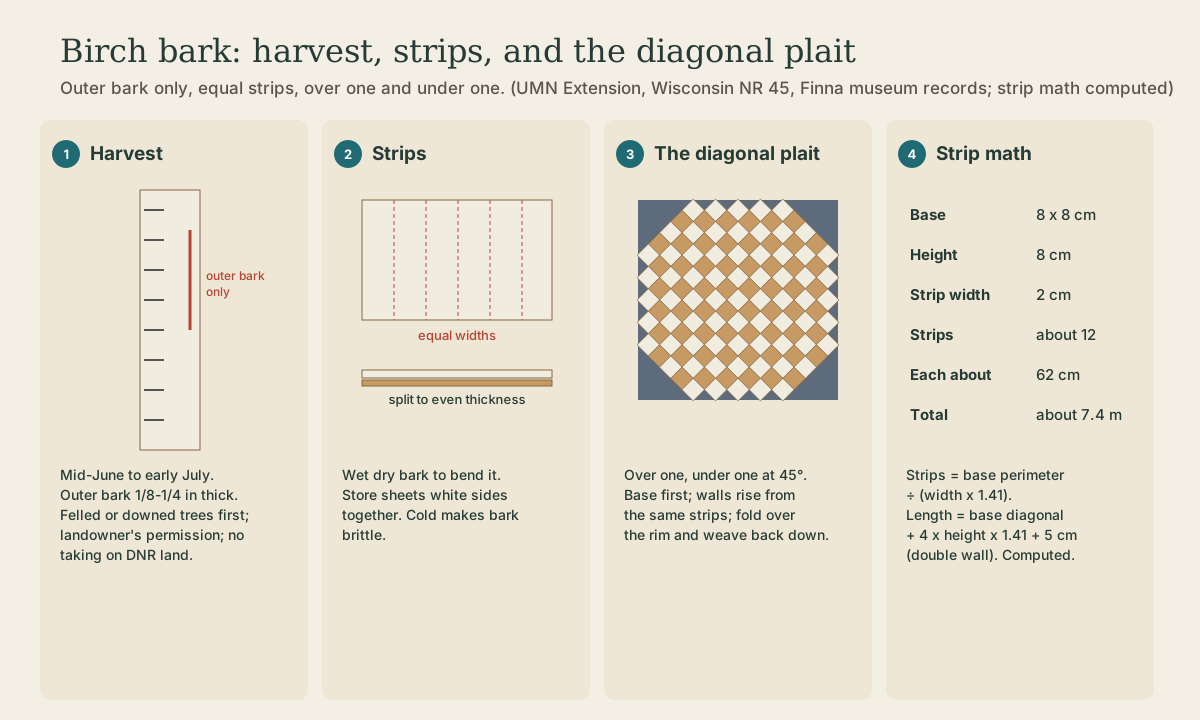
Thin the bark to an even thickness by peeling off layers so it bends without cracking; wet dry bark to make it pliable again. Then cut strips, all the same width 1. North House’s lidded basket class has students “split, snip, and grade raw bark” 2: sort the strips by thickness and use like with like. A straightedge and knife, or a paper trimmer, cuts even strips. Fresh bark curls within hours, so keep it under weight until you use it 3.
How many strips
For a box woven on the diagonal, as an estimate:
- Number of strips ≈ the base’s perimeter ÷ (strip width × 1.41), half running each way.
- Length of each strip ≈ the base’s diagonal + 4 × the height × 1.41 + 5 cm, for a double wall.
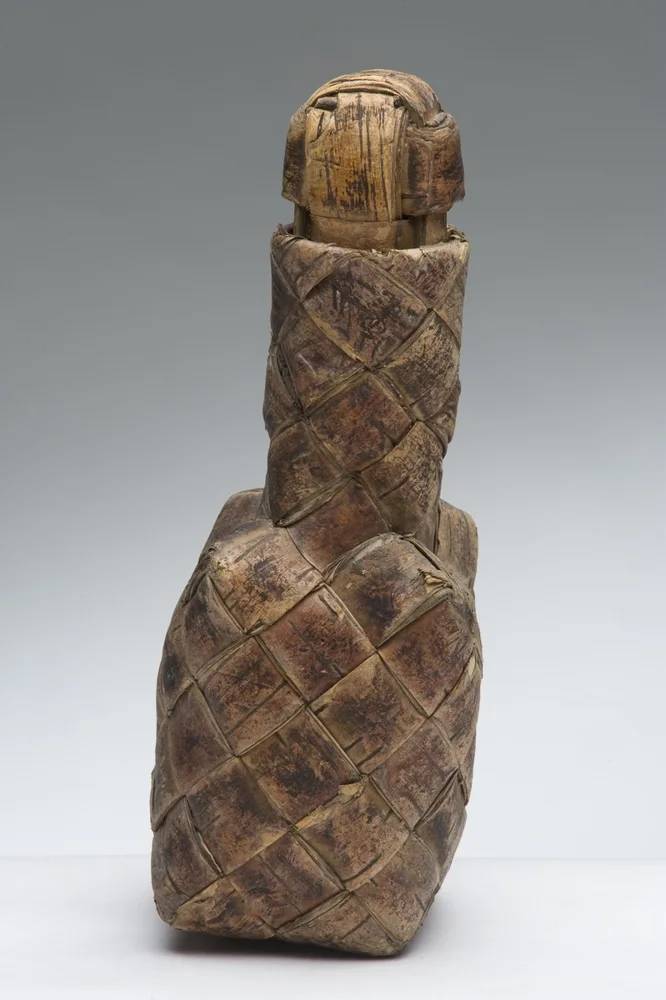
For an 8 cm square base, 8 cm tall, with 2 cm strips: about 12 strips of about 62 cm, some 7.4 meters in all. Check it against the Repola salt bottle, whose 7 cm sides each take two 2.2 cm strips 4.
Weave the base
- Lay half the strips side by side, white side up, and weave the other half across them over one, under one, at the center.
- Clip the crossing points with clothespins or toothless clips 5.
- Turn the work 45 degrees: the base is the square of woven strips in the middle, with strip ends standing out on all four sides.
In diagonal work the walls rise entirely from these base strips 1.
Quick check
That’s why all strips are the same width; straight weaving needs extra horizontal strips.
Raise the walls
Fold the strips up along the base’s edges and keep weaving over one and under one, now up the corners and walls, “diagonally up and down the basket,” as North House puts it 6. Keep the strips tight against each other and clip as you go.
The double wall
At the rim height, fold each strip down over the edge and weave it back down the inside, over and under the strips there. The Finnish backpack at the Forest Museum is a diagonal double plain weave, its strips turned at the top for a straight edge 7. Tuck the ends under crossing strips inside, and trim. Tembreull’s bias weave gives four layers 5.
Finish
North House’s field pouch adds a leather flap and handle on day three 6; the backpack closes with a wooden toggle 7. Store finished bark work out of strong sun, which ages it.
Playback is optional. If the player is unavailable, open the video at its source.
Try it
Before weaving a basket, cut a single strip 5 mm wide and about 25 cm long and wind it into a ring, as Finnish beginners do. It shows how thin the bark must be split to bend without cracking.
Lesson complete
Nice work.
Sources for this lesson
- 1Tuohi. Finnish Wikipedia. verifiedPeels best in May-June until midsummer; even a small wound usually stops new white bark forming. Store sheets white sides together; long strips wound in rolls. In diagonal work the sides are formed entirely from the base strips and all strips are the same width; straight work needs extra horizontal strips.
- 2Lidded Woven Birch Bark Basket. North House Folk School. verifiedTwo days: start with a horizontal base; students 'split, snip, and grade raw bark'; the lid fits on a natural root or stick hinge; finished about 6 x 4 x 4 in. Tools: scissors and clothespins; optional sloyd knife and fid.
- 3Never. Norwegian Wikipedia. verifiedBest taken before and around midsummer, for about 4-5 weeks after the leaves are full-grown; trees 8-30 cm in diameter; cut vertically without cutting the inner bark; the tree carries a black scar; new bark can be taken again after 7-8 years. Fresh bark curls within hours, so it is stacked under press.
- 4Suolapullo (salt bottle), Repola. National Museum of Finland (Finna). verifiedEast Karelia, before 1942: diagonally plaited from 2.2 cm strips, four-sided, each side from two strips; base side 7 cm, height 18 cm, neck 7.5 cm; wooden stopper. CC BY 4.0.
- 5Intro to Bias Woven Birch Bark Basketry. Finnish American Folk School (Finlandia Foundation). verifiedKaren Tembreull, Oct 5, 2025; class $80, materials $75 for prepped bark and a detailed pattern; the bias weave makes 'four layers which are strong, useful, flexible and repairable.' Bring 12 small toothless alligator clips, a pocket knife, scissors, and an old towel.
- 6Birch Bark Field Pouch. North House Folk School. verifiedBeth Homa Kraus, July 23-25, 2026 (day 1 2-6 pm, days 2-3 9-5); tuition $275, materials $120. Day 1: history and ecology of birch, sustainable harvesting, processing bark; day 2: weave diagonally up and down the basket; day 3: a leather flap and handle. Required: scissors; optional: clothespins, sloyd knife, thimble, pliers.
- 7Tuohikontti (birch-bark backpack). Lusto - Finnish Forest Museum (Finna). verifiedEarly 1900s: about 50 cm tall, base 15 x 33 cm, strips about 3 cm, diagonally plaited double plain weave, over one and under one; strips turned at the top for a straight edge; wooden toggle. CC BY 4.0.
Further reading
- Harvesting Birch Bark. University of Minnesota Extension / Minnesota Forest Stewardship (hosted by UW-Madison Forestry Extension). verifiedBest between mid-June and early July; make a small test cut at the base. Take only the outer bark, usually 1/8-1/4 in thick; the inner bark is 2-3 times thicker. Roll fresh bark or store it flat under weight. Usually from trees 6 in and up; sheet width about 3 times the diameter; dead and downed bark is more fragile but useful. Landowner permission; state land requires a permit and fee; the Forest Service requires a permit. Up to 20% of trees from which bark is removed die; harvest first from trees due to be cut.