Heat Colors and Working Temperatures
Reading temperature by color: forging heats from cherry red to yellow, why you stop at a dull red, welding heat and burning, scale, the magnet test near nonmagnetic, and temper colors on bright steel - plus the galvanized-steel fume hazard.
- 4 min
- 6 steps
- 3 questions
- Lesson 85 of 204
In this lesson
- Reading heat by color
- Forging heats
- The magnet test
- Temper colors
- Hazards
- What to take from this
Picking up where you left off.
Reading heat by color
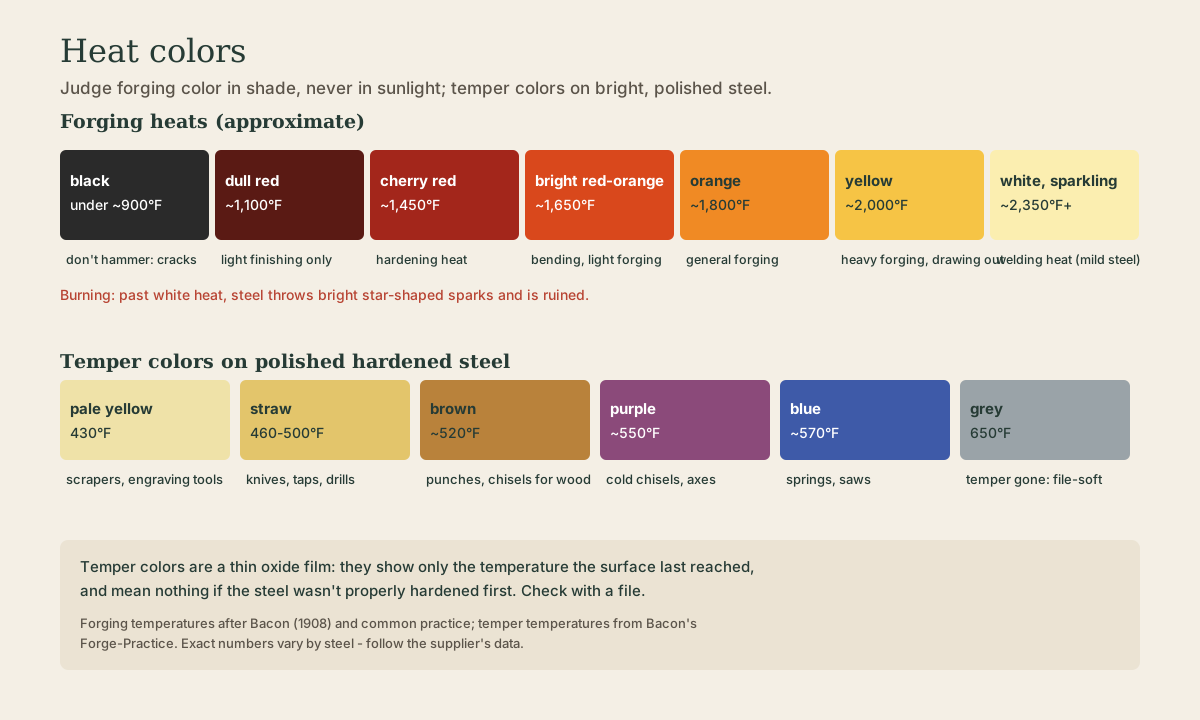
Smiths judge temperature by the color of glowing steel. Colors look darker in bright light and brighter in the dark, so judge them in shade and in the same light every time.
Forging heats
| Color (in shade) | Approximate | Use |
|---|---|---|
| No visible glow | under ~900°F | don’t hammer |
| Dull red | ~1,100°F | light planishing only |
| Cherry red | ~1,450°F | hardening heat for many carbon steels |
| Orange | ~1,800°F | general forging, bending |
| Yellow | ~2,000°F | heavy forging and drawing out |
| White, sparkling | ~2,350°F+ | welding heat for mild steel |
- Forge hot. Bacon advises drawing out at “as high a heat as it will stand” without burning 1 - hot steel moves easily, so you do more with each blow.
- Stop at a dull red and reheat. Hammering cold steel cracks it, and blows just bounce.
- Too hot: past white heat the steel burns, throwing white, star-shaped sparks; burned steel is rough, spongy, brittle, and ruined 1. High-carbon tool steel burns at a lower heat than mild steel.
Scale: hot steel reacts with air to form a black oxide skin that flakes off - Bacon’s “black scale continually falling from heated iron” 1. Brush it off with a wire brush before finishing blows so it isn’t hammered into the surface, and keep the fire from blowing excess air over the work.
Quick check
Reheat early and often; working in the right heat is faster.
Quick check
Bacon describes these white, exploding star sparks as burning iron; burned steel is spongy and ruined.
The magnet test
Steel loses its magnetism near 1,414°F (768°C), its Curie point. A magnet on a rod tells you when a piece has passed it. For simple carbon steels like 1084, the right hardening temperature is just a little past nonmagnetic - so the magnet is the hobby smith’s thermometer for hardening (see Carbon Steel and Hardening).
Temper colors
Hardened steel reheated to a few hundred degrees grows a thin oxide film whose color shows the temperature reached 1 2:
| Color | °F | Typical use (Bacon) |
|---|---|---|
| Pale yellow | ~430 | engraving tools, scrapers |
| Straw to dark straw | 460-500 | taps, dies, drills; knives |
| Brown to purple | 520-560 | cold chisels, saws |
| Blue | ~570 | springs |
| Grey | ~650 | temper gone; file-soft |
The colors appear only on bright, polished steel and mean nothing if the steel wasn’t properly hardened 1. A file test confirms hardness.
Hazards
- Galvanized steel: the zinc coating gives off zinc oxide fumes when heated, causing metal fume fever - fever, chills, cough, headache, and aches within hours, usually gone in a day 3. Don’t forge galvanized, plated, or painted scrap; strip zinc off with vinegar or acid first if you must.
- Hot-looking cold steel: steel at 600°F looks exactly like cold steel. Assume anything near the forge is hot; pick up with tongs; mark hot pieces.
- Burns: keep a bucket of water and a burn kit handy.
Quick check
Fever, chills, cough, and aches come on within hours; strip zinc off chemically first or avoid galvanized stock.
What to take from this
Judge color in shade: cherry red (~1,450°F) for hardening many carbon steels, orange to yellow (~1,800-2,000°F) for forging, white (~2,350°F) for welding, and stop at a dull red. Star-shaped sparks mean burning. Steel turns nonmagnetic near 1,414°F, a handy hardening guide. Temper colors run pale yellow (430°F) to blue (570°F) on polished hardened steel. Never forge galvanized steel.
Lesson complete
Nice work.
Sources for this lesson
- 1John Lord Bacon. Forge-Practice: Elementary. John Wiley & Sons. 1908. verifiedPublic-domain trade-school text from the Lewis Institute; fire building with coking coal, welding heat and fluxes (sand, borax, sal ammoniac), upsetting, drawing out, bending, punching, and tool-steel hardening and tempering colors (430 F pale yellow to 570 F blue, temper gone near 650 F).
- 2Tempering (metallurgy). Wikipedia. 2026. verifiedQuenched steel is at its hardest and most brittle; tempering trades some hardness for toughness. Temper color table from faint yellow (about 349 F) through straw, brown, purple, and blues.
- 3Metal Fume Fever: A Review of the Literature and Cases Reported to the Louisiana Poison Control Center. CDC Stacks (Journal of the Louisiana State Medical Society). verifiedZinc oxide fume from heating, welding, or cutting galvanized steel causes fever, chills, cough, and aches within hours, usually resolving in about a day.