
The Primstav and What to Buy
Rebecca Hanna's three-day Vesterheim class copies one of three historic primstavs on a painted basswood board with kroting and chip carving. What a primstav was, the museum sticks you can copy and how big they are, what Vesterheim means by kroting, the wood, paint, and tools with suppliers, and a three-day plan.
- 4 min
- 5 steps
- 2 questions
- Lesson 160 of 204
In this lesson
- What a primstav is
- The sticks you can copy
- Kroting
- Try it
Picking up where you left off.
What you need
| Have it | Material | Spec | Qty | Where to get it |
|---|---|---|---|---|
| Basswood boardHanna: hardwoods do not work for kroting. | Fine-grained basswood, about 1/2 x 3 x 36 in; rip to 2 in wide to copy the 1566 stick | 1, plus a scrap for practice | Woodcraft | |
| Acrylic paint | A dark color: dark blue, green, or red | 1 small bottle | Craft store | |
| White graphite transfer paper and tracing paper | For transferring the design onto dark paint | 1 sheet each | Craft or art store | |
| Finish (at home) optionalThe class leaves the finish to students. Linseed oil will yellow the pale cut lines. | Wipe-on oil or a satin clear coat | Small can | Hardware store |
Tools
Checkmarks are saved on this device.
The plan
-
Day 1
History, layout, and practice
- Learn the two sides and the symbols; choose a model
- Lay out the handle and calendar band; step off 26 weeks with dividers
- Transfer the symbols with white graphite paper
- Practice V-tool and chip cuts on a painted scrap
-
Day 2
Kroting
- Cut the day lines and weekly ticks on both sides
- Cut the symbol outlines with the V-tool
-
Day 3
Chip carving and lettering
- Chip-carve triangles, rosettes, handle decoration, and edge notches
- Add initials and a date
- Erase the graphite; finish later at home
This module reconstructs Vesterheim Folk Art School’s three-day A Matter of Time: A Revival of the Primstav, taught by Rebecca Hanna. Students recreate one of three primstavs: Vesterheim’s stick dated 1566, an oval primstav from 1700 in Vesterheim’s collection, or a Norsk Folkemuseum primstav dated 1707. After transferring the design, “the carving techniques of kroting and chip carving will bring your painted or stained board to life.” No carving experience is needed; the $25 materials fee covers everything but the final finish 1. The class plan isn’t published; this follows the sources cited.

What a primstav is
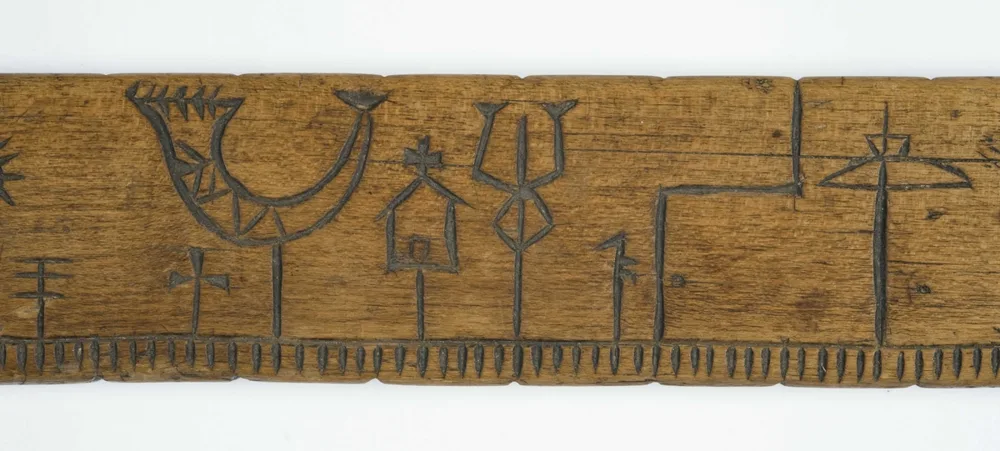
A primstav is a wooden perpetual calendar, used in Norway from about the 1300s to the 1800s. Every day is a notch, every seventh day has a special mark, and the feast days carry symbols, about 55 of them, mostly saints’ attributes. The summer side begins on April 14 and the winter side on October 14. Many are shaped like a ruler or a sword; others are round, oval, or tablets. The oldest Norwegian one is dated 1457. They grew common through the 1600s and faded after 1700, when Norway’s change to the Gregorian calendar moved the feasts 11 to 14 days 2. About 650 survive 3.
Quick check
The summer side starts April 14 and the winter side October 14.
The sticks you can copy
- Vesterheim LC0291, dated 1566, from Fåberg in Gudbrandsdal: about 90.5 × 4.8 × 1.1 cm (35 5/8 × 1 7/8 × 7/16 in), with “well carved symbols, numbers, and letters” 4.
- Norsk Folkemuseum NF.1895-0247, dated 1707, from Valle in Setesdal: birch, 80.5 × 6.6 × 1.8 cm, inscribed “Dreng Biøn Søn ANO 1707” 5.
- Vesterheim’s oval primstav of 1700 isn’t published online.
Other museum sticks give a range: a birch stick from Telemark dated 1791 is 81.5 × 5.4 × 1.7 cm 6, and a pine one from Vik is 99 cm long with deeply cut figures 7. Norwegian Wikipedia gives 50 to 80 cm long and 4 to 6 wide as typical 3. A board about 36 inches long and 2 to 2 1/2 inches wide copies either model.

Kroting
At Vesterheim, kroting means “cutting lines into wood after it has been painted or stained” 8: a V-tool cuts through dark paint so each line shows as pale wood. In Norway the word also names something else, wall decoration drawn in chalk or lime before Christmas 9.
Hanna’s supply list for kroting is specific 10:
- Wood: soft basswood with fine or no grain. “Hardwoods do not work.”
- Paint: sand, then two coats of acrylic in a dark color, dark blue, green, or red. “Do not put a finish on” before carving.
- Tools: a 2 or 3 mm V-tool, sharpened, and a strop.
- Layout: tracing paper, white graphite paper, a clear ruler, a soft pencil, a white eraser, low-tack tape, and non-slip shelf liner.
- Blanks: Hanna names the Vesterheim store and Lusk Scandia Woodworks, and says to order two months ahead.
Woodcraft sells basswood boards 1/2 × 3 × 36 inches 11. For chip carving, a Pfeil chip-carving knife 12 or the Flexcut three-knife set 13 works.
Quick check
In Norway the word also names chalk wall decoration at Christmas, a different thing.
Try it
Paint a scrap of basswood with two coats of the dark acrylic now, so it is dry for practice. Cut a few straight lines and a curve with the V-tool; if the paint chips at the edges, the tool needs stropping.
Lesson complete
Nice work.
Sources for this lesson
- 1A Matter of Time: A Revival of the Primstav. Vesterheim Folk Art School. verifiedRebecca Hanna, Nov 6-8, 2026, 9-5, beginner friendly, $290 members / $320; $25 materials, instructor provides everything except the final finish. Recreate a primstav from Vesterheim's collection (one dated 1566, or an oval primstav from 1700) or the Norsk Folkemuseum primstav dated 1707; transfer the design, then kroting and chip carving 'bring your painted or stained board to life.'
- 2Audun Dybdahl, Eivind Falk. Primstav. Store norske leksikon. 2026. verifiedA wooden calendar used from about the 1300s to the 1800s; every day notched, every seventh day specially marked; summer side from April 14, winter side from October 14; about 55 symbols, mostly saints' attributes; ruler, sword, round, oval, and tablet shapes; oldest Norwegian example dated 1457; numbers rose through the 1600s and fell after 1700, when the Gregorian reform moved feasts 11-14 days earlier.
- 3Primstav. Norwegian Wikipedia (Bokmål). verifiedAbout 650 Norwegian primstavs known, late 1400s to early 1800s, typically 50-80 cm long and 4-6 cm wide; days marked by lines or notches, some with weeks; stick-figure symbols related to house marks; a day-by-day table of feast days and symbols after Juel Lund, Primstaven (1983).
- 4Calendar Stick (LC0291). Vesterheim Norwegian-American Museum. verifiedDated 1566, from Jørstadmoen, Fåberg, Sør-Gudbrandsdal; Luther College Collection, gift of Norwegian museums. About 35 5/8 x 1 7/8 x 7/16 in (90.5 x 4.8 x 1.1 cm). 'Features well carved symbols, numbers, and letters.'
- 5Primstav (NF.1895-0247). Norsk Folkemuseum (DigitaltMuseum). verifiedBirch with brass screws, 80.5 x 6.6 x 1.8 cm; used in Valle, Setesdal; inscribed 'Dreng Biøn Søn ANO 1707' (Dreng Bjørnsson Brottveit). Model for a 1944 paper knife. Close-ups of Simonsmess and Helgemess, and of Andersmess to Lussi.
- 6Primstav (TGM-BM.1928-29:046). DigitaltMuseum. verifiedBirch, 81.5 x 5.4 x 1.7 cm, inscribed 'J BS 1791'.
- 7Primstav (DHS.03334). DigitaltMuseum. verifiedPine, 99 x 4-4.4 x 1.8-2.2 cm, from Vik, with deeply cut figures.
- 8Introduction to Kroting. Vesterheim Folk Art School. verifiedRebecca Hanna's class; kroting defined as 'cutting lines into wood after it has been painted or stained'; kit with V-tool, brushes, paint, and practice boards.
- 9Ingun Grimstad Klepp. Kroting. Store norske leksikon. 2020. verifiedIn Norway, kroting is wall decoration drawn with chalk or lime before Christmas; distinct from the Norwegian-American carving sense.
- 10Rebecca Hanna. Kroting - a Norwegian Decorative Technique (supply list). The Sawmill Museum, Clinton, Iowa. 2023. verifiedSoft basswood with fine or no grain; 'Hardwoods do not work.' Sand, then two coats of acrylic in a dark color (dark blue, green, or red); 'Do not put a finish on.' A 2 or 3 mm (1/8 or 9/64 in) V-tool, sharpened, and a strop; tracing paper, white graphite paper, a clear ruler, soft pencil, white eraser, low-tack tape, non-slip shelf liner. Basswood blanks from the Vesterheim store or Lusk Scandia Woodworks (order 2 months ahead).
- 11Basswood Dimensional Lumber. Woodcraft. verifiedBasswood boards in several sizes, including 1/2 x 3 x 36 in.
- 12Pfeil Swiss Made Chip Carving Knife #1. Woodcraft. verifiedPfeil chip-carving knives No. 1 ($28.99), No. 2, and No. 3; HRC 57-60.
- 13Flexcut 3-pc. Chip Carving Set. Rockler. verifiedKN115 set: KN11 skew, KN15 chip, KN20 mini-chip knives, $69.95.