Hardanger and What to Buy
North House's two-day class and Vesterheim's online doily class. What Hardanger embroidery is and how it belongs to the Hardanger bunad, fabric and thread pairings, needles and scissors with suppliers, and a two-day plan.
- 3 min
- 4 steps
- 2 questions
- Lesson 190 of 204
In this lesson
- What Hardanger is
- Fabric and thread
- Try it
Picking up where you left off.
What you need
| Have it | Material | Spec | Qty | Where to get it |
|---|---|---|---|---|
| Hardanger fabric | Zweigart 22-count Hardanger, white or antique white | A fat quarter (enough for a bookmark, a sampler, and a small doily) | Hobby House Needleworks | |
| Pearl cotton | DMC pearl cotton #5, white or ecru, for kloster blocks and edges | 2 skeins | Hobby House Needleworks | |
| Pearl cotton | DMC pearl cotton #8, matching color, for bars and fillings | 1 ball | Vesterheim Store | |
| Tapestry needles | Blunt sizes 20 or 22 for #5, 22 or 24 for #8 | 1 pack each | Hobby House Needleworks |
Tools
Checkmarks are saved on this device.
The plan
-
Day 1 morning
Counting and kloster blocks
- History and materials; counting on 22-count
- A diamond of kloster blocks in #5
-
Day 1 afternoon
Cutting and weaving
- Cutting rules and a practice cut
- Woven bars in #8
- Start a bookmark: klosters and buttonhole edge
-
Day 2 morning
Fillings
- Eyelets; cut the bookmark
- Woven bars and dove’s eyes
-
Day 2 afternoon
Finishing
- Trim the edge from the back
- Wash and press; plan a doily
This module reconstructs North House Folk School’s two-day Norwegian Needlecraft: Taking the ‘Hard’ out of Hardanger with Lori Zimmerman, who promises that if you “can count to five, you can do hardanger!” 1, and Vesterheim’s online class with Shan Rayray, which makes a small doily of kloster blocks, woven bars, a buttonhole edge, and fillers such as picots, spoked wheels, and dove’s eyes 2. The class plans aren’t published; this follows the sources cited.
What Hardanger is
Hardangersøm took its present form in western Norway, especially Hardanger, continuing the Italian cutwork called reticella. It is a white embroidery (hvitsøm) worked by counting threads, first on fine textiles such as bridal shirts and aprons, and today on the shirts and aprons of the Hardanger bunad, where a wide apron border can take up to 180 hours. It was worked on local linen with linen thread; what matters is a plain weave whose threads can be counted. It spread widely among Norwegian Americans in the Midwest 3. It flourished from about 1650 to 1850 4.
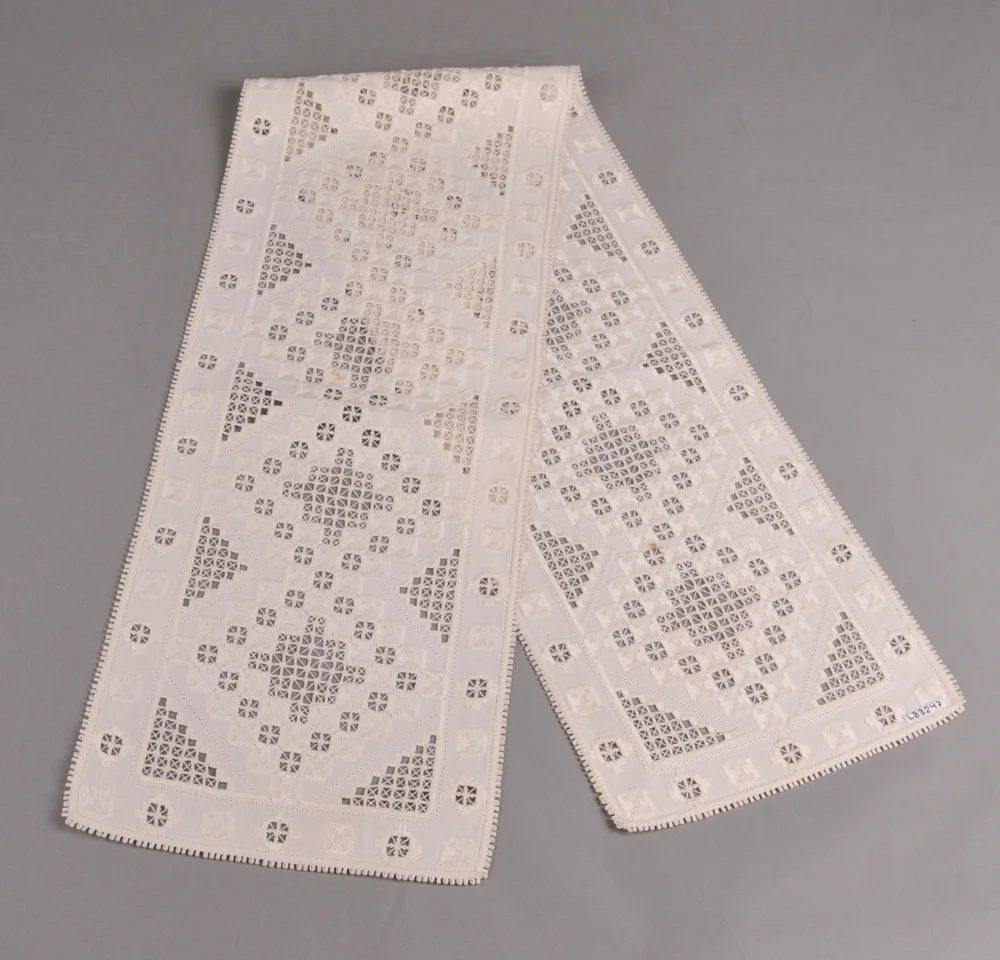
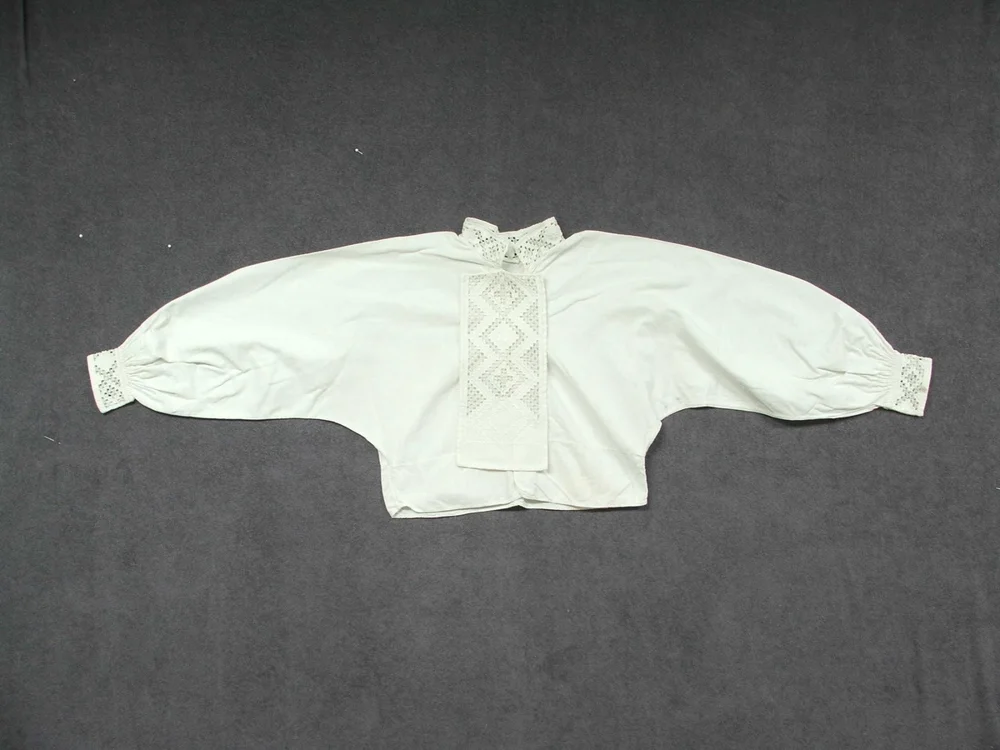
The Vest-Telemark Museum’s runner is 26 by 132 cm 5; a Hardanger bunad shirt at Nordfjord carries the work at the neck, cuffs, and bib, with eight-petal roses between 6.
Quick check
Every stitch is placed by counting threads.
Fabric and thread
Old pieces were on linen of 36 threads per inch or finer. Modern Hardanger fabric is cotton woven with threads in pairs, 22 per inch 4. Carol Leather’s pairings 7:
| Fabric | Thread | Needle |
|---|---|---|
| 22-count Hardanger | pearl cotton #5 for blocks, #8 for bars | 20 or 22, and 22 or 24 |
| 28-count | #8 and #12 | 22 and 24 |
| 32-count linen | #12 | 24 |
Hobby House sells Zweigart 22-count Hardanger by the fat quarter for $9.25, DMC pearl cotton #5 at $1.99 a skein, and tapestry needles 8; Vesterheim sells pearl cotton #8 and Gingher stork scissors 9. Vesterheim’s kit gives four prepared 22-count squares, DMC thread, and tapestry needles 2.
Quick check
Finer fabrics take finer pearl cotton: 28-count with #8 and #12, 32-count linen with #12.
Try it
Cut a 6-inch square of the fabric and count 18 threads in from the center along one line, as Leather’s first lesson does 7. Count it twice. Counting is the whole skill; if it comes out the same both times, you’re ready for lesson 2.
Lesson complete
Nice work.
Sources for this lesson
- 1Norwegian Needlecraft: Taking the 'Hard' out of Hardanger. North House Folk School. verifiedLori Zimmerman, Jan 9-10, 2027, 9-5; tuition $230, materials $25. A small project from start to finish; Hardanger made 'at least since 1650'; 'If you have interest and can count to five, you can do hardanger!' Optional: hoop, sharp embroidery scissors, #22 tapestry needles.
- 2Intermediate Hardanger Embroidery (online). Vesterheim Folk Art School. verifiedShan Rayray on Zoom, Tuesdays Nov 3-Dec 1, 2026, four sessions with video tutorials; $215-235. A small doily: kloster blocks and satin stitch, drawn threadwork with woven bars, buttonhole edge, with filler stitches chosen from picots, spoked wheel, dove's eye, adjoining wraps, and webbing. Kit ($45 value): four prepared 22-count Hardanger squares, DMC thread, tapestry needles; students supply sharp embroidery scissors (stork scissors preferred).
- 3Barbro Tronhuus Storlien. Hardangersøm. Store norske leksikon. 2025. verifiedArose in its present form in western Norway, especially Hardanger, continuing Italian reticella cutwork; a form of white embroidery (hvitsøm) worked as geometric counted embroidery, originally on finer textiles such as bridal and groom shirts and bridal aprons; today on the shirts and aprons of the Hardanger bunad, where a wide apron border can take up to 180 hours. Traditionally on local linen with linen thread; the essential requirement is a plain weave whose threads can be counted. Spread widely among Norwegian Americans in the Midwest.
- 4Hardanger embroidery. Wikipedia. verifiedFlourished 1650-1850; on the bunad shirt's cuffs, collar, and yoke, the apron, and sometimes the headband. Historic linen 36 count or finer; modern Hardanger fabric is cotton woven in pairs at 22 per inch; pearl cotton #5 for kloster blocks and #8 for fillings. Kloster block = 5 satin stitches over 4 x 4 threads; woven and wrapped bars, wheels, dove's eyes, picots, buttonhole and hemstitch edges.
- 5Duk (LB.03247). Vest-Telemark Museum (DigitaltMuseum). verifiedHardanger runner of white linen, 26 x 132 cm. CC BY-SA.
- 6Skjorte og skjortebryst til Hardangerbunad (NFM.1989-00181). Nordfjord Folkemuseum (DigitaltMuseum). verifiedHardanger bunad shirt of white cotton with Hardanger embroidery at the neck, sleeve ends, and front bib, eight-petal roses between; 43 x 42 cm. CC BY-SA.
- 7Carol Leather. Hardanger Embroidery: free lessons. Needlework Tips and Techniques (X-Calibre Designs). verifiedLesson 1: a 6 in square of 22-count fabric, pearl cotton #8 ball and #5 skein, tapestry needles 22 and 24, small hoop; waste knot; each satin stitch covers 4 threads; reuse the corner hole; end threads by weaving under blocks; cut 'always along the edge where stitches go down… Never cut parallel to the stitches', 4 threads at a time; needleweave with #8 'over two, under two', bars in diagonal rows. Later lessons: wrapped bars, dove's eye (wrap half a bar, 4 buttonhole loops, finish the bar); a bookmark on 6 x 10.5 in fabric worked klosters, buttonhole edge, eyelets, cut, weave, trim from the back; pairings 22 ct with #5 and #8, 28 ct with #8 and #12, 32 ct linen with #12; needles 20 for #5, 22 for #8, 24 for #12; remove the hoop before cutting.
- 822 ct Antique White Hardanger Fabric. Hobby House Needleworks. verifiedZweigart 22-count Hardanger: fat eighth $4.70, fat quarter $9.25, yard $36.90. Also DMC pearl cotton #5 (27 yd, $1.99) and Pony tapestry needles size 20 and 22 ($3).
- 9DMC Cotton Perle 8, Blanc. Vesterheim Store. verifiedDMC pearl cotton size 8, white, 95 yd, $2.50; Vesterheim also sells Gingher stork embroidery scissors ($26).