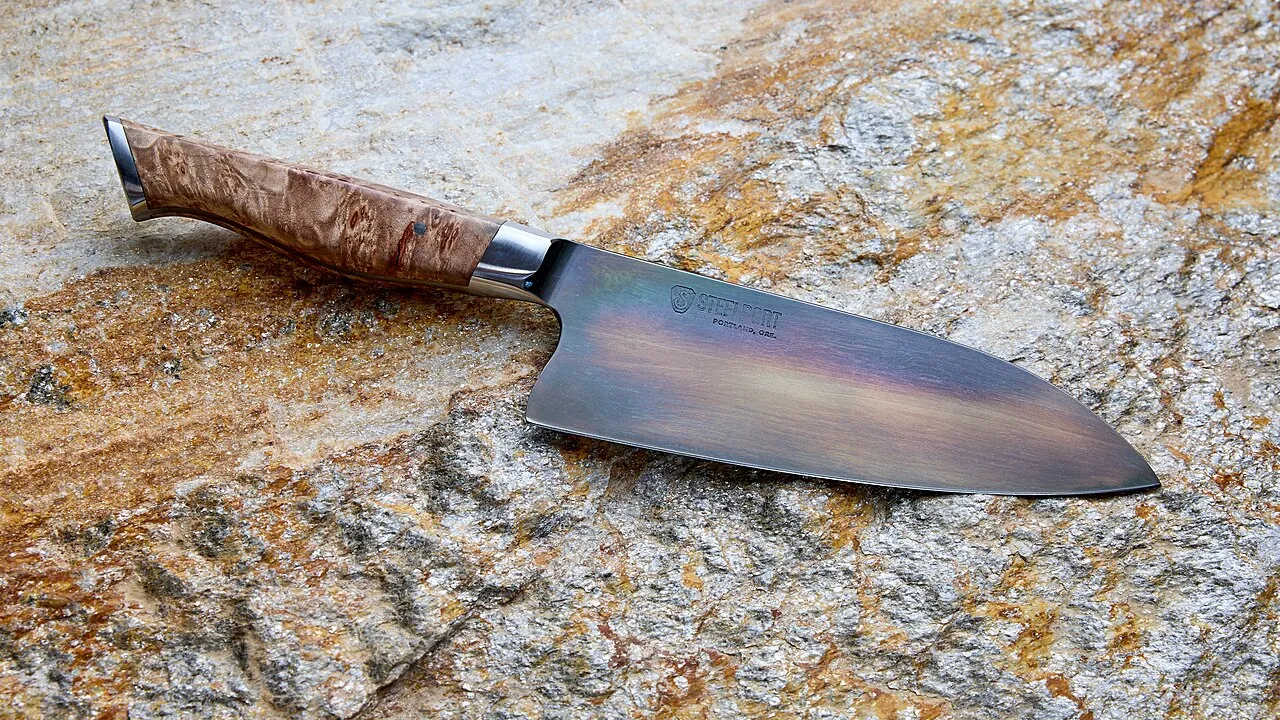
A Knife Blade
Forging a simple utility knife from 1084: profiling and forging the tip, distal taper, and bevels, the tang, normalizing, grinding, hardening, oven tempering at 400°F, and fitting a wooden handle - with the checkpoints that keep the blade straight and uncracked.
- 4 min
- 5 steps
- 3 questions
- Lesson 95 of 204
In this lesson
- Steel and design
- Forging the blade
- Heat treatment
- Finishing
- What to take from this
Picking up where you left off.
Steel and design
Use a known high-carbon steel: 1084 is forgiving and simple to heat treat 1. Start with 1/8 × 1 inch (3 × 25 mm) bar, enough for a 3.5-4 inch blade and a tang.
-104A7331.jpg)
Design: a straight-backed utility blade or a sloyd-style blade, with a hidden tang (a narrow spike into a drilled handle) or a full tang (handle scales riveted to each side).
Forging the blade
- Tip: at a bright orange, forge the end to a point by hammering the corner down at an angle, bringing the tip toward the spine side.
- Bevels: hammer the edge side at an angle along the blade, working from the ricasso (heel) to the tip. The edge will curve up toward the spine as the edge side stretches; pre-curve the blank the other way, or straighten on the edge of the anvil as you go.
- Distal taper: thin the blade gradually toward the tip.
- Leave the edge thick: about the thickness of a dime (1/32 in., 1 mm). Thin edges overheat and crack in the quench.
- Tang: draw out the tang behind a clean shoulder (see Drawing Out).
- Straighten at a dull red, never cold.
Forge hot and stop at a dull red 2; keep the thin tip out of the hottest part of the fire.
Playback is optional. If the player is unavailable, open the video at its source.
Quick check
Leave about 1/32 inch (1 mm) at the edge through hardening.
Heat treatment
Follow the steel’s data 1:
- Normalize three times, at about 1,650, 1,500, and 1,350°F, air-cooling to black each time.
- Grind the profile and bevels to 120-grit, edge still about 1 mm thick. File-work and drilling happen now, while the steel is soft (anneal first if it’s too hard).
- Harden: heat evenly to just past nonmagnetic, 1,450-1,480°F, and quench edge-first in fast oil (or warm canola) with an up-and-down motion 1. A file should skate on the edge.
- Temper immediately, twice for 1-2 hours at about 400°F in a checked oven, giving a hard, tough edge around 58-60 HRC; lower temperatures leave it harder, higher softer (300°F ≈ 65 HRC, 650°F ≈ 50 HRC) 1 3.
- If it warped, straighten while still warm from tempering, clamped with shims, then temper again.
Quick check
As-quenched steel is brittle enough to crack sitting on the bench.
Quick check
Three cycles stepping down in temperature, air-cooled.
Finishing
Grind and hand-sand the bevels to the final edge, keeping the blade cool (dip often) so you don’t draw the temper - blue color at the edge means you softened it. Fit a handle of birch, maple, or antler: for a hidden tang, drill the handle, test-fit, and glue with epoxy or burn it on; for a full tang, rivet or pin scales. Sharpen and strop, and oil the blade - carbon steel rusts.
What to take from this
Forge 1084 hot: point the tip, hammer the bevels from heel to tip, thin the blade toward the tip, leave a dime-thick edge, and draw a tang behind a clean shoulder. Normalize three times, grind, harden just past nonmagnetic (1,450-1,480°F) in fast oil, and temper twice at about 400°F. Finish grinding cool, fit a handle, and keep carbon steel oiled.
Lesson complete
Nice work.
Sources for this lesson
- 11084 Knife-Making Blade Steel. Blacksmiths Depot. verifiedSupplier heat-treat guidance for eutectoid 1084 - normalizing cycles stepping down from about 1,650 F, hardening at 1,450-1,480 F with a 5-15 minute soak, a fast oil quench (Parks 50), about 64-65 HRC as quenched, and tempering from 300 F (about 65 HRC) to 650 F (about 50 HRC).
- 2John Lord Bacon. Forge-Practice: Elementary. John Wiley & Sons. 1908. verifiedPublic-domain trade-school text from the Lewis Institute; fire building with coking coal, welding heat and fluxes (sand, borax, sal ammoniac), upsetting, drawing out, bending, punching, and tool-steel hardening and tempering colors (430 F pale yellow to 570 F blue, temper gone near 650 F).
- 3Tempering (metallurgy). Wikipedia. 2026. verifiedQuenched steel is at its hardest and most brittle; tempering trades some hardness for toughness. Temper color table from faint yellow (about 349 F) through straw, brown, purple, and blues.