Birch Skis and What to Buy
Ian Andrus's four-day North House class makes a custom pair of birch skis from prepared blanks, with a materials fee that covers leather bindings. The old Nordic ski and its Sámi and Telemark roots, how long and how shaped a ski should be, birch and its alternatives, what to buy for the mold, tar, and bindings, and a four-day plan.
- 4 min
- 6 steps
- 2 questions
- Lesson 139 of 204
In this lesson
- The class before
- The Nordic ski
- Size and shape
- Wood
- Try it
Picking up where you left off.
What you need
| Have it | Material | Spec | Qty | Where to get it |
|---|---|---|---|---|
| Ski blanksNorth House prepares the blanks before class. Ash and hickory are the old alternatives. | Straight-grained, knot-free birch (yellow or paper), air-dried if possible, about 1 1/4 x 4 in x your ski length plus 4 in | 2, plus a spare if you can | A hardwood dealer or sawmill; flat-sawn so the rings run across the width | |
| Mold lumberTalbot’s adjustable form; braces unscrew to change camber and tip. | Two 1x8 x 8 ft and two 2x4 x 6 ft pine boards, plus screws | 1 set | The Argobuilder | |
| Template stock | 1/4 in plywood, as long as the ski | 1 strip about 5 in wide | Lumberyard | |
| Steam box or soaking trough | Long enough for the front third of a ski; a closed box with a steam source, or a trough of hot water | 1 | Make from plywood or pipe; Hansen's class used a hot-water bath on a wood stove | |
| Pine tarFangel lists Finn Sisu, Akers Ski in Maine, and horse-supply stores. | Regular (thin with mineral spirits) or quick-drying ski pine tar | 1 small can | Wooden Cross-Country Skis | |
| Ski wax | Glide and kick wax for the snow you ski | As needed | A cross-country ski shop | |
| Rawhide | A strip for the foot strap, about 1 in wide | 2 pieces about 18 in | A leather supplier or harness maker | |
| Tanned leather straps and buckles | Harness or latigo leather about 3/4-1 in wide | Enough for a toe and a heel strap per ski, about 4 ft each | A leather supplier or harness maker | |
| Modern Nordic bindings optionalInstead of leather; North House lets you bring your own bindings. | Screw-on touring bindings to fit your boots | 1 pair | A cross-country ski shop |
Tools
Checkmarks are saved on this device.
The plan
-
Day 1 (evening)
Size, lay out, and soak
- Choose a length for your height, weight, and skiing
- Make the plywood template and trace it on the blanks
- Cut the outlines, thin the bending zone, and start the blanks soaking
-
Day 2
Bend
- Set the mold’s tip braces and camber block
- Steam or boil the tips and clamp both skis into the mold
- Leave them to set overnight
-
Day 3
Shape
- Release the skis and check the arch and tip rise
- Taper the thickness toward tip and tail; true the sides
- Cut the groove, carve the tips, and make the binding slot
-
Day 4
Tar and bindings
- Scrape and sand; pine-tar the bases
- Cut, soak, and punch the rawhide; fit the leather straps to your boots
- Wax and test
This module reconstructs North House Folk School’s four-day Craft of Birch Ski Making: Making Your Own Set, taught by Ian Andrus. Students make “a custom pair of birch skis” sized to their “height, weight, and intended use,” covering wood grain, bending wood, bindings, and use. It is “not a log to ski course”: the instructor does preliminary steps beforehand, and the $150–175 materials fee depends on whether you choose leather bindings or bring your own 1. The class’s own plan isn’t published; this follows the sources cited.
The class before
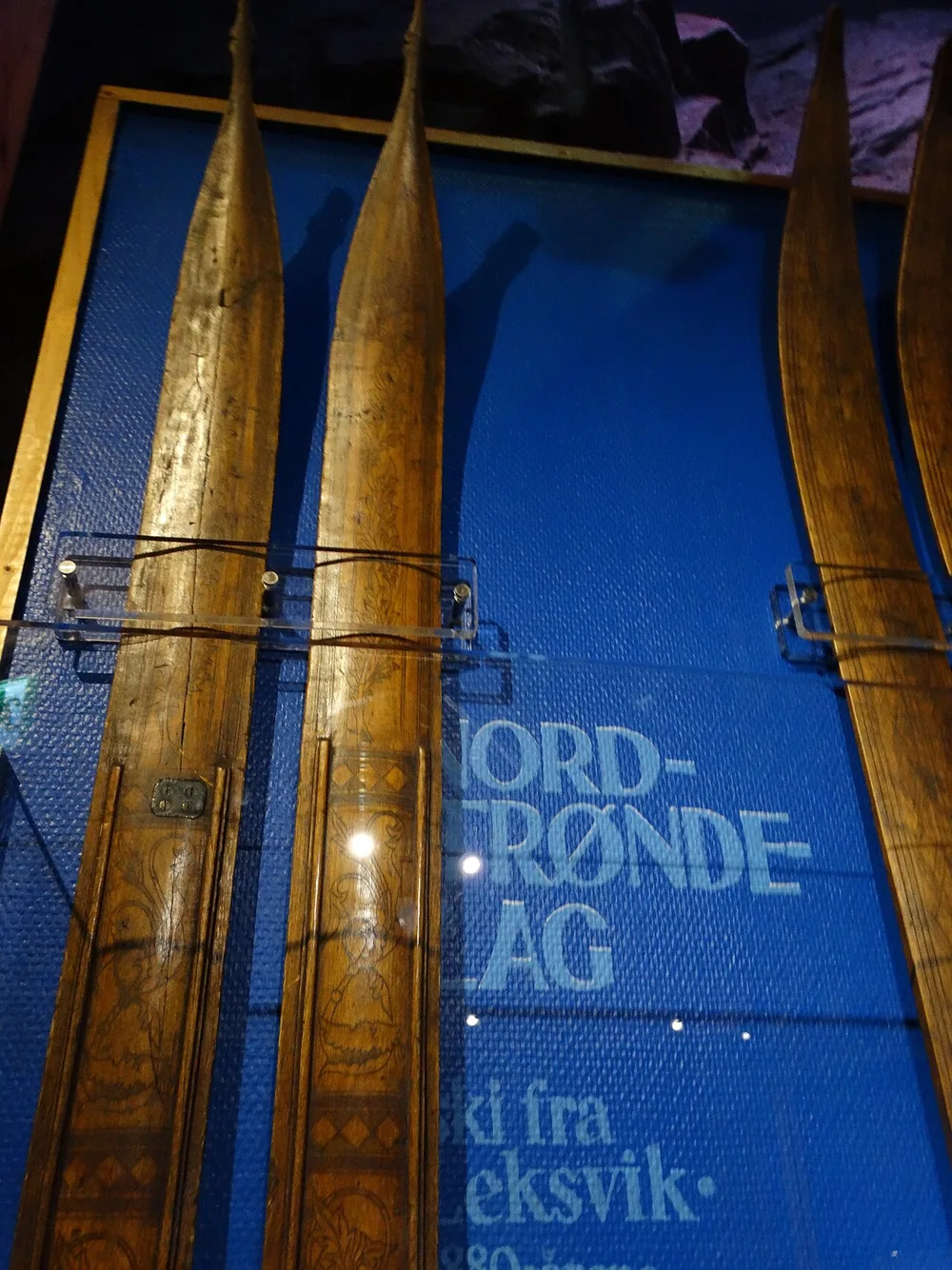
Greg Fangel took the class when Mark Hansen taught it in 2 1/2 days. Hansen pre-cut the birch; the blanks went into a hot-water bath heated by the wood stove while students adjusted their molds, “including the camber below the foot,” and the skis set overnight. The next day they cut, gouged, scraped, and chiseled the bent blanks into skis, with a bandsaw to speed things up, and added carved tips and decorative lines. The last day was finishing, pine tar, and leather strap bindings: a rawhide strap for the foot, soaked, cut, and punched, and tanned straps sized to each student’s boots 2. Andrus’s four days follow the same arc with more time.
The Nordic ski
Skis are old in the North, and Sámi skiers were among the most skilled. Linnaeus described Sámi skis made of compression wood (tjur), the dense wood on the lower side of a leaning Scots pine; in the 1930s Anta Pirak described birch for the outer part of the underside and compression pine for the inner part, the combination giving the right bend 3. Norwegians used ash, birch, and pitch-saturated pine 4. Telemark in Norway gave its name to the classic shape that 19th-century makers copied 5.

Quick check
Compression wood forms on the lower side of a leaning pine and was valued for skis, bows, and sledges.
Size and shape
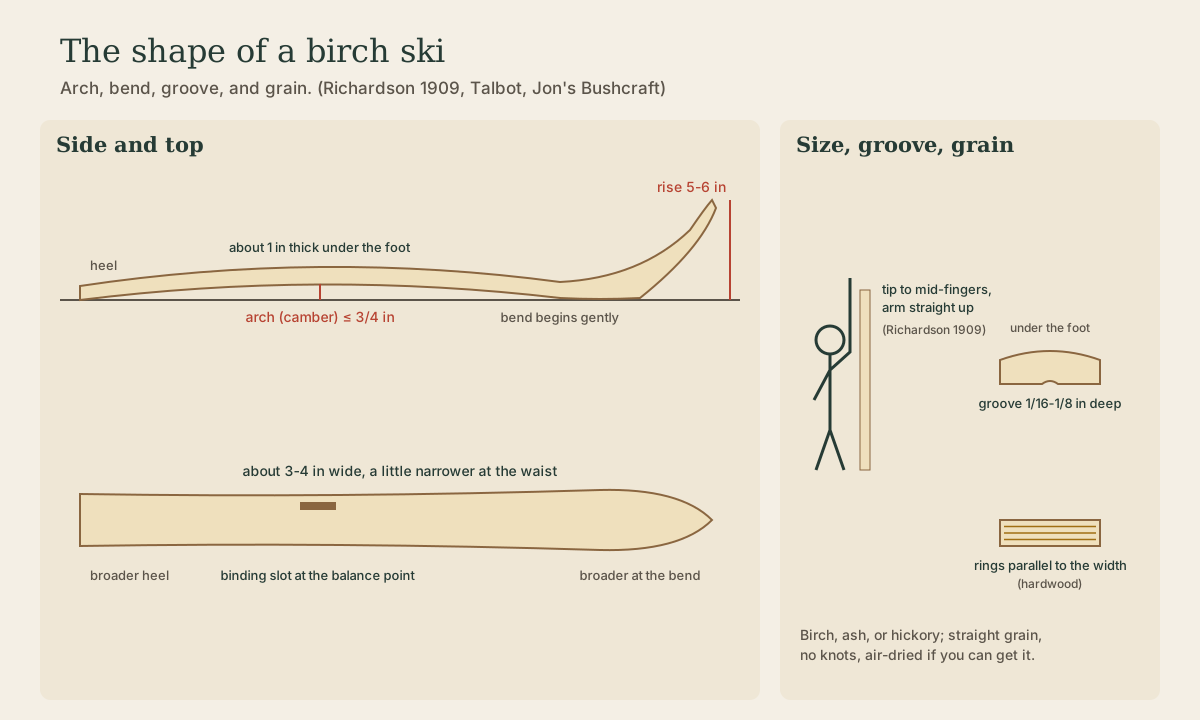
E. C. Richardson’s The Ski-Runner (1909) describes the Telemark ski in numbers that still work 5:
- Length: the tip “reaches to the middle of the fingers when the hand is held above the head.” A Wisconsin maker sized his to the wrist with the arm up 6. North House adjusts for weight and use 1.
- Size: about 3 1/2 inches wide and 1 inch thick in Richardson’s general description.
- Arch (camber): no more than 3/4 inch; too much and the ski runs on its ends.
- Bend (tip): a total rise of 5 to 6 inches, starting so gently “it should be impossible to say just where it begins,” like a good bow. A thin bend is less likely to break than a thick one.
- Sides: slightly broader at the bend and the heel than at the middle.
- Groove: about 1/12 inch deep and rounded on Telemark skis; about 1/8 inch and square on Swedish ones.
- True: a line from the middle of the tip to the middle of the heel must split the ski into two equal halves, or it will run in a curve.
Quick check
Richardson’s 1909 rule; a modern Wisconsin maker used ground to wrist.
Wood
North House uses birch 1. Richardson preferred ash and hickory and found birch light but “apt to be brittle,” though Norwegian makers used birch impregnated with tar 5. For hardwood skis, lay out the blank so the growth rings run parallel to the width of the ski 4. Talbot looked for air-dried rather than kiln-dried wood because it bends and holds a bend better, and paid $28 for his rough ash 6.
Buy yellow birch from a hardwood dealer in 5/4 thickness, clear and straight for the full length, a few inches longer than the finished ski. Sight down each board; any twist in the grain will make the ski run crooked.
Try it
Hold your arm straight up against a wall and mark the middle of your fingers, then your wrist. Those two marks bracket your ski length. A shorter ski turns more easily among trees; a longer one spreads your weight over more snow.
Lesson complete
Nice work.
Sources for this lesson
- 1Craft of Birch Ski Making: Making Your Own Set. North House Folk School. verifiedA custom pair of birch skis sized to height, weight, and use; wood grain, bending wood, bindings, use and handling. Materials $150-175 depending on leather bindings. 'Not a log to ski course': the instructor does preliminary steps. Optional tools: tape, pencils, spokeshave, low-angle block plane, carving knife, drawknife, V-tool. Instructor Ian Andrus; session Jan 14-17, 2027, day 1 4-8 pm, days 2-4 9-5.
- 2Greg Fangel. Traditional Birch Ski Making. Wooden Cross-Country Skis. verifiedAccount of Mark Hansen's 2 1/2-day North House class: pre-cut birch blanks soaked in a hot-water bath heated by a wood stove; molds adjusted, including camber under the foot; skis set overnight; then cut, gouged, scraped, and chiseled to a pointed ski, band saw allowed; decorative tips and lines; pine tar on the base, wax over it; Norwegian leather bindings: rawhide foot strap soaked, cut, and punched, tanned leather straps sized to the footwear.
- 3Isak Lidström, Ingvar Svanberg, Sabira Ståhlberg. Traditional sports and games among the Sámi people in Northern Fennoscandia (Sápmi): an ethnobiological perspective. Journal of Ethnobiology and Ethnomedicine. 2022. verifiedSámi skis of compression wood (tjur) from the lower side of a Scots pine stem, described by Linnaeus; Anta Pirak in the 1930s: birch for the outer part of the underside and compression pine for the inner part, the combination giving the right bend; compression wood wore less on crust. Olaus Magnus (1555) on skis covered with reindeer skin.
- 4Make Your Own Traditional Wooden Skis. Jon's Bushcraft. verifiedScandinavians generally used ash or birch, also pitch-saturated pine. For hardwoods the growth rings lie parallel to the width of the ski; for softwoods, perpendicular. Split the log with wedges; straight grain without twist; shape while green.
- 5E. C. Richardson. The Ski-Runner. Published by the author, London. 1909. verifiedSkis about 7 1/2 ft long, 3 1/2 in wide, 1 in thick. Size: tip reaches the middle of the fingers with the hand held above the head. Arch no more than 3/4 in; bend rising 5-6 in, gentle like a bow; broader at the bend and heel; groove about 1/12 in deep and rounded (Swedish 1/8 in, rectangular); a narrow slit near the middle for the binding. Ash and hickory preferred; birch light but apt to be brittle; Norwegian birch skis impregnated with tar.
- 6Making Traditional Scandinavian Wooden Skis. The Argobuilder. verifiedA Wisconsin build: sized ground to wrist with the arm up; adjustable steam-bending form of 1x8 and 2x4 pine with removable cross braces, tip curve drawn steeper than wanted for springback; 1/4-in plywood template, side curve drawn with a batten; ash blanks 1 1/16 x 4 x 80 in, air-dried preferred; 3/8 x 1/16 in groove from 12 in behind the tip to 12 in from the tail; tapered to 5/16 in at tip and tail.
Further reading
- Greg Fangel. Wooden Ski Base Prep. Wooden Cross-Country Skis. 2011. verifiedScrape old wax and tar, sand 60 then 100-120 grit. Quick-drying pine tar follows its can; regular pine tar is thinned and heated in: heat the base, brush on, heat until it bubbles, reheat and wipe off the excess, in 6-12 in sections; wipe until no tar shows; glide wax after cooling. Sources: Finn Sisu, Akers Ski (Maine), any horse supply house.