Riving and Shaping the Staves
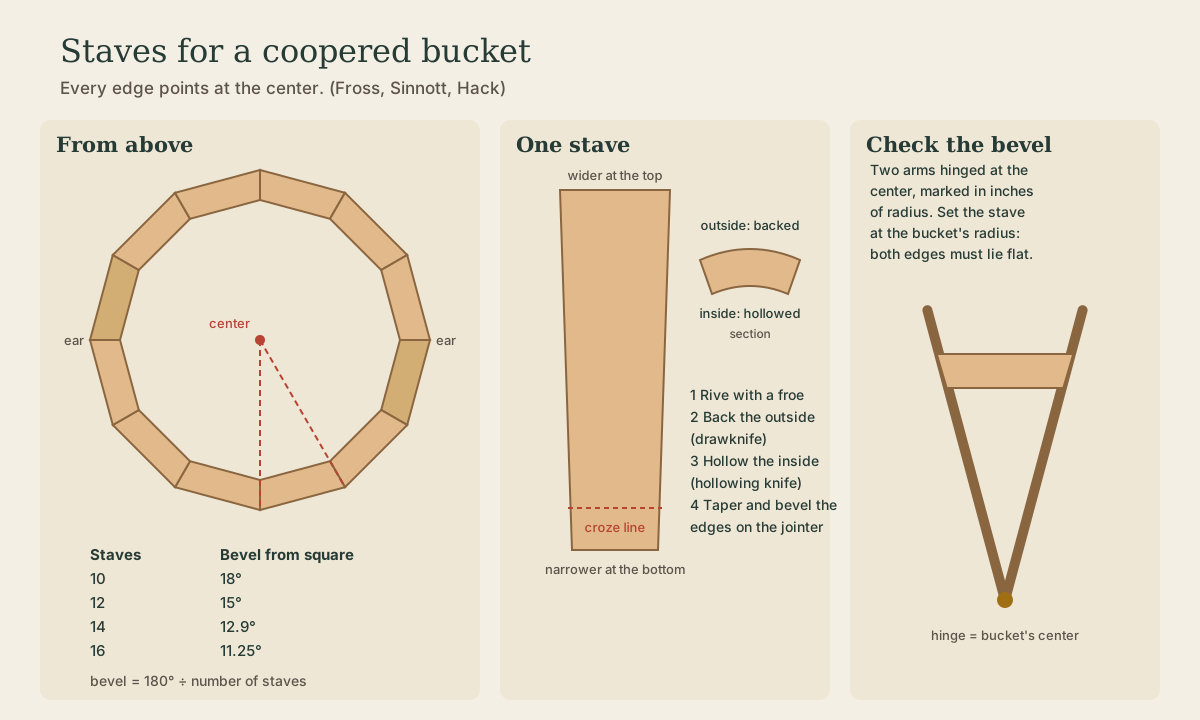
Days one and two: split cedar into staves with the froe, back the outside with the drawknife and hollow the inside with the hollowing knife, then taper the staves and bevel their edges on the cooper's jointer until every edge points at the bucket's center. The bevel angle for any number of staves, the hinged gauge that checks it, and the two longer ear staves.
- 4 min
- 7 steps
- 2 questions
- Lesson 137 of 204
In this lesson
- Rive the staves
- Back and hollow
- The bevel
- Taper and bevel on the jointer
- Check every edge
- The ear staves
- Try it
Picking up where you left off.
Rive the staves
Cut the cedar log to length: about 10 1/4 inches for the ten short staves and 13 1/2 for the two ear staves, plus spares. Split it in halves and quarters with the froe, then split off staves about an inch thick, keeping each split centered so it runs straight. Split along the radius of the log, so that at the stave’s end the growth rings run across its thickness. Tangential shrinkage, around the rings, is about twice the radial 1, so these staves shrink least in width and the joints stay closer.
Back and hollow
At Williamsburg the stave is clamped on the shaving horse and its outside curve cut first with a backing knife (drawknife); then the inside curve is cut to match with a hollowing knife, scooping thick pieces first and finishing with fine cuts 2. The Williamsburg coopers check the curve against an iron brace 3.
- Back. Shave the outside to a gentle curve that matches the bucket’s outside radius, about 5 1/2 inches at the top in the design from lesson 1.
- Hollow. Shave the inside to a matching curve, leaving the stave about 5/8 inch thick.
- Check. Cut a template from thin plywood with the outside curve and hold it against each stave.
Good light matters: hold the stave up and tilt it to see the curve as you work 3.
The bevel
Each stave’s two edges must lie along lines that run to the bucket’s center 4. For n staves, each covers 360/n degrees of the circle, so each edge is beveled half of that, 180/n degrees from square:
| Staves | Bevel from square |
|---|---|
| 10 | 18° |
| 12 | 15° |
| 14 | 12.9° |
| 16 | 11.25° |
The bevel is the same whatever the stave’s width.
Quick check
Each stave covers 360/12 = 30 degrees of the circle, and each edge takes half of that.
Taper and bevel on the jointer
The staves are wider at the open end than at the bottom: the taper is what makes the bucket a cone 5. In this design each stave narrows by about one-seventh from top to bottom (11 inches at the top, 9 1/2 at the bottom).
Push each edge down the cooper’s jointer in one smooth stroke, holding the stave at the bevel angle and with fingers well clear of the blade, the way Williamsburg teaches it 2. Coopers judged taper and bevel by eye 6; until your eye is trained, mark the top and bottom widths on each stave and plane to the marks. The jointer is long so the edge comes out straight over the whole stave 7.
Check every edge
Fross’s class checked bevels with two wooden arms hinged with leather and marked in inches. Open the gauge, lay the stave across the arms at the mark for the bucket’s radius, and both edges must sit flat; if not, plane until they do 4. Sinnott’s sector, marked in bucket radius, works the same way 5.
Staves will come out different widths from uneven splitting and extra planing, and the last one may need to be narrower; that’s fine 4. Only the angles matter.
Quick check
Staves of different widths still close into a circle if every edge is aimed at the center.
The ear staves
The two long staves carry the handle. Shape them like the others, then leave their top 3 inches flat or rounded over. Mark a hole about 1 1/2 inches below the top for a rope handle, but bore it after the bucket is assembled, so both holes line up.
Playback is optional. If the player is unavailable, open the video at its source.
Try it
Before beveling the real staves, bevel three scrap staves and stand them together on a drawn circle of the bucket’s radius. If the joints are tight inside and out, the gauge and jointer are set right.
Lesson complete
Nice work.
Sources for this lesson
- 1Wood Handbook, Chapter 4: Moisture Relations and Physical Properties of Wood. USDA Forest Service, Forest Products Laboratory. 2021. verifiedThermal conductivity of structural softwood at 12% MC 0.10-0.14 W/m-K (0.7-1.0 Btu in/h ft2 F), versus aluminum 216, steel 45, concrete 0.9, glass 1, plaster 0.7, mineral wool 0.036; R-value is resistivity times thickness. Heat capacity of dry wood cp0 = 0.1031 + 0.003867 T (kJ/kg K, T in K), about 1.2-1.4 near room to sauna temperature, higher with moisture, nearly independent of species.
- 2Kyle VanHemert. Barrels and Buckets: the Cooperage at Colonial Williamsburg. Material Matters, Winterthur Program in American Material Culture, University of Delaware. 2017. verifiedStudents shaped bucket staves with master coopers Ramona Vogel and Jonathan Hallman: edges trued and angled on the cooper's jointer, 'a long plane held diagonally to the ground by two legs'; the outer curve cut with a backing knife (drawknife) on a shaving horse; the inside with a hollowing knife. 18th-century coopers did all of this by eye without measuring; household pails were held to a lower standard than tight casks.
- 3Katharine Fitzgerald. No Holes in This Bucket. Material Matters, Winterthur Program in American Material Culture, University of Delaware. 2019. verifiedColonial Williamsburg cooperage, Atlantic white cedar. Staves pre-cut to length with the side angles already shaved; students shaved the outside first, then the inside to match, checking the curve against an iron brace; ten staves made a bucket.
- 4Michael Fross. Finally knocked a project off the bucket list.... Sawmill Creek Woodworking Community. 2016. verifiedA two-day cedar pail class with a croze and a Nantucket driver. Staves may differ in width; what matters is that both edge angles point at the bucket's center, checked with two wooden arms hinged with leather and marked in inches, set at the bucket's radius. Recommends James Gaster's How to Make a Coopered Wooden Bucket.
- 5Dean Sinnott. My Coopering Toolkit. Southern Alberta Woodworkers Society. 2021. verifiedFrom a Port Townsend coopering class: tapered stave templates, wider at the open end; side bevels on a 5-ft cooper's plane fitted with Stanley No. 8 works; a sector marked in bucket radius sets and checks the bevels; hoops from recycled whiskey-barrel bands, riveted flat then hammered on the inside to flare; hoop drivers; a scorp for the inside; a croze with two nickers cutting a groove about 1/8 in wide and deep; a sun (topping) plane levels the ends; bottom turned to fit the groove.
- 6Garrett Hack. Cooper's Planes. Fine Woodworking. 2021. verifiedPails and churns are 'white coopering.' Staves tapered and beveled by eye on a long jointer used upside down with the toe raised. Ends leveled with a topping plane (a curved jack); the howel cuts a shallow hollow and the croze a narrow groove for the head, both riding on large round fences; heads of two or three boards doweled together, edges cut to a fine bevel to fit the groove; inside smoothed with an inshave or stoup plane; hoops of wood or steel.
- 7Derek Cohen. Cooper's Jointer/Big Jointer. In the Woodshop. verifiedSalaman: the largest of planes, up to 6 ft and more, used stationary with the sole up while the cooper pushes the stave along it. Often set on legs at the rear at about 60 degrees with the toe on the floor. Cohen built a 42-in jointer as a keg-size example.