Bentwood Boxes
Oval and round boxes from thin bent bands: the Shaker oval box with its maple band, swallowtail fingers, and clinched copper tacks, and the Nordic bentwood box laced with root or bark. Making bands, boiling and bending, forms and shapers, tops and bottoms.
- 4 min
- 5 steps
- 3 questions
- Lesson 12 of 204
In this lesson
- Why bend
- The Shaker oval box
- Making one
- Nordic bentwood boxes
- What to take from this
Picking up where you left off.
Why bend
A box bent from a single thin band has one joint instead of four, weighs almost nothing, and nests. Across the North, the same idea shows up as Swedish and Norwegian bentwood boxes (svepask), Sámi and Russian bark boxes, and American Shaker oval boxes.

The Shaker oval box
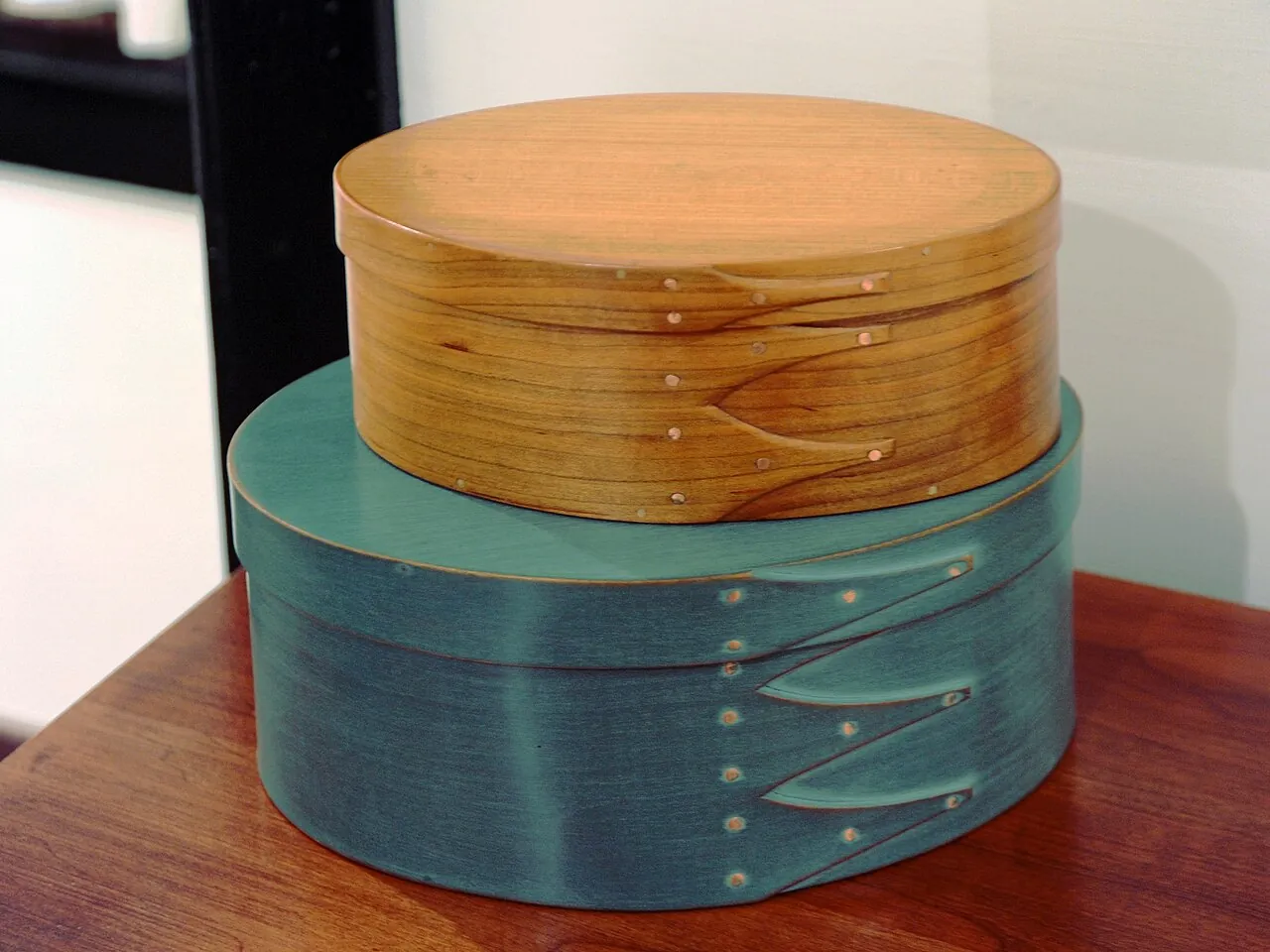
The Shakers made oval boxes in nesting sets for storage. John Wilson, who taught their making for decades, has students build a stack of five, from a small #0 to a #4, in about a day and a half, starting with the mid-sized #2 1.
| Part | Material |
|---|---|
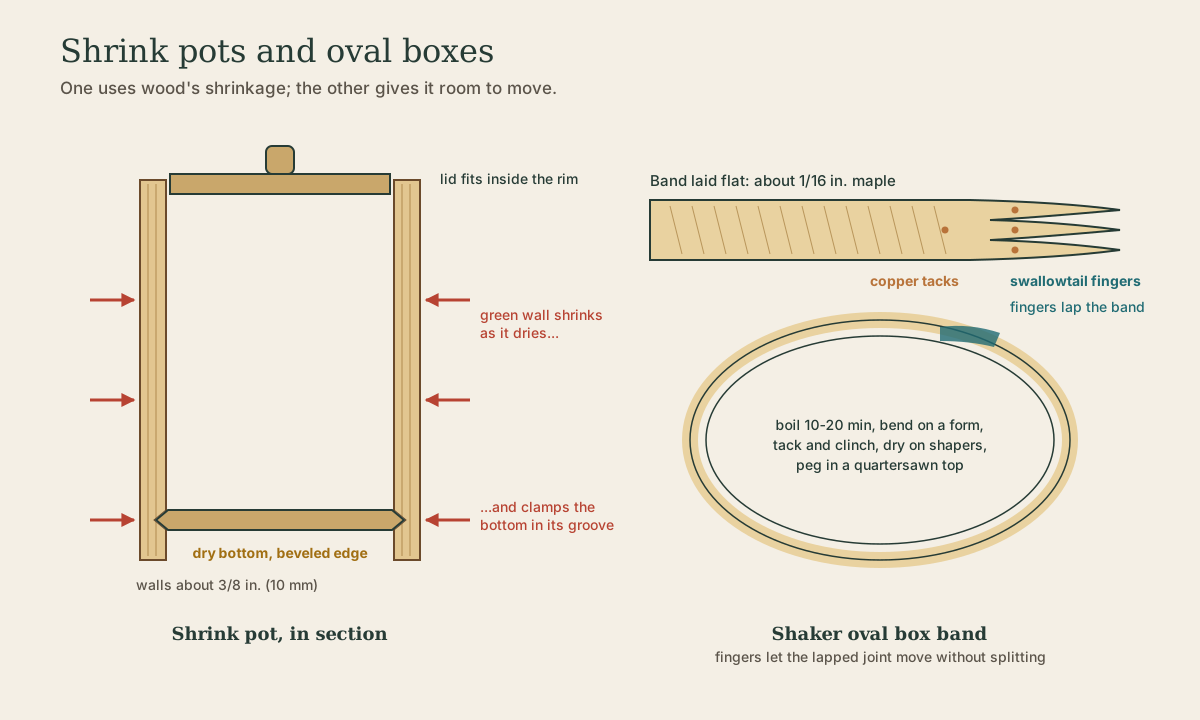
| Bands (box and lid) | straight-grained maple, about 1/16 in. thick (3/64 for small boxes); ash, cherry, or sycamore also work |
| Top and bottom | pine traditionally, about 1/4 in., quartersawn so it barely moves |
| Fasteners | copper tacks clinched inside the band; small wooden pegs through the band into the top and bottom |
| Joint | swallowtail fingers at the band’s outer end, lapped over |
The fingers are the signature. A straight lap joint would split as the band swells and shrinks; tapered fingers reinforce the lap and spread the stress 2.
Quick check
Straight-grained maple bends well when boiled; pine tops are stable and light.
Quick check
A straight lap would crack as the wood moved; tapered fingers spread the stress.
Making one
- Mill or buy bands from clear, straight-grained stock with no grain run-out 2.
- Cut the fingers at one end with a knife, beveling their edges, and drill or punch tack holes 2.
- Boil or soak in very hot water for 10-20 minutes until pliable 2.
- Bend around an oval form quickly, lining up marks, with the fingers on the outside.
- Tack: drive copper tacks through the lap against an iron anvil (a pipe) inside the band; they clinch over. Steel tacks are too hard to clinch properly 2.
- Shapers: press oval plugs into each end of the bent band to hold the shape while it dries 2.
- Make the lid band the same way around the dried box band.
- Fit the top and bottom: trace inside the dry band, cut, and bevel the edge slightly for a snug fit, then pin with small wooden pegs every couple of inches 2.
- Finish with milk paint, as the Shakers often did, or a clear finish 2 1.
Playback is optional. If the player is unavailable, open the video at its source.
Quick check
The tacks are driven against an iron anvil inside the band, which bends their points over.
Nordic bentwood boxes
Swedish and Norwegian bentwood boxes use the same principle with different joinery: a thin band of pine, spruce, or birch, bent green or after soaking, overlapped and laced with split spruce root or strips of birch bark through rows of holes, with a carved or fitted bottom and often a lid held by a wooden peg. Many are painted, and some carry carved or kolrosed decoration 3.
Bands for these can be riven and shaved green, then bent while still wet, which suits a shop with an axe and shaving horse rather than a bandsaw.
What to take from this
Bentwood boxes wrap a thin band into one joint. Shaker oval boxes use 1/16-in. maple bands with swallowtail fingers, boiled 10-20 minutes, bent on a form, fastened with clinched copper tacks, held by shapers while drying, and fitted with pegged quartersawn pine tops and bottoms. Nordic boxes lace the lap with spruce root or birch bark and are often painted.
Lesson complete
Nice work.
Sources for this lesson
- 1John Wilson. Shaker Oval Boxes. Fine Woodworking. 1993. verifiedFine Woodworking 102. Maple bands and pine tops historically; a nesting set of five boxes,
- 2David Tilson. Making Shaker Oval Boxes. Tilson woodworking library. 2026. verifiedBands about 1/16 in. of straight-grained maple, boiled 10-20 minutes, bent on a form, held by clinched copper tacks; fingers reinforce the joint; shapers hold the oval while drying; pegged quartersawn tops.
- 3Jögge Sundqvist. Slöjd in Wood. Lost Art Press. 2018. verifiedPublisher excerpt (PDF) of the English translation of the Swedish classic; butter knife, spoons, bowls, sheath, hooks, and painted decoration in the Västerbotten tradition.