Flat-Plane Figure Carving
The Scandinavian flat-plane style: rural figures carved with one sloyd knife, its near disappearance and revival by Harley Refsal of Decorah, and how to carve one: choosing wood, sawing a profile blank with the grain, roughing big planes, leaving the knife marks, and painting thin.
- 4 min
- 6 steps
- 3 questions
- Lesson 18 of 204
In this lesson
- The style
- A tradition nearly lost
- Tools and wood
- Carving a figure
- Try it
- What to take from this
Picking up where you left off.
The style
Rural Scandinavian carvers made small figures of what they knew, horses, fishermen, farmers, using the one tool every household had: a thick-bladed sloyd knife 1. The figures are chunky but expressive 1, built from a few large, flat facets with the knife marks left showing 2. Nothing is sanded; each cut is a decision you can see.
Quick check
The facets are the style; sanding them off destroys it.
A tradition nearly lost
Harley Refsal, raised in Minnesota, first saw these rustic figures on a 1965 Luther College choir tour of Norway 2. When he returned for graduate study in the mid-1980s, the old carvers had died and the tradition had largely disappeared 1. His dissertation became Art and Technique of Scandinavian-Style Woodcarving (1991) 1, and he taught Norwegian and folk art at Luther College in Decorah, taught carving at Vesterheim and across the U.S., Canada, and Scandinavia, and wrote seven more carving books 2. He’s credited with bringing the style to Americans and helping revive it in Norway; in 1996 Norway awarded him the St. Olav’s Medal 2. He died in Decorah on September 8, 2024 2.
Playback is optional. If the player is unavailable, open the video at its source.
Quick check
He met the style on a 1965 choir tour and later taught it at Vesterheim and across Scandinavia.
Tools and wood
- One knife: a sloyd knife or a carving knife with a short, stiff blade (1-1/2 to 2 in.) and a comfortable handle (see The Sloyd Knife and Knife Grips in Green Woodworking). Keep it razor sharp; a dull knife crushes basswood instead of slicing a clean facet.
- Wood: basswood (linden) is the standard in the Midwest: fine, even, soft, and it holds a crisp edge. White pine and birch work too.
- Saw: a coping saw or bandsaw for the profile.
- Paint: thinned acrylics or oil paints, or milk paint (see Traditional Paints), and boiled linseed oil or wax.
- A thumb guard or carving glove on the hand holding the work.
Carving a figure
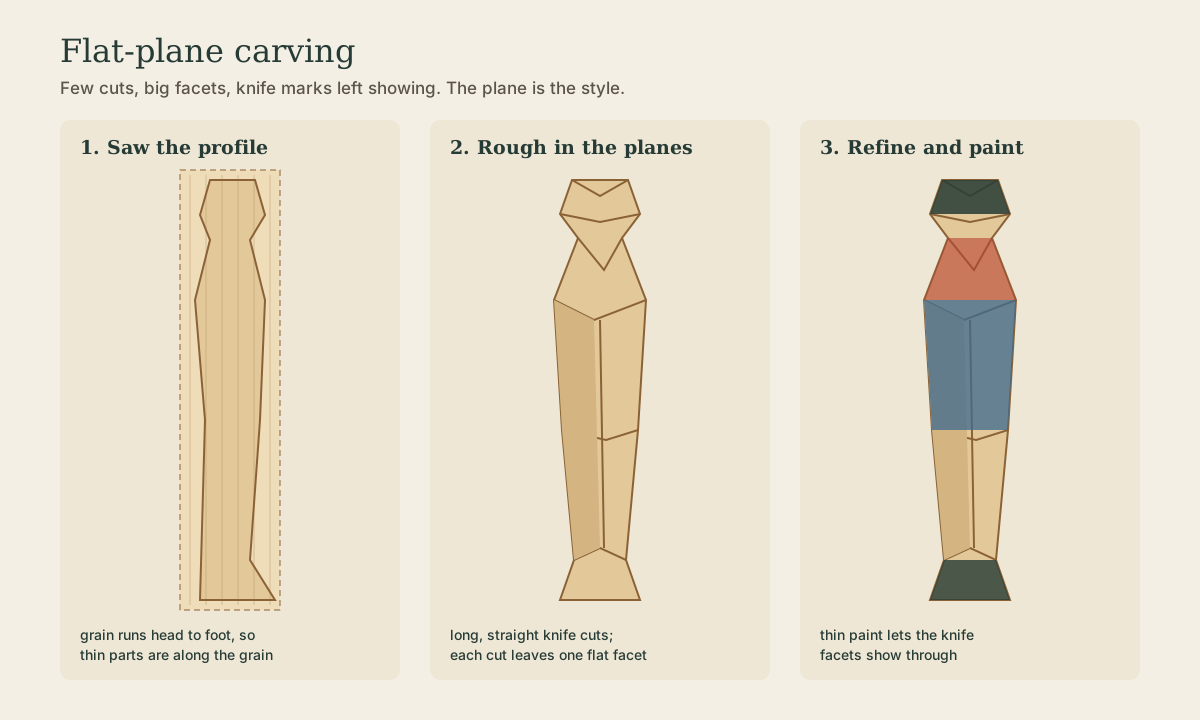
- Draw a side profile on a blank, with the grain running from head to feet. Thin parts, legs, necks, a fishing pole, must run along the grain or they’ll snap off.
- Saw the profile. For a stockier figure, saw the front view too.
- Rough in the planes: with long, straight cuts, take off the corners and establish the big facets: the hat brim, the slope of the shoulders, the front and side of the coat. One cut, one facet.
- Stop cuts and slicing cuts: make a stop cut straight in along a line (where a hat meets the face, a coat meets the legs), then slice in toward it to pop out a clean chip.
- Refine sparingly: a nose is two cuts; an eye can be a single nick. Resist rounding everything off.
- Paint thin: washes that let the grain and facets show through. Paint in blocks of color by facet: hat, face, coat, trousers, boots. Seal with oil or wax.
Carve with the grain, downhill, as you would any wood: if a cut tears, turn the work and come from the other direction.
Quick check
Short grain across a narrow part breaks at the first knock.
Try it
Saw a 1 x 1-1/2 x 5 in. basswood blank to the profile of a standing man with a hat. Carve him with no more than about 60 cuts, counting as you go, then paint him with thinned colors and leave every facet showing.
What to take from this
Flat-plane figures are carved with one sharp knife in a few big facets, tool marks showing, the way rural Scandinavians carved what they knew. Harley Refsal of Decorah revived the style after its carvers died out. Saw the profile with the grain running through the thin parts, rough in the planes with long cuts, use stop cuts and slicing cuts for details, and paint thin.
Lesson complete
Nice work.
Sources for this lesson
- 1Harley Refsal is the 2012 Woodcarver of the Year. Woodcarving Illustrated. 2016. verifiedRural carvers made chunky, expressive figures of what they knew, horses, fishermen, farmers, with one thick-bladed sloyd knife; by the mid-1980s the tradition's carvers had died out; Refsal's 1991 book grew from his dissertation.
- 2Remembering Harley Refsal. Vesterheim National Norwegian-American Museum & Folk Art School. 2024. verifiedRefsal (died September 8, 2024, Decorah) taught Norwegian and Scandinavian folk art at Luther College; met rustic flat-plane figures on a 1965 choir tour; credited with bringing flat-plane carving to Americans and reviving it in Norway; author of Art and Technique of Scandinavian-Style Woodcarving; St. Olav's Medal 1996; Vesterheim Gold Medalist and instructor.