Drawing Out and Tapering
Making steel longer and thinner: why you hammer over the far edge and turn 90 degrees, square to octagon to round, forging a clean point, avoiding cold shuts and folds, and using the horn and cross-peen to move metal faster.
- 4 min
- 6 steps
- 3 questions
- Lesson 86 of 204
In this lesson
- What drawing out does
- Technique
- Square, octagon, round
- Tapering to a point
- Avoiding flaws
- What to take from this
Picking up where you left off.
What drawing out does
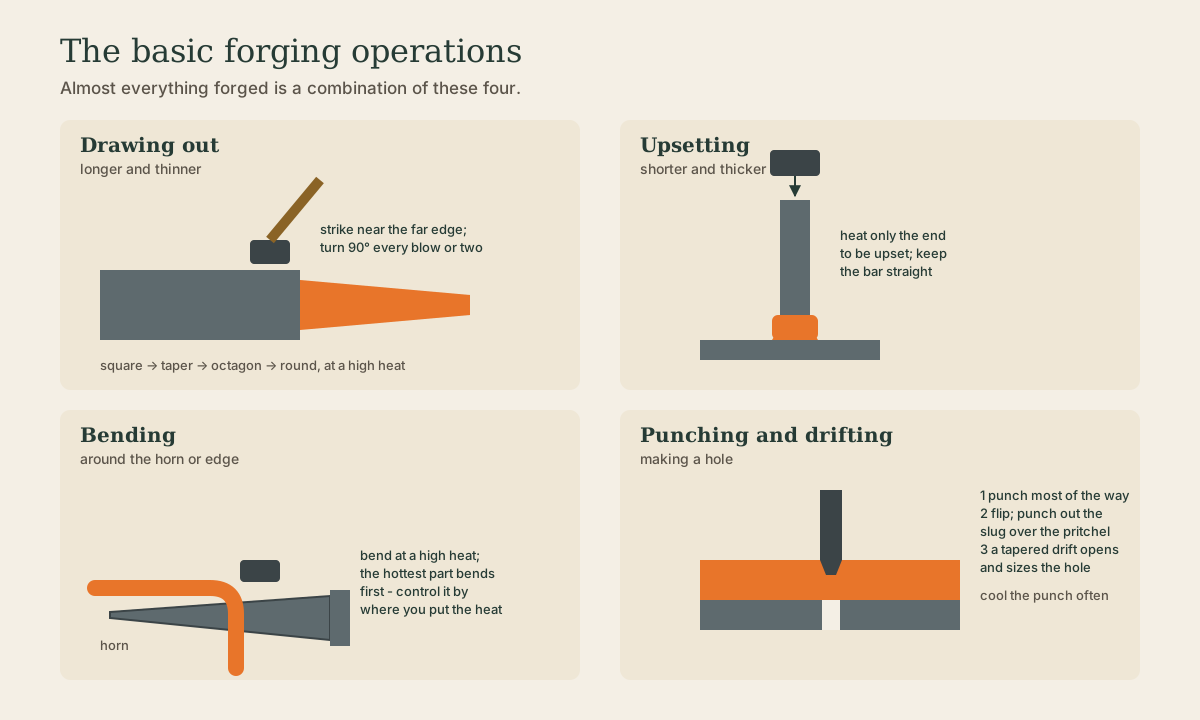
Drawing out makes stock longer and thinner. It’s the most common operation in smithing - every point, taper, and spread starts here.
Bacon’s guidance: heat the metal to as high a heat as it will stand without burning, because hot metal moves fastest 1.
Technique
- Heat the length you’re working to a bright orange or yellow.
- Lay the bar over the anvil’s far edge or the horn and strike just beyond the support, with the hammer slightly angled. The edge acts like a blunt wedge, pushing metal lengthwise.
- Turn the bar 90 degrees every blow or two, alternating faces, so the section stays square 1.
- Move along the bar in overlapping blows, then switch to the flat of the face to smooth out the ripples.
- Reheat before the color drops to a dull red.
Faster drawing: the cross-peen spreads metal in one direction - strike with the peen across the bar to lengthen it, then smooth with the face. Fullers (rounded bottom and top tools) do the same in heavier work.
Square, octagon, round
Forge round stock square first, draw it down, then knock off the corners to an octagon, then round it with light, rolling blows 1. Forging round directly can split the center and wander off size; square keeps the metal sound and the taper straight.
If a square bar goes diamond-shaped (rhombus), correct it by hitting on the long diagonal - the obtuse corners - to push it back square.
Quick check
Hitting one pair of faces too long squashes the square into a rhombus.
Quick check
Square, octagon, round keeps the metal sound and the taper true.
Tapering to a point
- Start the taper at the very end, in a high heat.
- Hold the bar at a slight angle to the anvil face so the hammer forms the taper’s slope.
- Turn 90 degrees between blows, square up, then octagon and round if needed.
- Finish lightly at a lower heat (orange to red) for crisp edges; the very tip heats and cools fastest, so watch it.
Avoiding flaws
- Cold shuts: metal folding over itself without welding, leaving a seam that becomes a crack. Caused by striking an edge that has rolled over, or by forming a sharp step; dress rolled edges back early, and blend shoulders smoothly.
- Piping: a split down the center from forging round stock round or working too cold.
- Hammer marks: a hammer with sharp edges or tilted blows; dress your hammer and hit flat.
Playback is optional. If the player is unavailable, open the video at its source.
Quick check
Caused by hitting an edge that has rolled over or by sharp steps; dress them out early.
What to take from this
Draw out at a high heat over the anvil’s far edge or horn, turning 90 degrees every blow or two to stay square, and move metal faster with the cross-peen. Forge round stock square, then octagon, then round. Taper by angling the bar, finish lighter at a lower heat, and avoid cold shuts by dressing rolled edges and blending shoulders.
Lesson complete
Nice work.
Sources for this lesson
- 1John Lord Bacon. Forge-Practice: Elementary. John Wiley & Sons. 1908. verifiedPublic-domain trade-school text from the Lewis Institute; fire building with coking coal, welding heat and fluxes (sand, borax, sal ammoniac), upsetting, drawing out, bending, punching, and tool-steel hardening and tempering colors (430 F pale yellow to 570 F blue, temper gone near 650 F).
Further reading
- Robert H. Harcourt. Elementary Forge Practice. Stanford University Press. 1917. verifiedPublic-domain trade-school text with step-by-step exercises in drawing out, bending, twisting, and welding.