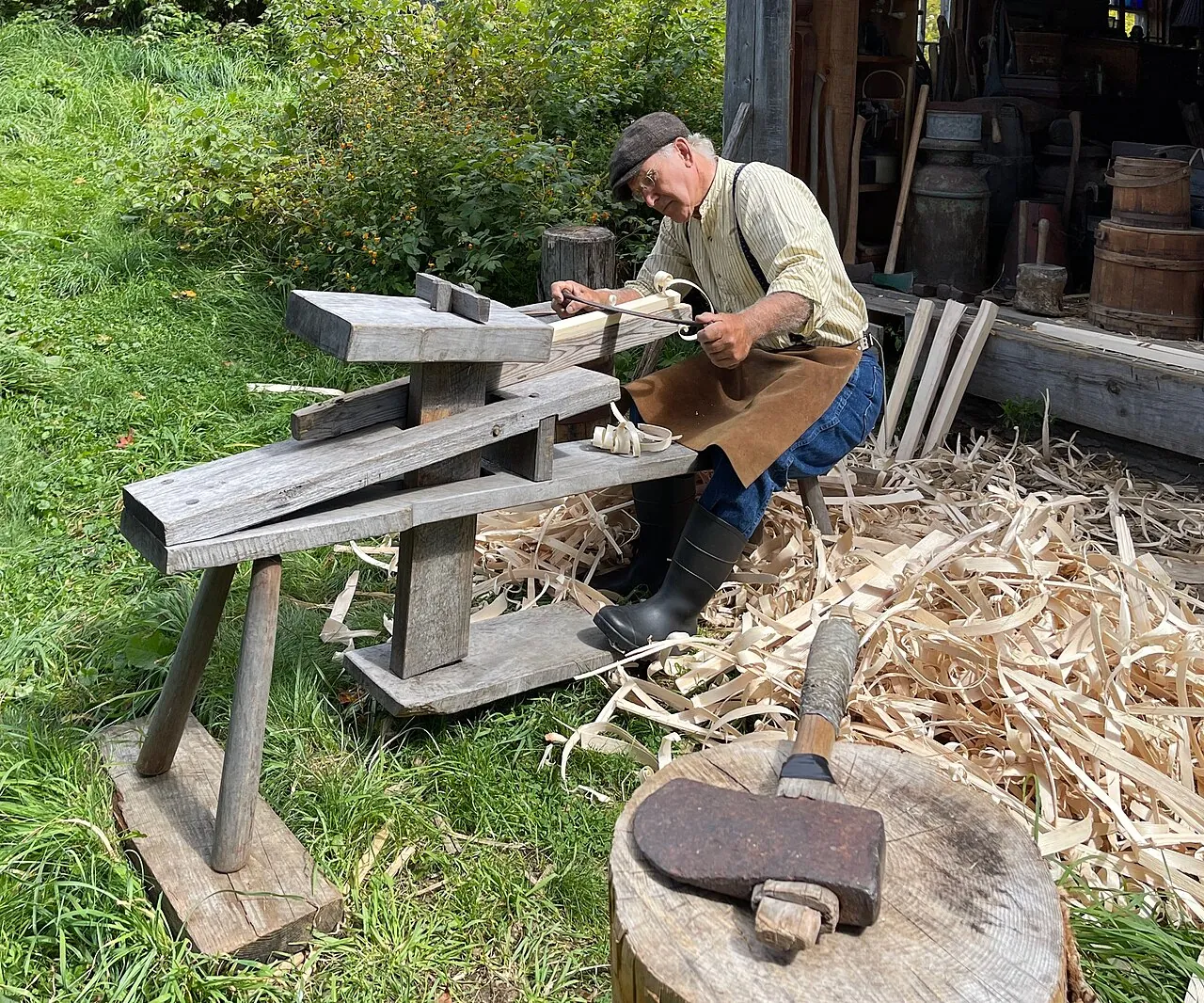
The Shaving Horse and Drawknife
The foot-powered vise that holds green wood for the drawknife: how the clamp self-tightens, bodger versus dumbhead styles, setting one up, drawknife bevel-up versus bevel-down, and taking a riven billet from square to octagon to round.
- 4 min
- 5 steps
- 3 questions
- Lesson 5 of 204
In this lesson
- How it works
- Setting one up
- The drawknife
- Square, octagon, round
- What to take from this
Picking up where you left off.
How it works
A shaving horse is a bench and a foot-operated vise in one. You sit astride it, push a treadle with your feet, and a jaw clamps the work onto a sloping bridge in front of you 1.

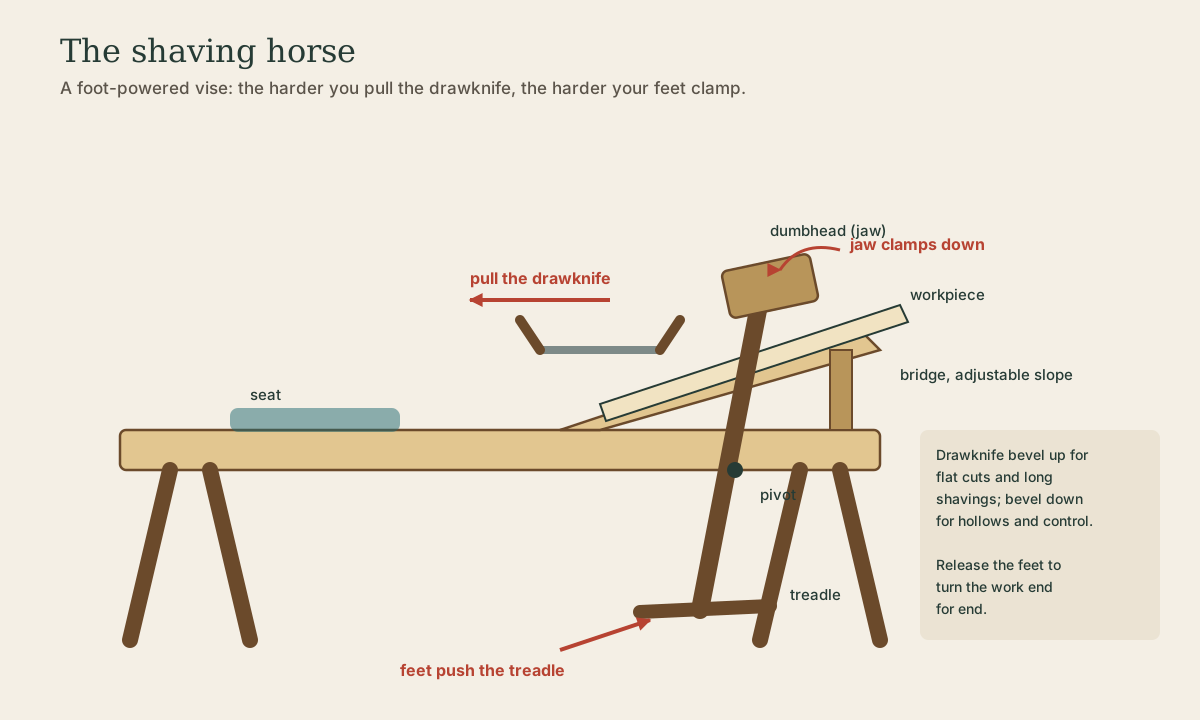
The genius is that it self-tightens. Pulling a drawknife toward you makes you brace with your feet; bracing pushes the treadle; the treadle closes the jaw. The harder you pull, the harder it grips. Let off your feet and the jaw opens, so you can turn the piece, slide it, or flip it end for end in a second 1.
Two classic styles 1:
| English (bodger) | German (dumbhead) | |
|---|---|---|
| Clamp | a frame of two side arms with a crossbar jaw | a single arm through a slot in the bridge, with a heavy block (the dumbhead) on top |
| Strengths | light, holds wide work | strong grip, holds work close to the jaw for spoon blanks and small parts |
| History | made from logs in the woodland by English chair bodgers | standard in central Europe; a drawknife on a horse appears in the 1556 De Re Metallica |
Quick check
The body’s natural reaction becomes the clamping force.
Setting one up
Most horses are shop-made: a split log or plank bench, a bridge block, an arm, and a treadle 2. What matters:
- Jaw height: when clamped, the work should sit around the height of your lower chest, so you pull with straight arms and lean back with your body rather than curling your arms.
- Adjustable bridge slope or arm length, to fit both thick and thin work.
- Treadle reach: your legs should be bent a little when the jaw closes, so you can push harder.
- A comfortable seat - you’ll sit for hours. Some makers use an old Windsor seat.
The drawknife
A drawknife is a blade 20-30 cm long with a handle at each end, pulled toward you.
- Bevel up: the flat back rides the wood, so the knife goes straight. Use it for flat, straight surfaces and long shavings.
- Bevel down: the bevel acts like the sole of a plane, so you can rock the edge into or out of the cut. Use it for hollows, curves, and scooping cuts.
- Skew the blade - slicing at an angle cuts more easily and cleanly than pulling straight.
- Work downhill with the grain, and start each cut near the jaw where the work is stiffest.
- Use your body: arms nearly straight, lean back to pull.
- Sharpen like a big chisel: flatten the back, hone the bevel, strop. Sheath it - a drawknife on a bench is two exposed edges.
A spokeshave follows the drawknife for finer, more controlled smoothing.
Playback is optional. If the player is unavailable, open the video at its source.
Quick check
Bevel up, the flat back rides the surface for straight, flat cuts; bevel down gives more control in concave shapes.
Square, octagon, round
To make a round part (a chair leg, a rung, a tool handle) from a riven billet:
- Square it: shave the billet to a square with sides as wide as the finished diameter, following the grain rather than a pencil line, so the fibers stay continuous.
- Octagon: take off the four corners evenly until all eight faces match.
- Sixteen sides: take off the eight new corners.
- Round: a few light passes with a spokeshave, checking with a gauge (a hole the right size in a board).
Each stage takes corners off evenly, which keeps the part straight. For chair parts, leave them oversize to dry, then shave to final size (see the Chairs course and the Wood Drying lesson on green chair parts).
Quick check
Taking the corners off evenly at each stage keeps the part straight and round.
What to take from this
A shaving horse is a self-tightening foot vise: pulling the knife makes you push the treadle, which closes the jaw. English horses use a two-arm frame; German dumbheads use a single arm and heavy jaw. Set the jaw at chest height and pull with straight arms and the body. Use the drawknife bevel up for flat, straight work and bevel down for hollows, skewing and working downhill, and shape round parts square → octagon → sixteen → round.
Lesson complete
Nice work.
Sources for this lesson
- 1Shaving horse. Wikipedia. 2026. verifiedFoot-operated clamp and bench; English bodger style versus German dumbhead style.
- 2Drew Langsner. Country Woodcraft: Then & Now. Lost Art Press. 2020. verifiedExpanded edition of the 1978 book that seeded American green woodworking; shavehorses, riving, spoons, bowls, and country tools.