Natural Dyes, the Base, and the Sides
Days two through five: color some splints in Cherokee bark and root dyes, then weave the basket: a filled rectangular base about 10 by 6 inches, stakes upset sharply into walls, and side rows woven and packed one splint at a time. A reconstructed cut list for a basket about 5 by 10 by 6 inches.
- 4 min
- 5 steps
- 2 questions
- Lesson 130 of 204
In this lesson
- Natural dyes
- Lay out the base
- Upset the stakes
- Weave the sides
- Try it
Picking up where you left off.
What you need
| Have it | Material | Spec | Qty | Where to get it |
|---|---|---|---|---|
| Long stakes | 3/4 in wide, the thickest splints | About 7, 24 in long (10 in base + 5 + 5 sides + tucks) | Your splints | |
| Short stakes | 3/4 in wide | About 11, 20 in long | Your splints | |
| Filler splints | Narrow, thin | 6-8, about 12 in | Your splints | |
| Side weavers | 3/8-1/2 in wide, about 1/16 in thick | 10-12, each about 36 in (perimeter plus 3-4 in overlap) | Your splints |
Checkmarks are saved on this device.
Natural dyes
Cherokee basketmakers color white oak with bark and roots. Eva Taylor’s notes from Cherokee give the times 1:
- Bloodroot, gathered in spring: orange, about 1 hour.
- Yellowroot: yellow, about 1 hour.
- Walnut bark: brown, a 4- to 5-hour boil.
- Butternut bark: black, a 4- to 5-hour boil.
Older accounts also list walnut root and butternut root for browns and bloodroot for red; yellowroot was once gathered so heavily it nearly vanished locally 2. Grow bloodroot or buy it rather than digging wild plants. Simmer the coiled splints in the dye bath, let them cool in it, rinse, dry, and re-soak before weaving. North House’s class offers “some natural dyes on the splints to add color” 3; a few dyed weavers in the sides are enough to make a pattern.
Quick check
Bloodroot and yellowroot take about an hour.
Lay out the base
The stakes are the basket’s foundation 4. For a basket about 10 inches long, 6 wide, and 5 high, this reconstruction uses:
- about 7 long stakes, 3/4 inch wide and 24 inches long, running the length;
- about 11 short stakes, 20 inches long, running across.
Lay the long stakes side by side on a table with gaps a little narrower than the stakes. Weave the short stakes across them one at a time, over-under, alternating which stakes they go over, until the woven center measures about 10 by 6 inches. Mark the center lines with a pencil and keep the base square by measuring diagonals.
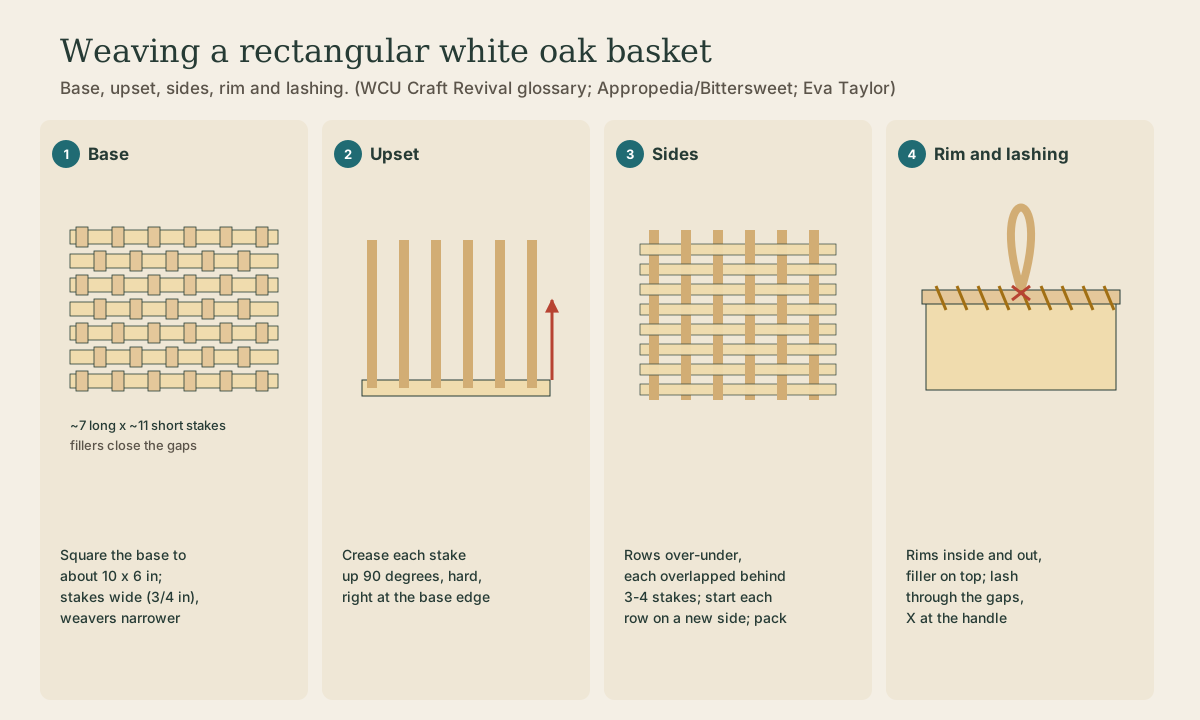
A filled bottom has extra narrow splints woven in to close the gaps, so small things don’t fall through 5; makers call these fillers or bye-stakes 4. Weave fillers between the long stakes across the base. Cherokee makers start differently, laying 3 splints and crossing 3 more and expanding outward with wider, sturdier splints, then adding a border splint around the bottom 1.
Upset the stakes
Wet the stakes well. At the edge of the base, bend each stake sharply upward, a full 90 degrees, creasing it right at the corner of the base. A crisp crease gives square corners and straight walls.
Quick check
A crisp crease makes square corners and straight walls.
Weave the sides
The sides are woven one row at a time with thinner weavers, 3/8 to 1/2 inch wide 1:
- Start a weaver behind a stake on one side and weave over-under all the way around.
- Overlap the end behind 3 or 4 stakes past the start, so the overlap is hidden.
- Start the next row on a different side, so the overlaps don’t stack up.
- Each row goes over the stakes the previous row went under.
- Pack each row down tight against the last with your fingers or a packing tool.
Keep the walls straight by drawing the stakes gently up and inward as you weave; let them flare and the basket grows wider at the top. Ten to twelve rows bring a basket like this to about 5 inches high. Cherokee makers spend 3 to 5 hours weaving the sides 1.
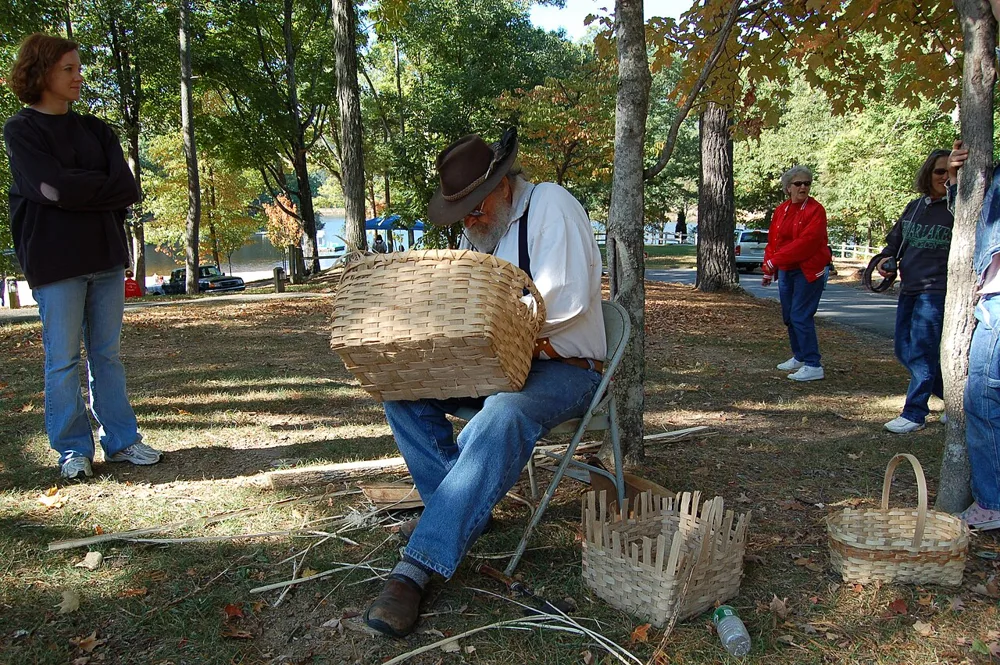
_(4071972611).jpg)
Try it
Dye three weavers different colors and weave them as one band three rows from the top. It’s the simplest way to see how a basket’s pattern comes from the weaving order.
Lesson complete
Nice work.
Sources for this lesson
- 1Eva Taylor. Hunting the White Oak. Cherokee Central Schools Cultural Department. verifiedTree centers become rims and handles. Preparing splints takes one to two days. Lay 3 splints, cross 3 more, expand with wider sturdier splints, add a border splint around the bottom, bend the stakes up and weave the sides one splint at a time (3-5 hours), fold and tuck the top ends, attach handle and rim; a handle woven in at the bottom is permanent, one added later replaceable. Dyes: bloodroot (orange, 1 hour), yellowroot (yellow, 1 hour), walnut bark (brown) and butternut bark (black), 4-5 hour boils.
- 2Bonita Freeman-Witthoft. Cherokee Indian Craftswomen and the Economy of Basketry. Expedition (Penn Museum) 19(3). 1977. verifiedSapwood is split tangentially into sticks about 2 inches wide; ten to twelve splints come from a good oak stick about an inch square; splints dried in coils and re-wet before use. Dyes: walnut bark or root and butternut root for browns, bloodroot for red; yellowroot nearly exterminated locally.
- 3White Oak Basketry. North House Folk School. verifiedSix-day course (Oct 6-12, 2026, with a day off for Basket Week's Gathering Day), instructor Mary W. Thompson, $670 tuition plus $220 materials. Starting from the log, students split, cut, and scrape their own white oak splints, may use natural dyes, and weave a horizontal plain-weave basket about 5 x 10 x 6 inches with an optional handle. Tools: sloyd or carving knife, scissors, leather to cover the leg when scraping; optional packing tool and clips.
- 4Craft Revival: Baskets Glossary. Western Carolina University Hunter Library. verifiedTerms: stakes (the foundation); bye-stakes or fillers; row-by-row weaving with an even number of working ends; spiraling; chasing; rim (thick splits around the top); lashing (binding rims to the body); tails (handle ends inserted into the side weaving).
- 5Peter Follansbee. Basket tour pt 2. Joiner's Notes (blog). 2020. verifiedYou split white oak growth rings apart instead of pounding as with ash. Related posts: filled bottoms use extra splints so small items don't fall through; a double-woven bottom's added splints can be slipped up into the side weaving.
Further reading
- White Oak Baskets (from Bittersweet). Appropedia. verifiedFrom the Lebanon, Missouri, school folklore magazine Bittersweet (maker Lyn Marble). Logs 4-5 ft long and 4-5 inches in diameter, cut in early spring or late fall. A small round-handled basket: bottom strips 24 in long and 1/2-3/4 in wide; side weavers 4 ft long, 3/4-1 in wide; rims two pieces 1 in x 4 ft; lashing 1/8-1/4 in x 4 ft; handle 2 ft, 1/8-1/4 in thick, 3/8 in wide, from bark-side wood. Soak dried splints overnight. Lashing passes under the rims and through the gap beside each stake, crossing in an X at the handle, the end pushed back through the first two wraps.