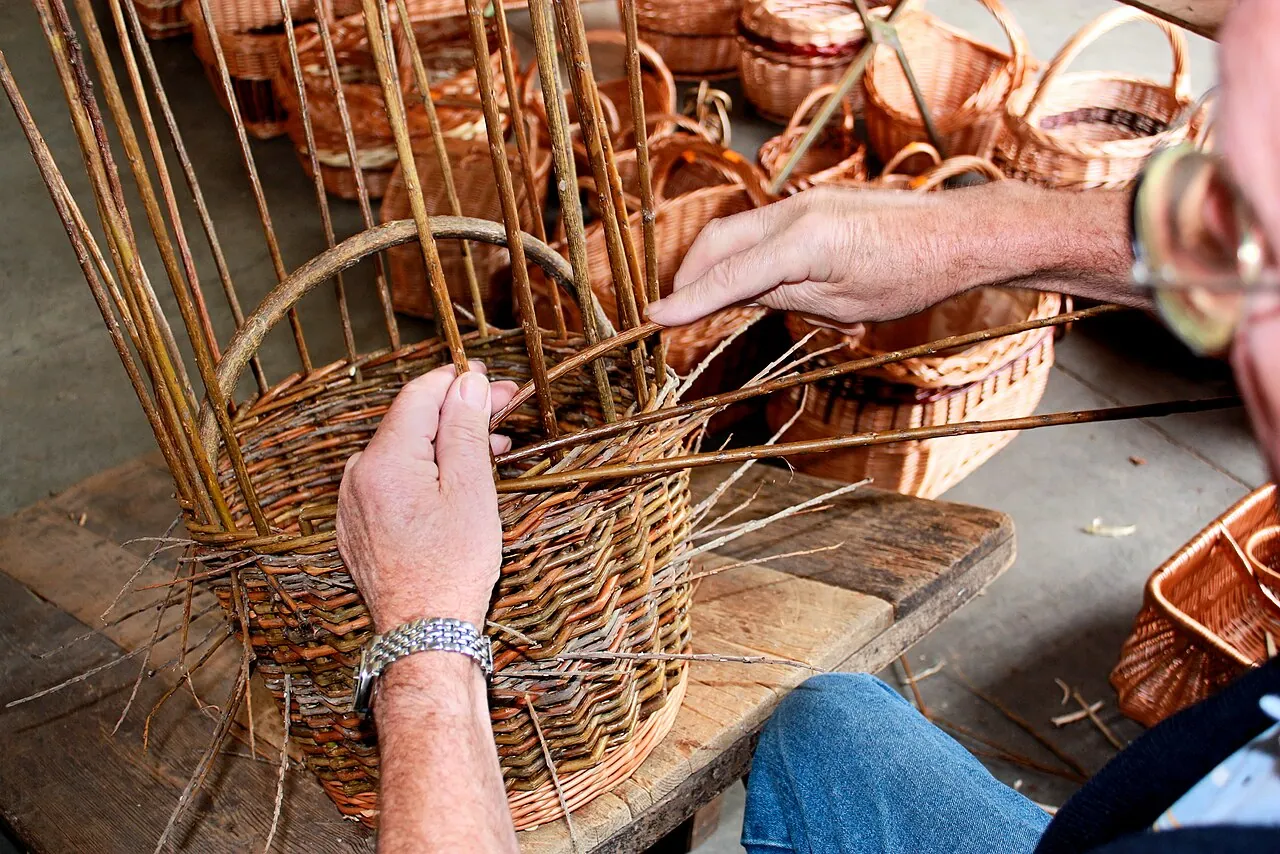
Willow Baskets
Stake-and-strand basketry in willow: growing and harvesting basket willows, soaking a day per foot and mellowing, then the parts of a round basket - slath and base, staking up, upsett and wale, randing, and a border - with notes on growing a willow bed in Wisconsin.
- 4 min
- 4 steps
- 3 questions
- Lesson 74 of 204
In this lesson
- Growing and harvesting
- Preparing rods
- Building a round basket
- What to take from this
Picking up where you left off.
Growing and harvesting
Basket willows grow long, pliant, one-year shoots with little pith 1. Common basketry species include Salix purpurea, S. triandra, and S. viminalis, in many cultivars with bark colors from green and gold to purple and near-black. Willow is coppiced: cut to the stool every winter, it sends up a fresh crop of straight rods the next season.
- Harvest in dormancy, about November through March, after the leaves fall and before spring growth, cutting as close to the ground as possible on days above freezing so the rods don’t splinter 1.
- Sort by variety and length into bundles 1.
- Dry standing upright or lying flat with good air circulation - barn rafters work - for several weeks 1.
Willow grows well in Wisconsin’s moist soils: plant 9-12 inch cuttings in spring about a foot apart, keep weeds down the first year, and cut a usable crop from the second or third winter.
Wild willows along ditches and rivers work for rustic baskets, though the rods are shorter, branchier, and more variable.
Quick check
Cut close to the ground, sort by variety, and dry upright with good air flow.
Preparing rods
Dry willow must be soaked until pliable - a rule of thumb is one day per foot of length, so 6-foot rods soak about six days 1. Warm water speeds it. After soaking, wrap the rods in a damp cloth or plastic overnight to mellow, letting the moisture spread evenly. Freshly cut green willow can be used without soaking, but it shrinks as it dries and the basket loosens.
Quick check
Then wrap them to mellow so the moisture evens out before weaving.
Building a round basket
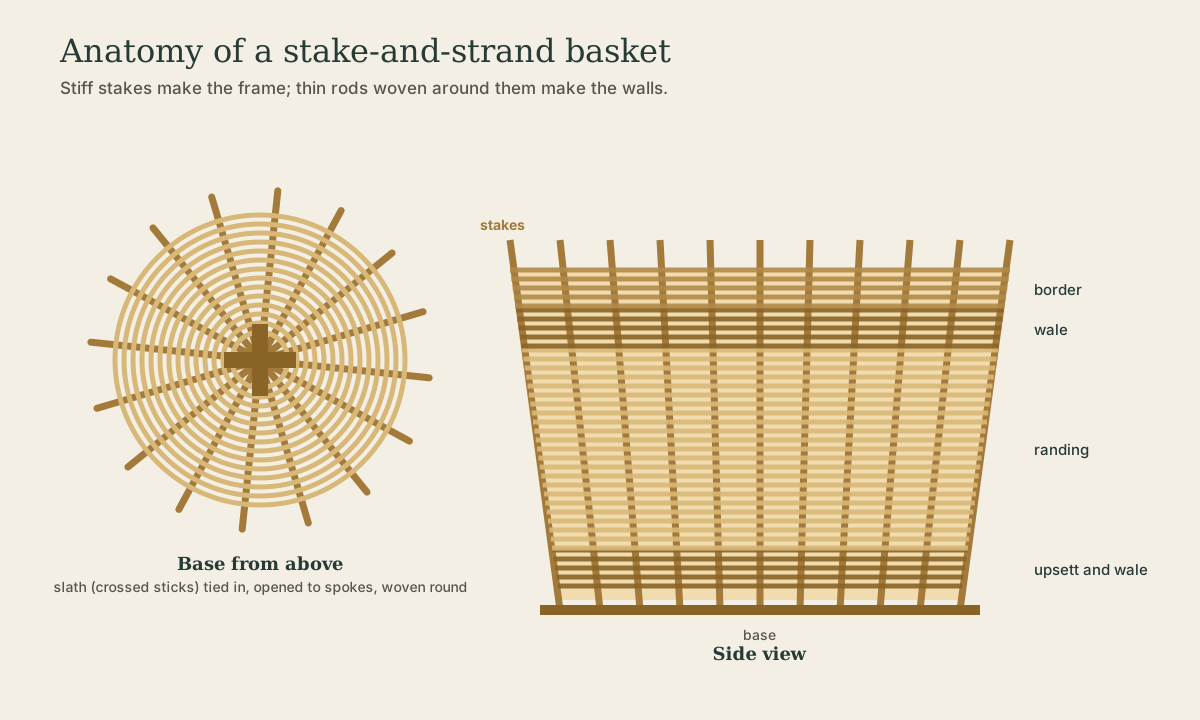

- Slath: cut thick rods for the base sticks; split half of them through the middle and thread the others through the slits to make a cross.
- Tie in: weave around the cross with two thin rods twisting past each other (pairing) for a few rounds, then open the sticks out into evenly spaced spokes and keep pairing out to the base size.
- Stake up: push a long stake into the base beside each spoke, pinch each stake at the base edge with your thumbnail, and bend it up (the upsett); tie the tops together in a hoop to hold them.
- Wale: weave several rounds of three-rod wale - three rods worked in sequence, each going in front of two stakes and behind one - which locks the stakes at the right angle and spacing and sets the basket’s shape.
- Randing: weave the walls with single rods over one stake and under the next (randing), or with French randing for an even, spiraling texture. Push each round down firmly.
- Wale again near the top to stiffen the rim.
- Border: lay the stake ends down one by one, each behind the next stakes and back out (a rod border), so they lock together into a rim.
- Handle: a thick bow rod pushed down beside stakes, wrapped with thinner rods.
Keep the work damp while weaving, and let the finished basket dry slowly. Trim the butts and tips flush with sharp shears (“picking off”).
Playback is optional. If the player is unavailable, open the video at its source.
Quick check
Wale is a strong twined weave of three or more rods; randing fills the walls above it.
What to take from this
Coppiced basket willows give straight one-year rods; harvest them November through March, sort, and dry upright. Soak a day per foot and mellow overnight. A round basket goes slath, pairing, stakes and upsett, three-rod wale, randing, more wale, and a laid-down border. Willow beds grow well from cuttings in Wisconsin and crop from the second or third winter.
Lesson complete
Nice work.
Sources for this lesson
- 1Marilee Williams. Willow, A New Old Crop. Cornell Small Farms Program. 2013. verifiedBasketry willows with long, pliant shoots and little pith; harvest in dormancy, November through March; bundle by variety and dry upright with good air flow; soak about a day per foot.