The Coopered Bucket and What to Buy
Eric Edgin's four-day North House class makes a cedar bucket with froe, drawknife, hollowing knife, compass, and cooper's jointer. What white cooperage is, a bucket design with its numbers, cedar and how to buy it, steel for the hoops, the tools a cooper uses and the ones you can make, and a four-day plan.
- 4 min
- 7 steps
- 2 questions
- Lesson 136 of 204
In this lesson
- White cooperage
- A bucket design
- Cedar
- Hoops
- Tools
- Try it
Picking up where you left off.
What you need
| Have it | Material | Spec | Qty | Where to get it |
|---|---|---|---|---|
| Cedar for stavesRived green or air-dried wood both work; rive a few extra staves. | Straight-grained, knot-free: a log section about 14 in long, or clear 5/4 boards; northern white, Atlantic white, or western red cedar | Enough for 12 staves about 3 in wide: 10 at 10 1/4 in and 2 ear staves at 13 1/2 in, plus spares | A sawmill or firewood cutter for a log; a lumberyard for clear boards | |
| Cedar for the bottom (head) | Two or three boards about 3/4 in thick, together about 10 in square | 1 set | Same stock as the staves | |
| Hoop steelSinnott’s class bucket used recycled whiskey-barrel bands. | Mild steel flat strap, about 3/4 x 1/16 in | About 6 ft (two hoops of roughly 32 and 36 in) | A metal supplier, or bands cut from a used whiskey barrel | |
| Rivets | Soft iron or copper, about 1/8 in diameter, short | 4 (two per hoop) plus spares | Hardware store or blacksmith supply | |
| Handle | Natural-fiber rope about 1/2 in, or a split hardwood bail | About 3 ft of rope | Hardware store | |
| Oakum or cotton caulking optionalOne maker packed the groove with oakum; well-fitted cedar usually seals by swelling. | For packing the bottom groove | A small hank | Plumbing or boat supply | |
| Bucket kit and book optional | James Gaster’s kit, book, or DVD, How to Make a Coopered Wooden Bucket | 1 | Beaver Buckets |
Tools
Checkmarks are saved on this device.
The plan
-
Day 1
Rive and rough the staves
- Split the cedar into billets and staves with the froe
- Back the outside of each stave with the drawknife
- Hollow the inside with the hollowing knife
-
Day 2
Bevel and raise
- Taper and bevel the edges on the jointer
- Check every edge with the bevel gauge
- Raise the bucket in the raising hoop and close the ring
-
Day 3
Hoops and the croze
- Measure, cut, rivet, and flare the two hoops
- Drive the hoops; clean the inside with the scorp
- Level the stave ends, chamfer inside, and cut the croze groove
-
Day 4
The bottom and the finish
- Step the dividers six times round the groove; make the bottom
- Spring the bottom in and drive the hoops tight
- Bore the ear staves, fit the handle, and soak-test
This module reconstructs North House Folk School’s four-day Coopering: Buckets in the Western European & American Style, taught by Eric Edgin. Each student makes “a wooden bucket from cedar using hand tools: froe, draw knife, hollowing knife, compass, and cooper’s joiner plane” 1. The class’s own plan isn’t published; this follows the sources cited, with the design numbers below marked as estimates.
.jpg)
White cooperage
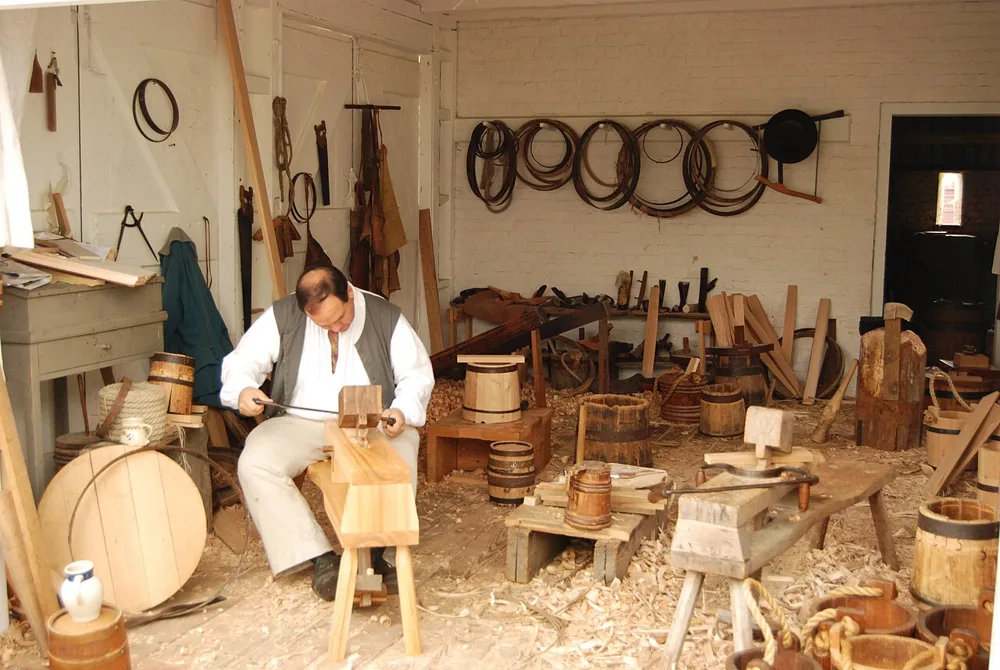
Coopers made casks for beer, rum, tobacco, and flour, and households used pails, tubs, and churns. Pails and churns are white cooperage, simpler than the tight, bulging casks that had to hold liquids under pressure 2. At Colonial Williamsburg the coopers explain that 18th-century coopers shaped every stave by eye, without measuring, and that household pails didn’t need the skill of a tight cooper 3.
A bucket has straight, tapered staves: a cone, not a barrel’s bulge, so it needs no fire or steam. The staves are held by hoops, and a round bottom (the head) sits in a groove cut inside the bottom ends. The Williamsburg shop uses Atlantic white cedar 4; North House specifies only cedar 1.
Quick check
Pails and churns are white cooperage, held to a lower standard than tight casks for beer or rum.
A bucket design
North House doesn’t publish its bucket’s size. A reasonable first bucket, as an estimate:
- Height about 10 inches, with two ear staves about 3 inches taller that carry the handle.
- Diameter about 11 inches outside at the top and 9 1/2 at the bottom. That holds about 2 1/2 gallons.
- 12 staves, so each edge is beveled 15 degrees (lesson 2 explains why). Staves about 3 inches wide at the top, narrowing toward the bottom; their widths can vary as long as they add up.
- Wall thickness about 5/8 inch finished.
- Two hoops, one near the bottom over the groove and one about two-thirds of the way up.
Draw the bucket full size from the side on a board before you start: the outline gives you the stave lengths, the taper, and where the hoops sit.
Cedar
Cedar is light, splits cleanly, and swells tight when wet. Use any straight-grained, knot-free cedar:
- Northern white cedar grows across the upper Midwest and is the likely wood of a Minnesota class.
- Atlantic white cedar is the Williamsburg wood 4.
- Western red cedar is sold at lumberyards in clear boards.
Riving from a log teaches the most and gives the strongest staves, since each one follows the grain. Port Townsend’s class uses Douglas fir or other old-growth softwood salvaged from buildings 5, so clear, quarter-sawn boards are a fair substitute. One maker milled white oak boards to 3/4 inch for 14 staves and 2 handle staves 6.
Hoops
Coopers made their own hoops. Metal bucket and barrel hoops run from 20 gauge to 3/16 inch thick depending on the vessel, usually with two rivets each, and are tapered to fit the staves 7. For a 2 1/2-gallon pail, 3/4 by 1/16-inch mild steel strap is about right. Old whiskey-barrel bands, cut down and re-riveted, work too 8.
Tools
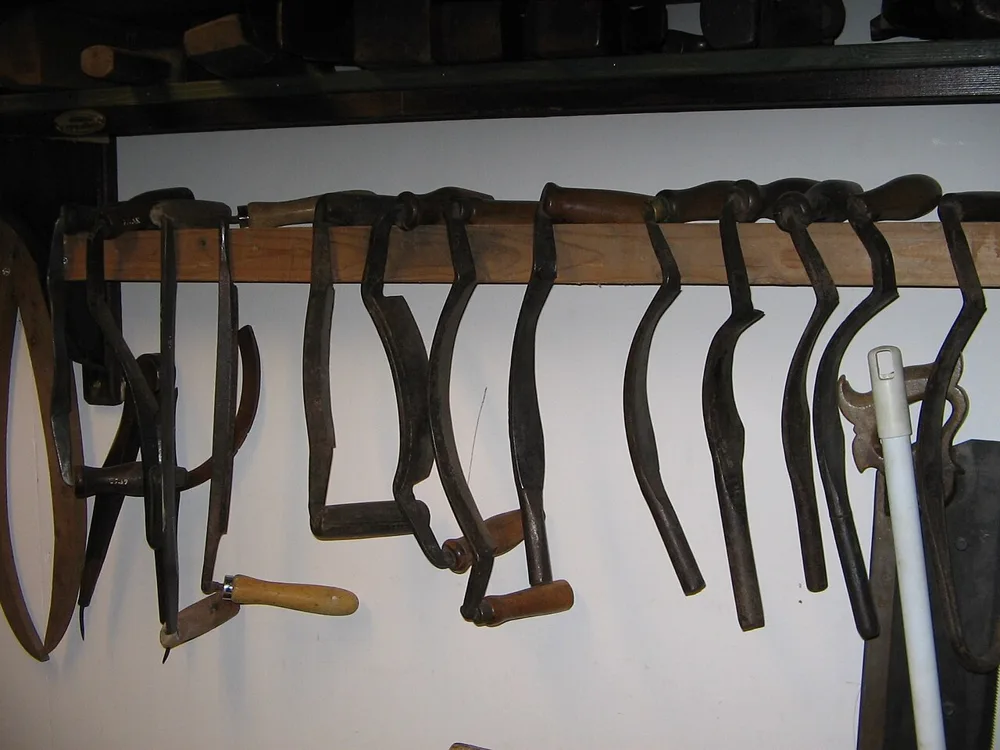

North House’s list is short: froe, drawknife, hollowing knife, compass, and cooper’s jointer 1.
- Cooper’s jointer. The largest of all planes, up to 6 feet long, used upside down and standing still while the cooper pushes the stave along its sole. It is often propped on legs at about 60 degrees with its toe on the floor 9. Dean Sinnott built a 5-foot one from the works of a Stanley No. 8 8. For a bucket, an inverted bench jointer clamped at an angle will do.
- Hollowing knife. A curved drawknife for the inside of the staves 3. An inshave or a scorp also works.
- Croze. A fence that rides on the stave ends, carrying a small cutter that cuts the groove for the bottom 2. You can make one.
- Topping (sun) plane. A curved plane that levels the stave ends 2. A block plane works on a bucket this small.
James Gaster of Beaver Buckets sells a bucket kit, a book, and a DVD, all called How to Make a Coopered Wooden Bucket 10.
Quick check
Long jointers rest at an angle with the toe on the floor; the cooper brings the work to the tool.
Try it
Make the bevel gauge first: two straight sticks about 14 inches long, hinged at one end with a leather strip and marked in inches from the hinge. It costs nothing and you’ll check every stave with it in lesson 2.
Lesson complete
Nice work.
Sources for this lesson
- 1Coopering: Buckets in the Western European & American Style. North House Folk School. verifiedFour days, instructor Eric Edgin. Covers the American and Western European traditions, 'one of the four traditional coopering styles.' Each student makes a wooden bucket from cedar with hand tools: froe, drawknife, hollowing knife, compass, and cooper's jointer plane. Optional: your own drawknife and sloyd knife. Session Mar 18-21, 2027.
- 2Garrett Hack. Cooper's Planes. Fine Woodworking. 2021. verifiedPails and churns are 'white coopering.' Staves tapered and beveled by eye on a long jointer used upside down with the toe raised. Ends leveled with a topping plane (a curved jack); the howel cuts a shallow hollow and the croze a narrow groove for the head, both riding on large round fences; heads of two or three boards doweled together, edges cut to a fine bevel to fit the groove; inside smoothed with an inshave or stoup plane; hoops of wood or steel.
- 3Kyle VanHemert. Barrels and Buckets: the Cooperage at Colonial Williamsburg. Material Matters, Winterthur Program in American Material Culture, University of Delaware. 2017. verifiedStudents shaped bucket staves with master coopers Ramona Vogel and Jonathan Hallman: edges trued and angled on the cooper's jointer, 'a long plane held diagonally to the ground by two legs'; the outer curve cut with a backing knife (drawknife) on a shaving horse; the inside with a hollowing knife. 18th-century coopers did all of this by eye without measuring; household pails were held to a lower standard than tight casks.
- 4Katharine Fitzgerald. No Holes in This Bucket. Material Matters, Winterthur Program in American Material Culture, University of Delaware. 2019. verifiedColonial Williamsburg cooperage, Atlantic white cedar. Staves pre-cut to length with the side angles already shaved; students shaved the outside first, then the inside to match, checking the curve against an iron brace; ten staves made a bucket.
- 5Coopered Bucket. Port Townsend School of Woodworking. verifiedTwo-day class with Steve Habersetzer, Douglas fir or other salvaged old-growth softwood: shape staves with a hatchet, bevel on a cooper's plane, rough-assemble, measure and make the iron bands and hammer them to flare, clean the inside with a scorp, make the base with bandsaw and hand plane, fit it and drive on the bands. $450 plus $100 materials, Aug 29-30, 2026.
- 6Coopering: Making a Bucket. Woodworkers' Apprentice. 2010. verifiedWhite oak buckets with machine help: boards planed to 3/4 in, 14 short staves and 2 longer handle staves, a 1/2-in groove for the base, beveled edges, staves rounded on the shaving horse; oakum in the groove before fitting the base; tapered iron bands from a local blacksmith.
- 7Coopered Buckets Hoops. Permies. verifiedBryant RedHawk: coopers make their own hoops; metal hoops from 20 gauge to 3/16 in thick depending on size, usually two rivets each, tapered to fit the staves; he forges 1070 mild steel to fit, and pulls the staves together for hooping with an adjustable ring and rope or strap clamps.
- 8Dean Sinnott. My Coopering Toolkit. Southern Alberta Woodworkers Society. 2021. verifiedFrom a Port Townsend coopering class: tapered stave templates, wider at the open end; side bevels on a 5-ft cooper's plane fitted with Stanley No. 8 works; a sector marked in bucket radius sets and checks the bevels; hoops from recycled whiskey-barrel bands, riveted flat then hammered on the inside to flare; hoop drivers; a scorp for the inside; a croze with two nickers cutting a groove about 1/8 in wide and deep; a sun (topping) plane levels the ends; bottom turned to fit the groove.
- 9Derek Cohen. Cooper's Jointer/Big Jointer. In the Woodshop. verifiedSalaman: the largest of planes, up to 6 ft and more, used stationary with the sole up while the cooper pushes the stave along it. Often set on legs at the rear at about 60 degrees with the toe on the floor. Cohen built a 42-in jointer as a keg-size example.
- 10James Gaster. Beaver Buckets. Beaver Buckets. verifiedWhite cooper James Gaster: buckets, churns, and tubs; sells a bucket kit, the book How to Make a Coopered Wooden Bucket, and a DVD of the same name; orders by phone, 308-364-2528.