The Norse Pram and What to Buy
North House's seven-day pram class builds an 11-foot Norwegian rowing pram with no molds, from lumberyard boards, planked by eye and riveted with copper. What a pram is and how it differs from a pointed færing, the boat this module builds, every material with where to buy it, the tools you'll make in the first day, and a seven-day plan.
- 4 min
- 5 steps
- 2 questions
- Lesson 123 of 204
In this lesson
- What a pram is
- How this build works
- Materials, explained
- Make your tools first
Picking up where you left off.
What you need
| Have it | Material | Spec | Qty | Where to get it |
|---|---|---|---|---|
| Plank boardsBuy long: an 11-ft pram needs 12-ft planks, or scarf shorter ones. | Clear white pine, spruce, or Douglas fir, 1x6 to 1x8, planed to 3/8-1/2 in | About 10-12 boards, 12-14 ft (estimate: 8 strakes plus spares) | Local lumberyard; pick the clearest, straightest-grained boards | |
| Bottom board | Pine or spruce, 1 in (5/4 rough), about 10-14 in wide total | One wide board or 2-3 edge-joined, 12 ft | Local lumberyard or sawmill | |
| Transom stock | 5/4 pine, or oak for a stiffer stern | Enough for two cleated transoms, about 4 board feet | Local lumberyard | |
| Frame, knee, and trunnel stock | White oak or black ash, straight-grained, 5/4-6/4 | About 10 board feet | Hardwood dealer or local sawmill | |
| Copper boat nails | #14 gauge x 1 to 1 1/4 in, square, countersunk | About 500 needed; one 1-kg box (about 900-1,000) | Fisheries Supply | |
| Copper roves | 5/16 in, for 14-gauge nails | One 1/2-kg bag, plus spares | Fisheries Supply | |
| Thwart and riser stock | 5/4 pine or spruce | 2-3 thwarts plus risers, about 6 board feet | Local lumberyard | |
| Thole pins or oarlocks | Oak thole pins in cleats, or bronze oarlocks and sockets | Two rowing stations: 4 pins or 2 oarlocks | Make the pins; oarlocks from a marine supplier | |
| Pine tarFor boat soup with boiled linseed oil and gum turpentine (lesson 5). | Kiln-burned Stockholm-type pine tar | 1 pint | National Historic Ships UK (Mystic Seaport) | |
| Boiled linseed oil and pure gum turpentine | 1 quart each | Hardware or paint store | ||
| Oars optional | A pair, about 7 ft for an 11-ft pram | 1 pair | Buy, or make later |
Tools
Checkmarks are saved on this device.
The plan
-
Day 1
History, stock, and shop-made tools
- Read the lumber; mill plank stock to thickness
- Make a bucking iron, a rove set, and wooden clamps
- Make the two transoms from cleated boards
-
Day 2
Bottom board and garboards
- Set the bottom board on horses and spring in the rocker
- Shape, bevel, and gain the garboard planks
- Clamp, drill, and rivet the first laps
-
Day 3
Second strake
- Spile from the plank below, shape the top edge by eye
- Bevel the laps, cut gains, rivet
- Sight the hull; spread it with struts from overhead
-
Day 4
Third strake
- Same sequence; keep checking for fairness
- Catch up on riveting
-
Day 5
Sheer strake and transoms
- Hang the top strake and trim the sheer line by eye
- Finish fitting and fastening the transoms
-
Day 6
Frames
- Take frame shapes with a joggle stick
- Saw, bevel, and fasten frames with wedged trunnels and rivets
- Fit the risers
-
Day 7
Fit out and launch
- Thwarts and knees, inwales, thole pins or oarlocks
- First coat of boat soup
- Launch
This module rebuilds North House Folk School’s seven-day class, Building the Norse Pram: Intro to Lapstrake Construction, taught by Brian Thorkildson and Phil Winger. The class builds one 11-foot rowing pram as a group “using lapstrake techniques and beveled watertight planking,” with “compound bevels for framing, riveting planks, and … trunnels to fasten frames,” and promises the method is simple enough to repeat in a backyard: no molds, lumber “from the lumberyard,” few tools, “including simple carving knives” 1. North House publishes no lesson plan, so what follows is a reconstruction from the course description and the sources cited.
What a pram is
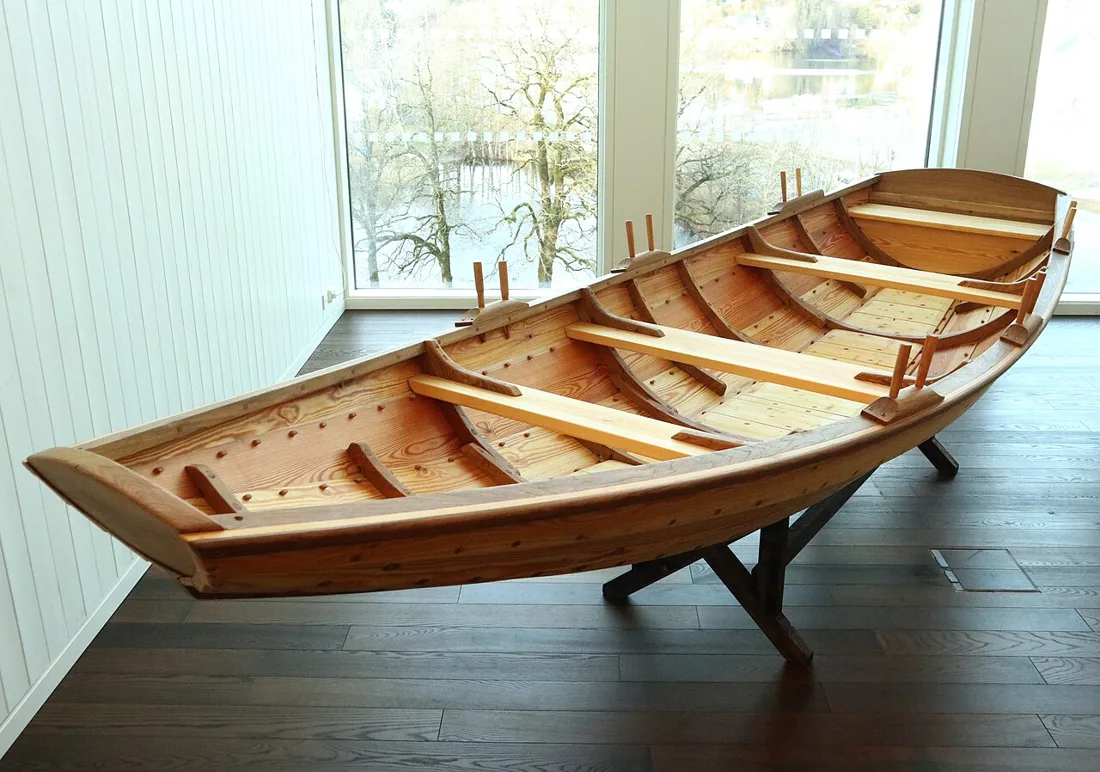
A pram is a clinker-built boat with a flat bottom board instead of an upright keel, a transom at the stern, and a bow that rises into a “snout” 2. Norwegians call the small bow transom the nose (nesa). The two classic coastal types are the Holmsbupram of the Oslofjord and the Arendalspram of the south coast; common sizes run from about 10 to 16 feet, and they were often worked with a single sculling oar over the stern 3. A færing, by contrast, is the pointed, keeled four-oared boat.
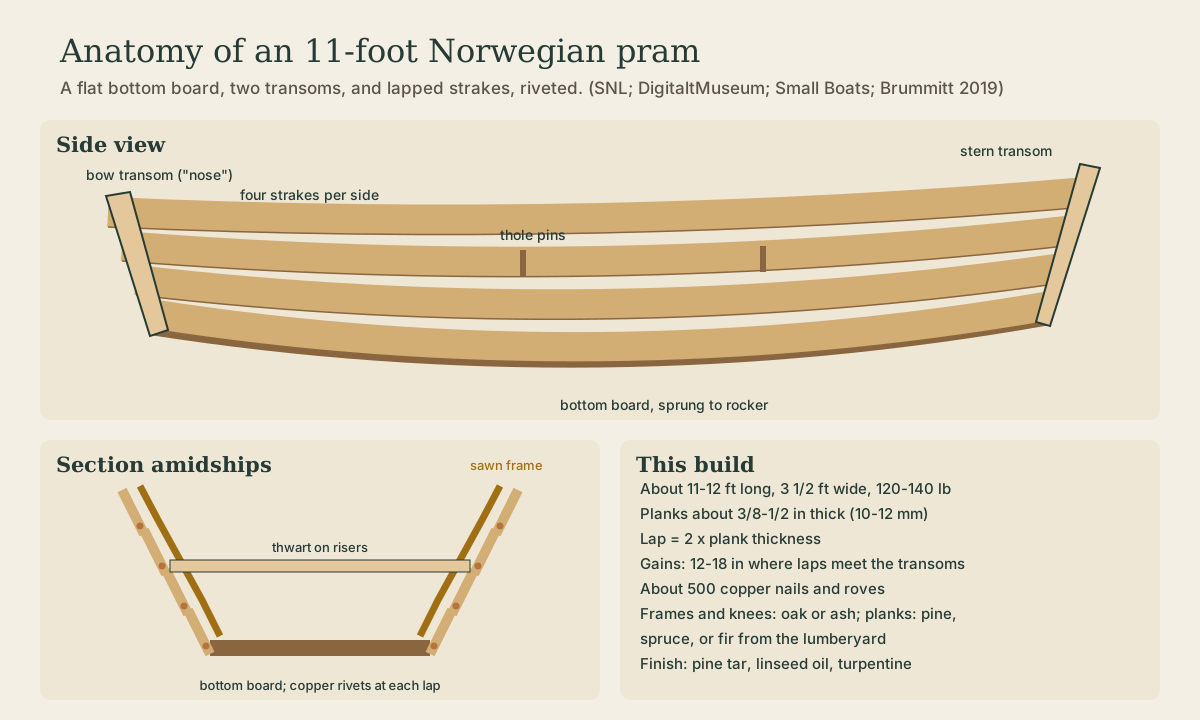
A museum Holmsbu pram in Akershus has four strakes a side plus a bottom board, with the bottom board lying under the two lowest strakes, “typical of Holmsbu prams,” four thole pins, and one thwart bored for a mast; it’s 5.46 by 1.42 meters 4. An 11-foot pram is a smaller cousin: Simon Watts’s 11-foot-9 Norwegian pram is 3 feet 6 inches wide and weighs 120 to 130 pounds 5, and a pram Phil Winger built in Minneapolis, 11 feet 7 inches, seats up to three rowers and took about 500 copper rivets 6.

Quick check
Its bow rises into a small square ‘nose.’
How this build works
“In traditional Norwegian building the planking would be completed ‘by eye’ before any transoms or frames are installed,” and the frames are sawn to fit the finished shell afterward 5. North House’s companion pram course describes the same method: lofting by eye, bevels on watertight planking, compound bevels for framing, and riveting, with students making their own wooden clamps, backing irons, and rove sets from patterns 7.
The sequence in this module:
- This lesson: materials, tools, and plan.
- Bottom board, transoms, and garboards.
- Planking by eye and riveting.
- Frames, trunnels, and fitting out.
- Boat soup and launching.
Quick check
Planks are shaped by eye first; frames are fitted to the shell afterward.
Materials, explained
Planks. North House’s older pram classes used white spruce, white pine, black ash, oak, and copper fastening 8; Watts specifies Douglas fir 5; Winger’s boat mixed pine, walnut, and fir 6. From a lumberyard, buy the clearest 1x boards you can find, long enough for full-length strakes, and plane them down. The plank thicknesses in the kit list (3/8 to 1/2 inch) are an estimate for a boat this size; pick one and hold it everywhere, because the lap width follows from it: a lap about twice the plank thickness 9.
Copper nails and roves. Each lap is fastened with a square copper boat nail driven through both planks, with a rove, a small domed copper washer, pressed over the point inside and the nail clipped and peened over it. Rivets beat clench nails in soft planking because the rove spreads the load 9. Fisheries Supply stocks Davey square copper boat nails in about 1-kg boxes (a #14 x 1-inch box is about 1,041 nails) and matching roves by the half kilo 10.
Frames and knees want a tough, straight-grained hardwood: oak or ash, as in North House’s older classes 8.
Finish. Pine tar, linseed oil, and turpentine, the traditional “boat soup” 11.
Make your tools first
Spend the first morning making the three things you can’t buy cheaply:
- A bucking iron: a heavy steel bar, a foot or so long, to hold against the nail head outside while you set the rove inside.
- A rove set: a short steel rod with a hole drilled in its end slightly bigger than the nail, used to drive the rove down the nail.
- Wooden clamps: two hardwood bars with a bolt and wing nut, enough of them to hold a plank along its whole length.
Playback is optional. If the player is unavailable, open the video at its source.
Try it
Price your kit: visit the lumberyard and count how many truly clear 12-foot boards they have. That number decides whether you’ll scarf planks or buy elsewhere.
Lesson complete
Nice work.
Sources for this lesson
- 1Building the Norse Pram: Intro to Lapstrake Construction. North House Folk School. verified7 days; instructors Brian Thorkildson and Phil Winger. Group builds an 11-foot wooden rowing pram with lapstrake techniques and beveled watertight planking; compound bevels for framing, riveting planks, and trunnels to fasten frames. No-mold construction from readily available lumberyard lumber with minimal tools including carving knives; adaptable to sailing, iceboating, and rowing positions. Required tools: sloyd knife, 10-16 ft tape, pencils, safety glasses and hearing protection; optional block plane and spokeshave.
- 2Andreas Osnes. pram. Store norske leksikon. verifiedA clinker-built boat with a flat-lying bottom board instead of an upright keel, a transom aft, and a bow rising into a snout; called eike in Østfold. From Old Norse prámr, via Middle Low German.
- 3Pram. Lokalhistoriewiki (archived copy). verifiedAfter Arne Emil Christensen, KYSTEN 2/1980. A pram has a transom aft and a small bow transom, the nose. Two main types: Holmsbupram (Oslofjord) and Arendalspram (Sørlandet). Common sizes about 10 to 15-16 feet; often worked with one sculling oar over the transom; built in western and northern Norway only after about 1900.
- 4Båt (Holmsbupram FMT.0108). Museene i Akershus, DigitaltMuseum. verifiedPine on pine with frames; four strakes per side plus a bottom board, the bottom board lying under the two lowest strakes, typical of Holmsbu prams; four thole pins; one thwart bored for a mast; 5.46 x 1.42 m.
- 511' 9" Norwegian Sailing Pram. Small Boats Magazine. 2026. verifiedDesign by Simon Watts: 11 ft 9 in x 3 ft 6 in, 120-130 lb, 65 sq ft sail, Douglas fir planking, copper fastened. In traditional Norwegian building the planking is completed by eye before transoms or frames are installed; Watts supplies transom shapes plus two temporary molds. Sawn frames go in after planking. The keel plank is bent to rocker first.
- 6Martha Brummitt. Building a Norwegian Pram and Weaving a Wool Sail. Norwegian Textile Letter. 2019. verifiedFebruary 26, 2019. A pram built with Phil Winger in Minneapolis: 11 ft 7 in long, seats up to three rowers, of pine, walnut, and Douglas fir with about 500 copper rivets, by hand tools; a woven wool sail coated with pine tar and tallow.
- 7Techniques of Pram Boat Building: Old World Boatbuilding Traditions. North House Folk School. verifiedTeaches lofting by eye, bevels on watertight planking, compound bevels for framing, and riveting; students make wooden clamps, backing (bucking) irons, and rove sets from provided patterns; lumberyard lumber.
- 8Caleb Mattison. Pram build. North House Folk School blog. 2015. verifiedJune 12, 2015. A pram from John Beltman's class, white pine and oak, secured mostly with copper rivets, later fitted with mast, daggerboard, and rudder. Older North House pram courses used white spruce, white pine, black ash, oak, and copper fastening, finished with pine tar, linseed oil, and turpentine.
- 9Harry Bryan. Thoughts on Lapstrake Planking. WoodenBoat. verifiedLap width about twice the plank thickness (1 inch for 1/2-inch planking); widest plank, lap included, 3 1/2 to 5 inches amidships. Gains at least 12 inches long on planking 3/8 inch or thinner, 18 inches or more on heavier, cut with a rabbet plane or chisel. Use a full-length batten to guide the lap bevel. Laps fastened with rivets or copper clench nails; rivets better in softwood because the rove spreads the load; steam-bent frames 1/2 inch or thinner best riveted.
- 10Davey & Co. Copper Boat Nails; Davey & Co. Copper Roves. Fisheries Supply. verifiedSquare countersunk copper boat nails in about 1 kg boxes, e.g., #14 x 1 in (about 1,041 pieces) $101.35, #14 x 1 1/4 in (about 900) $103.65, #13 x 1 1/4 in $115.25, #12 x 1 1/2 in $103.65. Roves (fisheriessupply.com/davey-and-co-copper-roves) in 1/2 kg bags: 5/16 in for 14 ga $76.08, 3/8 in for 13 ga $75.98, 7/16 in for 12 ga $74.90. Prices as of 2026.
- 11Theodore P. Kaye. Pine Tar: History and Uses. National Historic Ships UK (Mystic Seaport). 2011. verifiedMystic Seaport's soak: 1 quart pure gum turpentine, 1 quart boiled linseed oil, 1/2 pint pine tar, 1/2 pint Japan drier; below ground, equal thirds and no drier. Stockholm tar history; Auson grades: 588 dark (charcoal byproduct), 773 golden kiln-burned stump tar.