Leather and How It's Tanned
Leather is animal skin whose protein fibers have been chemically changed so they won't rot. Vegetable tanning, the oldest method, uses tannins from tree bark and takes weeks; it makes firm leather you can carve, stamp, and mold. Chrome tanning, about 90 percent of U.S. production, makes soft leather for clothes and bags. Grain and flesh sides, why leather thickness is measured in ounces, and how Milwaukee became one of the world's great tanning cities.
- 4 min
- 5 steps
- 3 questions
- Lesson 98 of 204
In this lesson
- What tanning does
- Two tannages
- Ounces are thickness
- Milwaukee leather
- Try it
Picking up where you left off.
Before you cut a single strap, it helps to know what leather actually is, because the kind you buy decides what you can do with it.
What tanning does
A raw hide rots. Tanning turns it into leather by chemically reacting the hide’s protein fibers, its collagen, with an agent such as plant tannins, chromium salts, or alum. Tanned leather resists decay and wetting and stays supple and durable 1. Most leather comes from cattle, sheep, and pigs 1.
Every piece of leather has two faces. The grain side is the outer surface of the animal, where the hair grew: smooth and dense. The flesh side is the underside: thicker, softer, and fibrous 1 2.
Quick check
The fibers react with tannins, chromium, alum, or other agents.
Two tannages
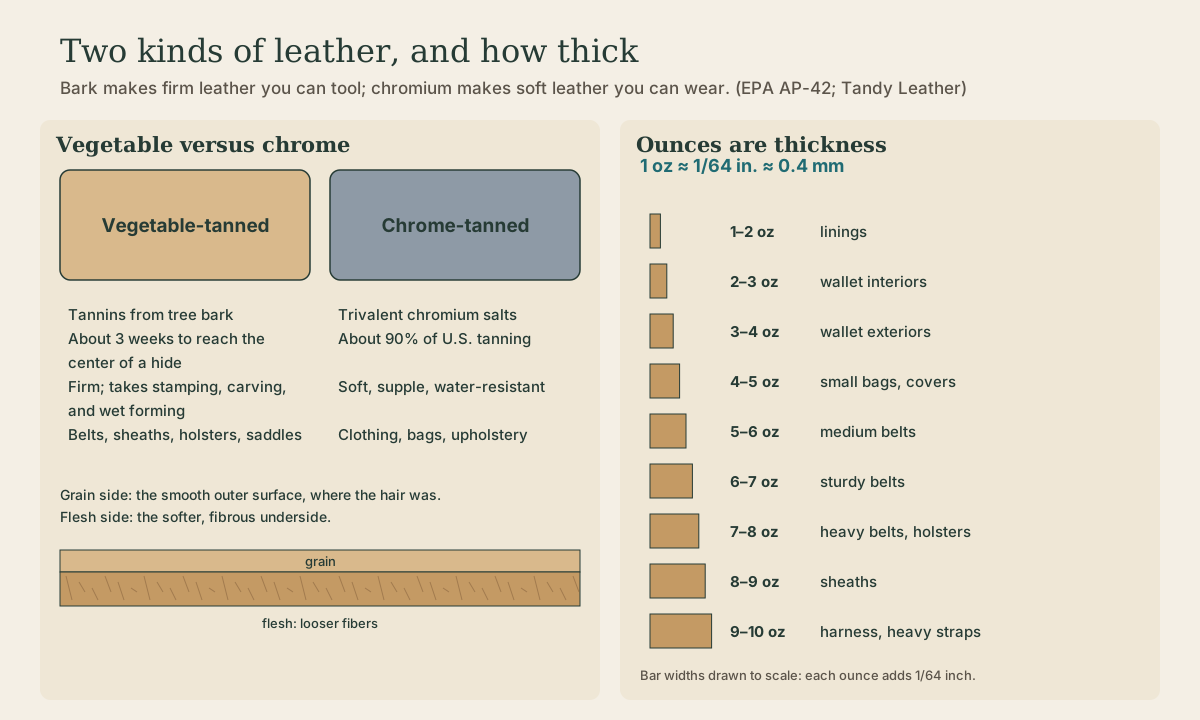
Vegetable tanning is the oldest process still in use. After the hides are soaked, fleshed, limed, and dehaired, they go through a series of tanning baths made from tannins extracted from tree bark, starting weak and growing stronger. It usually takes about three weeks for the tannin to reach the center of a hide 1. Vegetable tanning makes the firm, heavy leathers used for soles and saddles 1, and the “veg-tan” that leatherworkers prize for carving and dyeing 2. It’s the leather in this course: it takes stamping and carving, and when it’s wet it can be molded to a shape it will hold once dry.
Chrome tanning uses salts of trivalent chromium. It’s faster and makes soft, flexible leather for bags and clothing 2, and it accounts for about 90 percent of U.S. leather production 1. It won’t take carving or molding the way veg-tan does.

Quick check
Vegetable-tanned leather holds tooling and molded shapes; chrome-tanned is soft and springy.
Ounces are thickness
Leather thickness in the United States is given in ounces, which confusingly has nothing to do with weight. One ounce is about 1/64 inch, or 0.4 millimeter, so 4-ounce leather is about 1/16 inch thick 3. Tandy Leather’s chart gives rough uses 3:
- 1–3 oz: linings, wallet interiors, watch straps.
- 3–5 oz: wallet exteriors, small bags, notebook covers.
- 5–7 oz: medium and sturdy belts, tool pouches.
- 7–9 oz: heavy belts, holsters, sheaths, saddlery.
- 9–10 oz and up: harness, heavy straps, armor.
Too thin, and stitches pull through; too thick, and it won’t fold or sew well 3. For layered items, the total thickness is what matters 3.
Quick check
In leathercraft an ounce is a measure of thickness: about 1/64 inch.
Milwaukee leather
Wisconsin is part of the story. The EPA notes that Pennsylvania, Massachusetts, New York, and Wisconsin together hold almost half the country’s tanneries 1. In 1847 two German immigrants, Guido Pfister and Frederick Vogel, set up shop in Milwaukee, Vogel with a tannery on the Menomonee River. Within a year their firm made half the city’s leather. By the 1870s it was called the largest tannery west of the Alleghenies, and during World War I Pfister & Vogel employed more than 3,500 people and was one of the largest tanners in the world. Its last Milwaukee plant closed in 2000 4.
Playback is optional. If the player is unavailable, open the video at its source.
Try it
Next time you hold a belt or a wallet, flex it. Firm and holding its shape, with a smooth, tan grain? Likely vegetable-tanned. Soft and floppy? Likely chrome-tanned. Buy a small piece of 6–8 oz veg-tan for your first projects in this course.
Lesson complete
Nice work.
Sources for this lesson
- 1AP-42 Section 9.15: Leather Tanning. U.S. Environmental Protection Agency. 1997. verifiedTanning converts raw hides into leather by reacting the hide's collagen fibers with tannins, chromium, alum, or other agents, making them resistant to decay and wetting and keeping them supple. Grain side carries the hair and oil glands; the flesh side is thicker and softer. Most common U.S. agents: trivalent chromium and vegetable tannins from certain tree barks; chrome tanning is about 90 percent of U.S. production. Pennsylvania, Massachusetts, New York, and Wisconsin account for almost half of U.S. tanning facilities. Beamhouse (trimming, soaking, fleshing, unhairing), tanyard (bating, pickling, tanning, wringing, splitting), finishing. Vegetable tanning, the oldest process, makes heavy and sole leathers; liming, dehairing, deliming and bating; tannin concentration starts low and increases; it usually takes about 3 weeks to penetrate to the center of the hide.
- 2Beginner's Guide to Leathercraft: Tools, Terms & Easy First Projects. Tandy Leather. verifiedStarter tools: sharp knife or rotary cutter, cutting mat, metal ruler, harness needles, waxed thread, stitching chisels, edge beveler, burnishing tool, non-metal mallet, awl, wing divider, strap cutter. Terms: grain side, flesh side, veg-tan (for carving and dyeing), chrome-tan (soft, for bags and clothes), burnishing, casing, saddle stitch. Safety: cut away from your body; sharp blades are safer than dull; safety glasses when hammering or punching; ventilation when dyeing or gluing. First projects: key fob, card holder, cord wrap.
- 3Understanding Leather Weights and Thickness: A Complete Chart. Tandy Leather. verifiedIn leathercraft an ounce measures thickness, not weight: 1 oz is about 1/64 inch or 0.4 mm; 4 oz is about 1/16 inch. Chart: 1-2 oz linings and book covers; 2-3 oz wallet interiors, watch straps; 3-4 oz wallet exteriors, small bags; 4-5 oz clutches, notebook covers; 5-6 oz satchels, medium belts; 6-7 oz tool pouches, sturdy belts; 7-8 oz heavy belts, holsters; 8-9 oz saddlery, sheaths; 9-10 oz harness, heavy straps; 10+ armor. Combined thickness of layers matters. Too thin and stitches pull through; too thick and it won't fold or sew.
- 4Joseph B. Walzer. Pfister & Vogel Leather Company. Encyclopedia of Milwaukee (University of Wisconsin-Milwaukee). verifiedGuido Pfister and Frederick Vogel Sr., from Württemberg, came to Milwaukee in 1847; Vogel built a tannery on the Menomonee River; they merged in 1848. By the end of its first year the firm made half the leather produced in the city. Reincorporated as Pfister & Vogel Leather Company in 1872, 'the largest tannery west of the Allegheny mountains.' Workers grew from 60 (1860) to over 750 (mid-1890s) and over 3,500 during World War I, when it was one of the largest tanners in the world; mainly plain cowhide, calf, and kip. Peaked in 1919; last Milwaukee facility (as U.S. Leather) closed in 2000.