Bending, Lacing, and the Lid
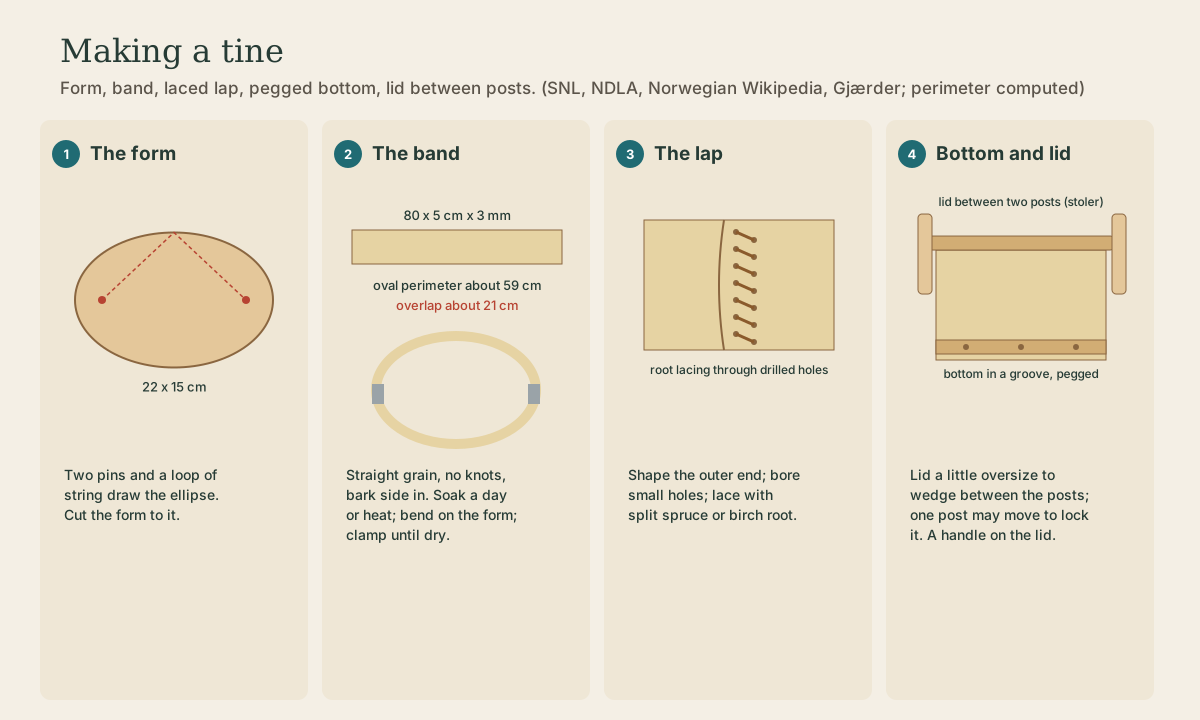
Days one through four: draw the ellipse and cut the form, soak or heat the band and bend it around the form until dry, shape and lace the lap with root, groove and peg in the bottom, and fit a lid between two upright posts, one of which may lock it.
- 3 min
- 5 steps
- 2 questions
- Lesson 204 of 204
In this lesson
- The form
- Soak and bend
- The lap
- The bottom
- The lid
Picking up where you left off.
The form
Draw an ellipse with two pins and a loop of string and cut a form to it from plywood 1. The Norwegian school project uses an oval about 22 by 15 cm 1, close to the Kvinesdal tine in lesson 1. Its perimeter is about 59 cm, so an 80 cm band leaves about 21 cm of overlap for the lap (a calculation).
Soak and bend
Put the bark side in 1. Soak the band for a day, or steam it over a pot under a plastic bag 1; in Sweden the band is heated over a fire or boiled 2. The Wood Handbook gives about 15 minutes per centimeter of thickness for wood at 20 to 25 percent moisture and 30 minutes per centimeter for drier wood 3, so a 3 mm band needs roughly 5 to 10 minutes of steaming or boiling.
Bend the hot band around the form, overlapping the ends, and clamp. Leave it on the form until fully dry; the wood holds its shape once dry 4 1. Mark the lap with a pencil that writes on wet wood, as Vesterheim’s tool list includes 5.
Playback is optional. If the player is unavailable, open the video at its source.
Quick check
Air-dry wood takes the longer figure; a day’s cold soak beforehand helps.
The lap
Off the form, shape the outer end of the overlap, often in scallops or fingers; the generous overlap allows decoration 6. Bore small holes along it with the fine bits and lace it with split root, birch or spruce 4. In Sweden the commonest stitch resembles a chain stitch 2. Soak the root first so it is supple; Vesterheim’s trough soaks wood and root lacing together 5.
Quick check
Round toothpicks make good pegs, which may be why Vesterheim’s tool list includes them.
The lid
The lid of a laup “is clamped between two staves at the ends” 7. The school version fixes two posts (stolper) to the outside of the band and cuts the lid about 5 mm oversize, shaping it to wedge between them 1. On old tines the posts are called stol, “two wooden structures like an ear… One is moveable and fastens the lid when it is moved inwards” 8. Carve a handle on the lid.
Playback is optional. If the player is unavailable, open the video at its source.
Try it
Make the lid from cardboard first and test it between the posts. Trim until it wedges with a firm push, then trace the cardboard onto the wood.
Lesson complete
Nice work.
Sources for this lesson
- 1Sveip. NDLA (Norwegian Digital Learning Arena). verifiedSchool project: an oval about 22 x 15 cm; band 80 x 5 cm, 3 mm thick, of knot-free pine or birch, bark side inward; lid of 13 mm solid wood, bottom 10 mm. Soak the band a day or steam it over a pot under a plastic bag; bend on the form and clamp until fully dry. Lid alternative: two posts fixed outside at the ends and a lid cut about 5 mm oversize, shaped to wedge between them. Form drawn as an ellipse with two pins and string; this version is glued.
- 2Svepask. Swedish Wikipedia. verifiedThe band is heated over fire or boiled; sewn with root thread, the commonest stitch like chain stitch; in the south the band wraps around the bottom, in the north the bottom is set in a rabbet; pegged bottoms; many different lid locks.
- 3Rebecca E. Ibach. Specialty Treatments (Chapter 19). USDA Forest Service, Forest Products Laboratory (Wood Handbook, FPL-GTR-190). 2010. verifiedSteam or boil about 15 min/cm (38 min/in) of thickness at 20-25% moisture content, 30 min/cm (75 min/in) for drier wood. Plasticized wood compresses 25-30% parallel to the grain but stretches only 1-2%; bends needing more than about 3% difference between outer and inner faces need a metal strap with end fittings. Birch, ash, hickory, oak are good bending species. Cool and dry the piece held in shape. Laminated members: dry laminations bent without end pressure against a form and bonded in one operation; bending thin laminates needs only moderate stress, no steam, and gives stronger members than single-piece bends; laminated bends change shape less with moisture; thickness-to-radius ratios impossible in single pieces are easy; any length can be made.
- 4Eivind Falk. Sveiping - sveipet beholder. Store norske leksikon. 2025. verifiedStraight-grained, knot-free wood planed to 2-4 mm; sallow and pine both suit; seams sewn with roots (tæger) of spruce or birch; heated, steamed, or bent green around a form, holding its shape once dry; bottom fixed with wooden pegs. Names: sveipeske, øskje, laup, tine, butt; Oseberg objects were made this way.
- 5Bentwood Box (archived). Vesterheim Folk Art School (Wayback Machine). verifiedHal Bitzer, Aug 21-24, 2025, four days, $365-405 plus $20 materials; some wood and knife experience needed. Learn history, 'select the wood, make a mold, wet the wood, and bend it on a form. Different types of lacing… construct and fit the bottom and lid.' Shared tools: hand router with 3/8 in bit, hand drill with 7/64 and 3/32 in bits, sandpaper, round toothpicks, an indelible pencil that writes on wet wood, glue, C-clamps and bar clamps, a 3 ft trough with a camp stove to soak wood and root lacing, carving knives and gouges.
- 6Sveiping. Norwegian Wikipedia. verifiedSallow most sought after; split rather than sawn blanks keep the surface fibers whole; dry blanks soaked or steamed; sewn with birch root, spruce also used; generous overlap allows decoration; bottom pegged through small holes. Literature: Johan Hopstad, Sveiping av øskjer og tiner (1983).
- 7Laup. Norwegian Wikipedia. verifiedAn oval box, especially for butter, today often called a tine; 'lokket klemmes fast mellom to staver i endene' (the lid is clamped between two staves at the ends).
- 8Old artifacts: tine or laup. Genealogical Research in Norway (blog). 2022. verifiedAfter Per Gjærder, Esker og Tiner (1981): 'two wooden structures like an ear, they are called stol… One is moveable and fastens the lid when it is moved inwards.' A laup from Oppdal, 19 x 35 cm, painted 1819.