Casting On and Twining
Day one: wind a ball with both ends free, knit a swatch, cast on with the three-strand two-color cast-on, and learn the twined knit and purl, which strand goes over or under, and how to let the twist spin out. Then the relief stitches for the cuff: the crook stitch, the crook round, and the chain path.
- 5 min
- 7 steps
- 2 questions
- Lesson 149 of 204
In this lesson
- Wind the ball
- The swatch
- The cast-on
- Knit and purl
- The crook stitch
- Chain path
- Try it
Picking up where you left off.
Wind the ball
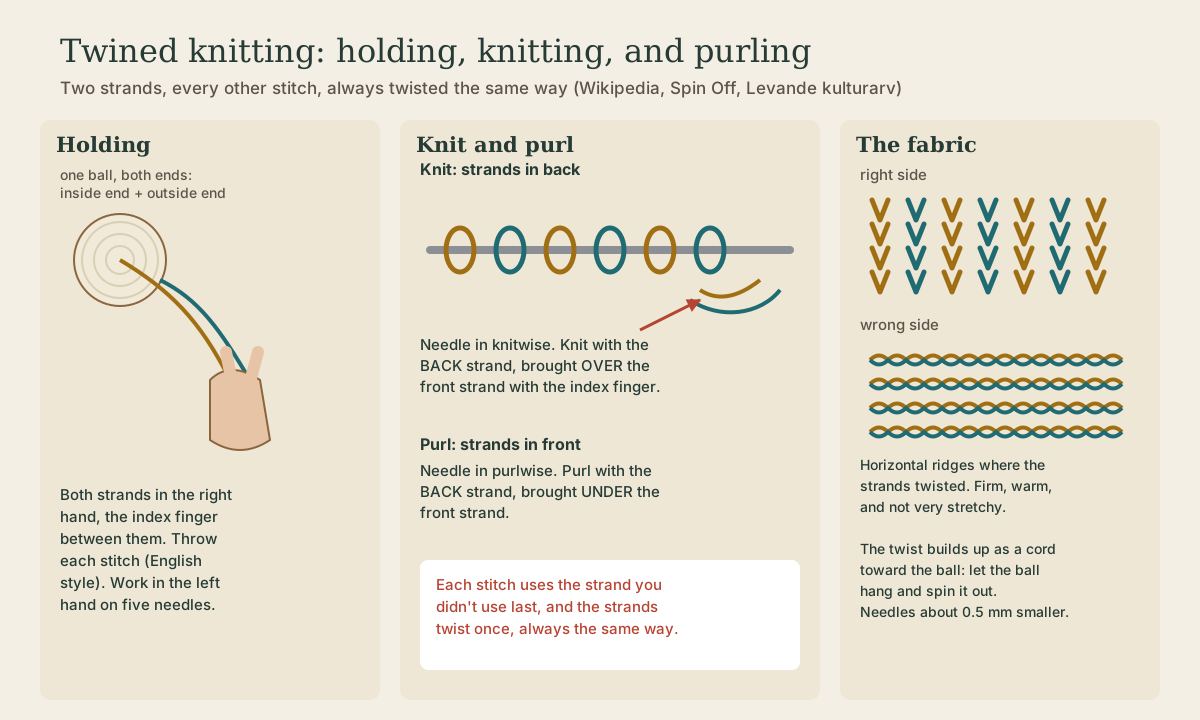
Wind a center-pull ball with a nøstepinne or ball winder so both ends are free, one from the inside and one from the outside 1. For two colors, wind one, then wind the second onto the outside of the same ball 2.
Because the strands always twist the same way, they build up into a cord between your hands and the ball. Throw one or two half hitches with the strands around the ball so it can hang by its own weight and spin the cord out 1 2.
The swatch
Twined fabric hardly stretches 3, so the mitten has to be knitted to size, and that needs your gauge. Knit a swatch in the round on your 2.5 mm needles 4, about 40 stitches around and 5 cm tall, wash it, let it dry, and count stitches across 10 cm. Lesson 3 turns that number into a mitten.
The cast-on
Twined knitting is cast on with the two strands and one more; there are three common ways 1. The class teaches a decorative two-colored one 5. Spin Off’s version 2:
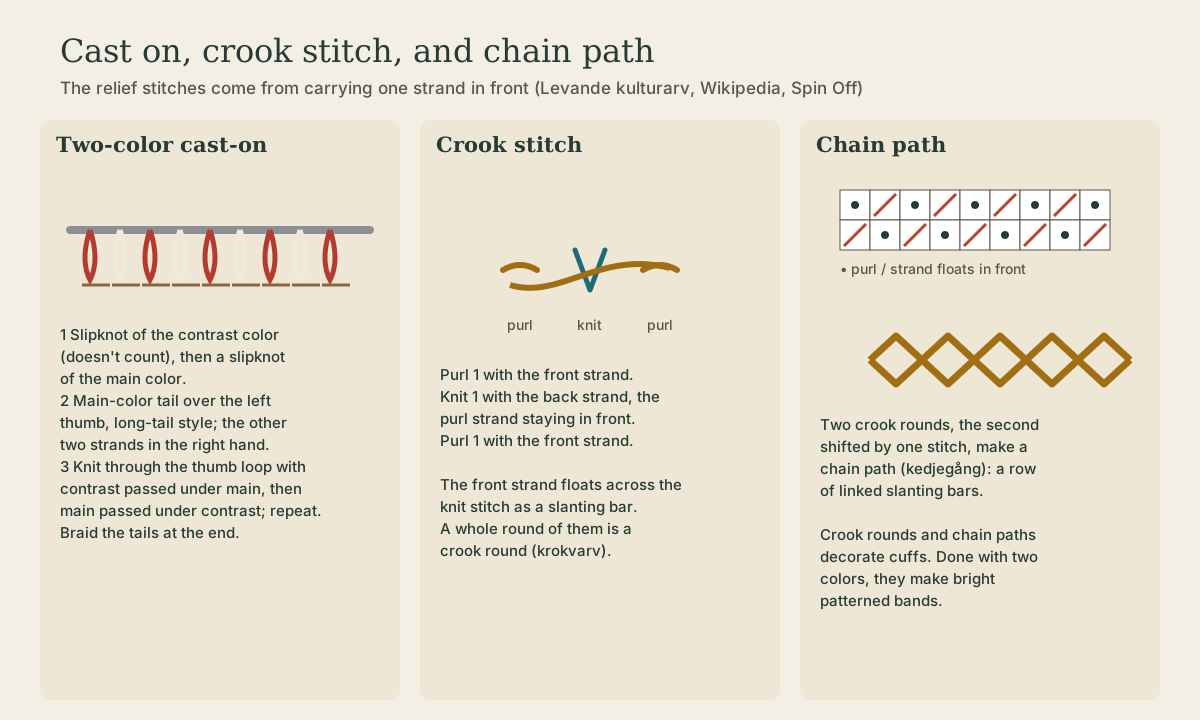
- Make a slipknot of the contrast color about 4 inches from its end and put it on the needle. It doesn’t count as a stitch.
- Make a slipknot of the main color about 2 yards from its end and put it on the needle. That’s stitch 1.
- Take the main-color tail over your left thumb as for a long-tail cast-on, and hold the other two strands in your right hand.
- Knit through the thumb loop with the contrast strand, passed under the main strand.
- Pick up a new thumb loop and knit through it with the main strand, passed under the contrast.
- Repeat steps 4 and 5, alternating colors.
It looks like a long-tail cast-on in alternating colors 2. Divide the stitches over four needles and join in the round. Leave the tails; on mittens they’re often braided into a decorative tie 1.
Knit and purl
Hold both strands in the right hand, separated by the index and middle fingers, and throw each stitch, English style 1:
- Knit: both strands at the back. Put the needle into the next stitch knitwise and knit with the back strand, bringing it over the front strand with your index finger 1.
- Purl: both strands in front. Put the needle in purlwise and purl with the back strand, bringing it under the front strand 1.
Every stitch uses the strand you didn’t use for the last one, and the strands twist once between stitches, always the same way 6 1. With Z-plied yarn the strands untwist a little near your hand and overtwist toward the ball; stop and let the ball spin whenever it gets hard to pick up a strand 3. If you’re using S-plied yarn, reverse the direction of the twist 2.
It’s slower than ordinary knitting, because the yarn is laid around the needle rather than flicked off a finger 7. Expect the first evening to feel clumsy.
Playback is optional. If the player is unavailable, open the video at its source.
Quick check
For a purl, both strands are in front and you purl with the back strand brought under the front.
The crook stitch
Relief patterns come from working with one strand in front and one behind: purl with the front strand, knit with the back strand 6. A crook stitch is three stitches: purl one, knit one with the purl strand left floating in front, purl one. The floating strand makes a slanting bar across the knit stitch 1. A whole round of crook stitches is a crook round, krokvarv 6.
A deep stitch is related: knit one stitch with the back strand while the front strand runs across in front 1.
Chain path
Two crook rounds one above the other, the second shifted by one stitch, make a chain path, kedjegång: a row of linked slanting bars 6 1. Charts mark purls with a dot and the floating strand with a slanting line.
For the cuff: after the cast-on, work a round of twined purl to keep the edge from rolling 2, a few rounds of plain twined knitting, a chain path, a few more plain rounds, and a second chain path. In two colors the same stitches make bright patterned bands, like the Floda mittens in lesson 1.
Playback is optional. If the player is unavailable, open the video at its source.
Quick check
A single round of crook stitches is a crook round.
Try it
On the swatch, after a few plain rounds, work one crook round and look at the right side. Then work a second, shifted by a stitch, and watch the bars link into a chain. If the bars slant the wrong way or don’t link, check that the floating strand is the one you just purled with.
Lesson complete
Nice work.
Sources for this lesson
- 1Twined knitting. Wikipedia. verifiedCalled tvåändsstickning, tvebandsstrikking, tvebinding. Forest regions of Värmland, Dalarna, Härjedalen, Jämtland, Hälsingland, and eastern Norway. Over 95 percent of knitted objects from Dalarna in the Nordic Museum and local museums are twined. Norwegian mittens worn inside out. Bornvanten, 24 by 11 cm, about 5.5 stitches per cm, radiocarbon-dated 1490-1645. Method: centre-pull ball, half hitches so the ball can hang and untwist; needles about 0.5 mm smaller than usual, metal preferred, five double-pointed needles; cast-on with the two strands plus a third, tails often braided. English style: to knit, both strands in back, separated by index and middle finger, knit with the back strand brought over the front strand; to purl, both in front, purl with the back strand brought under the front. Deep stitch: front strand runs in front while knitting with the back strand. Crook stitch: purl, knit with the purl strand left in front, purl; a row of them is a crook row; two crook rows shifted by one stitch make a chain path; 'O' stitch. (Its yarn-twist paragraph reverses the usual Z-plied terminology; not relied on.)
- 2Joan Goldstein. What is Twined Knitting?. Spin Off. 2025. verifiedExcess twist builds up as you work; wind both yarns onto one center-pull ball, secure the strands to the ball with a slipknot, and let the ball hang to untwist. Three-strand alternating cast-on: slipknot of the contrast color 4 in from its end (not counted), slipknot of the main color 2 yd from its end; main-color tail over the left thumb as for long-tail; knit through the thumb loop with contrast taken under main, then main under contrast, alternating; looks like a long-tail cast-on in alternating colors. A practice cuff: twined purl braids, sections with two colors knitted as they appear (vertical stripes) or into the opposite color (checkerboard). Written for S-plied yarns; with Z-plied yarns, twine in the opposite direction.
- 3Josefin Waltin. Twist Analysis: Twined Knitting. Spin Off. 2019. verifiedIn Dalarna the technique was simply 'knitting'; one-end knitting was called enkelstickning until it took over. Norwegian name tveband. The 1974 Dalarna mitten: two yarns twisted between each stitch on the wrong side; yarn spun S and plied Z; dated to the 1680s by soil layers, then by carbon-14 in 2017 to the mid-1500s to early 1600s. Wool often blended with winter rabbit fur; cotton and flax also used. The fabric is strong, firm, not bulky, with very little elasticity, more like weaving; fulling was a common finish; needles smaller than usual. Z-plied yarn untwists near the work and overtwists toward the ball; S-plied yarn kinks up much sooner. Use fibers at least 2 inches long since the yarn untwists in knitting.
- 4Tvåändsstickning - Mittens in Swedish "Twined" Knitting. North House Folk School. 2024. verifiedTwo-day class with Lily Bell (July 2024). Twined knitting, unique to Sweden and parts of Norway, uses two ends of yarn alternately for every other stitch; used mainly for mittens and socks and for knitted sleeves of sewn bodices, favored for strength and warmth in Sweden's logging forests; on Sweden's list of living cultural heritage under the UNESCO convention. Students begin a pair of striped mittens in Z-spun yarn from Wålstedts Spinneri: day one cast-on and technique, day two the thumb gusset. Materials fee $35-45 for yarn, pattern, and optional needles; a Swedish pattern book $16. Four or five double-pointed needles, US 1.5 / 2.5 mm. For knitters with some experience, age 16 and up.
- 5Twined Knitting. North House Folk School. verifiedOne-day workshop: two ends of yarn of the same color, knitted 'by throwing' in the old way, both strands held in the right hand and twisted around each other in the same direction between every stitch; the fabric is firmer and denser than stockinette. Mostly mittens and stockings for men who worked in the forests; nearly extinct, now revived for patterned mittens and hats. Covers preparing the yarn, a traditional decorative two-colored cast-on, knit and purl stitches, and starting wrist warmers.
- 6Tvåändsstickning. Levande kulturarv (Institutet för språk och folkminnen). verifiedSweden's national inventory of living heritage. Both ends of a ball are used, one from inside and one from outside; held in the right hand, alternating every stitch while twisting around each other; the right side looks like stockinette, the wrong side striped and ridged; denser, warmer, and harder-wearing. Relief patterns (mönsterkrus): one strand in front, one behind, purling with the front strand and knitting with the back one; a whole round is a krokvarv (crook round), two crook rounds make a kedjegång (chain path). Traditionally knitted in the round on five or more needles, for stockings, mittens, caps, and sleeves of livtröjor. Older pieces mostly in two-ply Z-plied wool; linen and cotton for best mittens. A twined glove found at Borns hyttegård in Falun in 1974, first assumed lost before 1680, was radiocarbon-dated in 2017 to about 1550. Dandanell and Danielsson's 1984 book fixed the name; earlier people said they knitted 'with two ends,' and one-end pieces were the ones given special names.
- 7Tvåändsstickning. Wikipedia (Swedish). verifiedAn old, exclusively Nordic technique: two strands used alternately for every other stitch and twisted around each other. Known from the forest regions of central Sweden and eastern Norway; oldest finds from the 1600s. The work is held in the left hand and the yarn in the right; slower than ordinary knitting because the yarn is laid around the needle, but denser and warmer. Relief from purl stitches, deep stitches, crook stitches, and crook rounds. In Dalarna parish costumes' knitted parts were twined; sleeves knitted and sewn on in Västerdalarna. In Norway and Värmland mittens and socks were worn wrong side out. Further reading: Dandanell and Danielsson 1984; Jönsson 2008; Kahnlund 2019; Ling 2002.