Laminating the Runners
Days one and two: lay out the 72-inch runner with its 6-inch curl, build a stacked MDF form, work out how thin the birch strips must be from the wood's strength, rip and even sixteen strips, rehearse dry, epoxy and clamp, then clean up the runners and fit plastic or tar bottoms.
- 4 min
- 7 steps
- 2 questions
- Lesson 152 of 204
In this lesson
- Lay out the runner
- The form
- How thin the strips
- Rip the strips
- Glue and clamp
- Clean up
- Try it
Picking up where you left off.
Lay out the runner
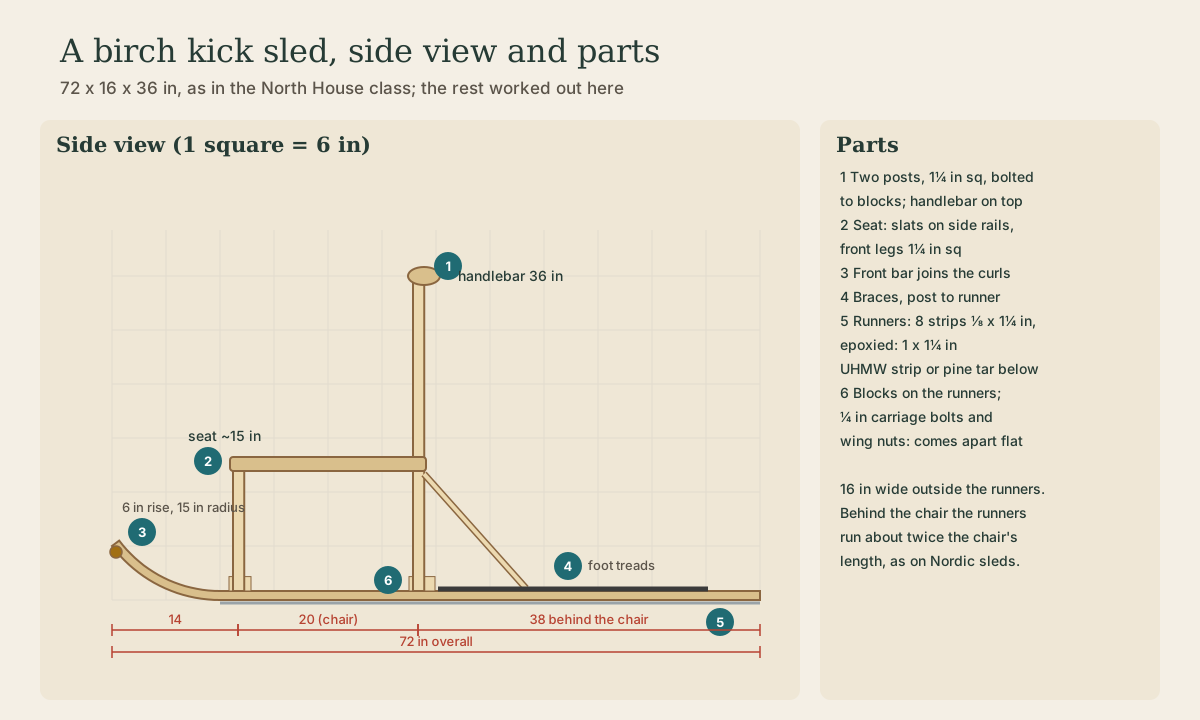
The class sled is 72 inches long 1. A runner that’s flat for 60 inches and curls up 6 inches at the front on a 15-inch radius takes 12 more inches of length for the curl, making 72 (this is geometry: the curl covers 53 degrees of arc and is 13.9 inches long, so the strips must be about 74 inches along the curve before trimming).
The form
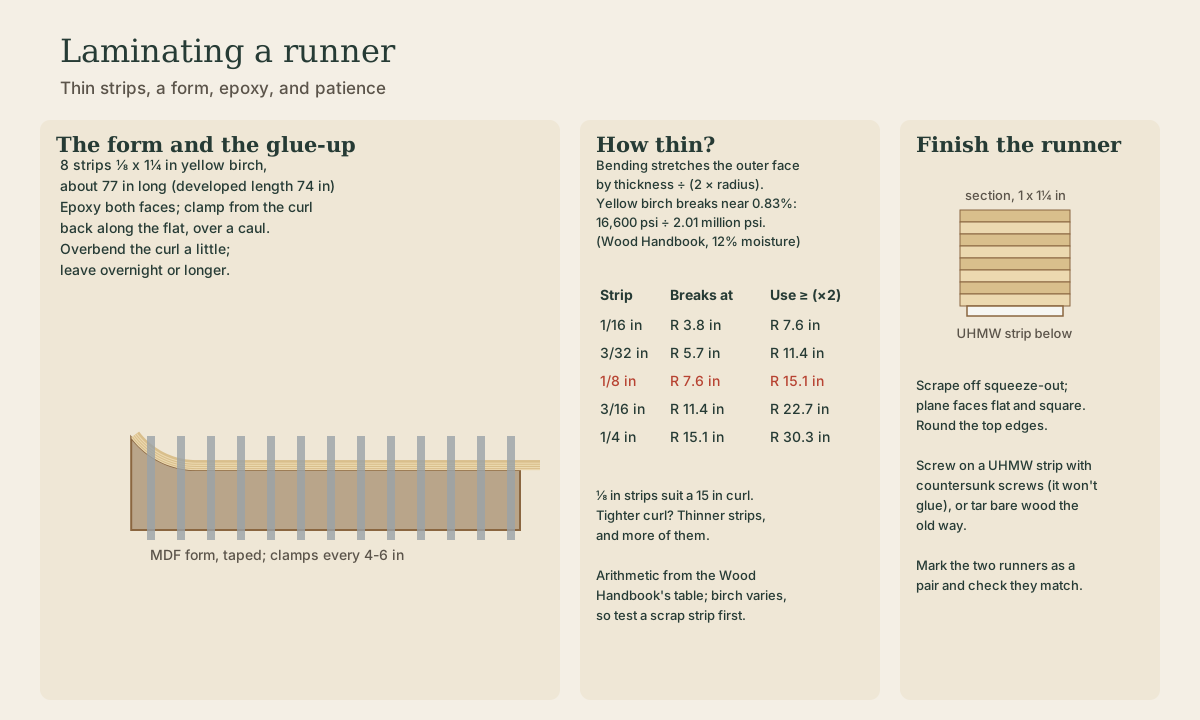
Make the form from 3/4-inch MDF stacked as thick as the runner is wide 2:
- Draw the curve on the first piece. A fair curve is easy with a thin strip of wood bent against a string or nails; the flat runs straight into it 2.
- Cut it with a jigsaw or bandsaw and file and sand it smooth. It’s the template for the rest 2.
- Screw and glue rough-cut pieces to the template one at a time and trim each flush with a router and flush-trim bit 2.
- Drill clamp holes through the form, or screw on clamping blocks, every 4 to 6 inches 2.
- Cover the face with packing tape so epoxy won’t stick.
How thin the strips
Bending a strip stretches its outer face by its thickness divided by twice the radius. Dry wood breaks at about the stretch its strength allows: for yellow birch at 12 percent moisture, a modulus of rupture of 16,600 psi over a stiffness of 2.01 million psi 3, about 0.83 percent (arithmetic from the Wood Handbook’s table).
| Strip | Breaks at radius | With a factor of 2 |
|---|---|---|
| 1/16 in | 3.8 in | 7.6 in |
| 3/32 in | 5.7 in | 11.4 in |
| 1/8 in | 7.6 in | 15.1 in |
| 3/16 in | 11.4 in | 22.7 in |
| 1/4 in | 15.1 in | 30.3 in |
So 1/8-inch strips suit the 15-inch curl. Eight of them make a runner 1 inch tall. That’s why lamination works: thin strips bend with only moderate stress and no steam, give stronger bends than single pieces, and change shape less with moisture 4. Birch varies, so bend a scrap strip around the form dry before you rip them all.
Quick check
The stretch is thickness divided by twice the radius, so halving the strip halves the strain.
Rip the strips
From a 6/4 yellow birch board, planed to 1 1/4 inches, rip strips a little over 1/8 inch off the edge, so each strip is 1/8 by 1 1/4 inches. Sixteen strips and a few spares take about 5 inches of board width. Run them through a planer on a carrier board or a drum sander to an even thickness. Keep them in order; strips that came from side by side bend alike.
Glue and clamp
- Rehearse dry. Clamp a stack of eight to the form with a caul strip on top, starting at the curl and working back along the flat. Professional rail benders bend dry first and leave it overnight 5.
- Spread epoxy on both faces of every strip except the outside faces. Epoxy needs only low pressure and fills small gaps 6.
- Clamp the stack the same way, curl first, every 4 to 6 inches.
- Overbend the curl very slightly by packing the tip; laminations spring back a little when released 5.
- Leave it overnight at room temperature, longer if cool. A hard glue like epoxy or plastic resin doesn’t creep, so the bend holds 5.
Do both runners from the same form, so they match.
Playback is optional. If the player is unavailable, open the video at its source.
Quick check
Ordinary PVA is rated for interior use, and hard glues resist the slow creep that lets a bend open up.
Clean up
Scrape off squeeze-out, then plane both faces flat and square and the top edges round. Lay the two runners side by side and check the curls match.
The bottom
- UHMW strip: a very low-friction, abrasion-resistant plastic 7. It doesn’t bond well 7, so screw a 1/8-by-1-inch strip to the bottom with countersunk stainless screws every 6 inches.
- Tar: old wooden runners were iron-shod or boiled in tar to glide in hard cold 8. Heat pine tar into bare birch as on the birch skis in module 6, and renew it each season.
Try it
Rip one spare strip and bend it by hand around a paint can, then a bucket, then a trash can. Watch where it starts to crackle on the outside. That’s the table above in your hands.
Lesson complete
Nice work.
Sources for this lesson
- 1Kick Sled Building: Push and Glide. North House Folk School. verifiedStudents craft a kick sled of birch, learning skills from laminating wood for the runners to shaping a customized handlebar for steering; hand and power tools. Up to two people per tuition; youth 8+ with an adult. Finished sled 72 in long, 16 in wide, 36 in high, and it collapses for transport.
- 2How to Build a Sled. Mother Earth News. verifiedCurved runners by bent lamination: thin strips glued together to a curve; lots of clamps and glue, but easier and safer than steam bending. Ash bends well; red or white oak also work. Form of stacked 3/4 in MDF strips, the curve drawn with a bent batten and string, the first piece cut and faired as a template and the rest flush-trimmed to it with a router; clamp holes drilled through the form.
- 3Wood Handbook: Wood as an Engineering Material (FPL-GTR-190). USDA Forest Service, Forest Products Laboratory (copy hosted by California Air Resources Board). 2010. verifiedTable 5-3b, clear wood at 12% MC (SG / MOR psi / MOE Mpsi / work to max load in-lbf/in3): American elm 0.50 / 11,800 / 1.34 / 13.0; rock elm 0.63 / 14,800 / 1.54 / 19.2; slippery elm 0.53 / 13,000 / 1.49 / 16.9; white ash 0.60 / 15,000 / 1.74 / 16.6; shagbark hickory 0.72 / 20,200 / 2.16 / 25.8; sugar maple 0.63 / 15,800 / 1.83 / 16.5; yellow birch 0.62 / 16,600 / 2.01 / 20.8; paper birch 0.55 / 12,300 / 1.59 / 16.0. Table 13-1: outdoor EMC at Madison, Wisconsin 12.5-15.7% by month; Table 13-2: interior wood about 8% (6-10%).
- 4Rebecca E. Ibach. Specialty Treatments (Chapter 19). USDA Forest Service, Forest Products Laboratory (Wood Handbook, FPL-GTR-190). 2010. verifiedSteam or boil about 15 min/cm (38 min/in) of thickness at 20-25% moisture content, 30 min/cm (75 min/in) for drier wood. Plasticized wood compresses 25-30% parallel to the grain but stretches only 1-2%; bends needing more than about 3% difference between outer and inner faces need a metal strap with end fittings. Birch, ash, hickory, oak are good bending species. Cool and dry the piece held in shape. Laminated members: dry laminations bent without end pressure against a form and bonded in one operation; bending thin laminates needs only moderate stress, no steam, and gives stronger members than single-piece bends; laminated bends change shape less with moisture; thickness-to-radius ratios impossible in single pieces are easy; any length can be made.
- 5Gluing and Clamping a Curved Laminated Stair Rail. WOODWEB Knowledge Base. 2006. verifiedProfessional rail benders: a hard glue (plastic resin or epoxy) is best, less for initial springback than because it doesn't creep. Bend the laminations dry first and leave overnight, then glue and re-bend and leave on the form about three days; overbend slightly to allow for springback.
- 6Charles R. Frihart, Christopher G. Hunt. Adhesives with Wood Materials: Bond Formation and Performance (Chapter 10). USDA Forest Service, Forest Products Laboratory (Wood Handbook, FPL-GTR-190). 2010. verifiedTable 10-2: phenol-, resorcinol-, and melamine-formaldehyde and isocyanates are structural and fully exterior; epoxy and polyurethane structural for limited exterior (short-term soaking); urea-formaldehyde interior; cross-linked PVA semistructural limited exterior; ordinary PVA nonstructural interior. Epoxy: two parts mixed by the user, limited pot life, cures at room temperature, needs only low pressure, high dry and wet strength, gap-filling; used for laminating boat hulls, architectural railings, and sports equipment; delaminates with repeated wetting and drying.
- 7Ultra-high-molecular-weight polyethylene. Wikipedia. verifiedVery low coefficient of friction, self-lubricating, highly resistant to abrasion, extremely low moisture absorption, resistant to most chemicals. It doesn't absorb water or wet easily, which makes bonding it difficult.
- 8Sparkstötting. Wikipedia (Swedish). verifiedTwo runners, usually steel, joined at the front by a bar; a chair on top, traditionally wooden, with a handlebar at the top of the back; the runners continue behind the chair about twice as far. You stand on one runner and kick with the other foot. Only on ice or hard-packed snow, not sanded or salted roads; 15-20 km/h comes easily; used for ice fishing. Grew from the drög, a short load sled with uprights. Generally held to have been invented in upper Norrland in the later 1800s, though Stockholm reports go back to the late 1700s. Early sleds: long runners with an upright stake each, joined by a seat; runners iron-shod or tarred to glide in hard cold; wooden runners could split in sharp turns. Orsasparken, 1909, Erik Timander and Anders Bertas, had patented spring-steel runners with an inverted-T profile at the front that doesn't cut into loose snow.