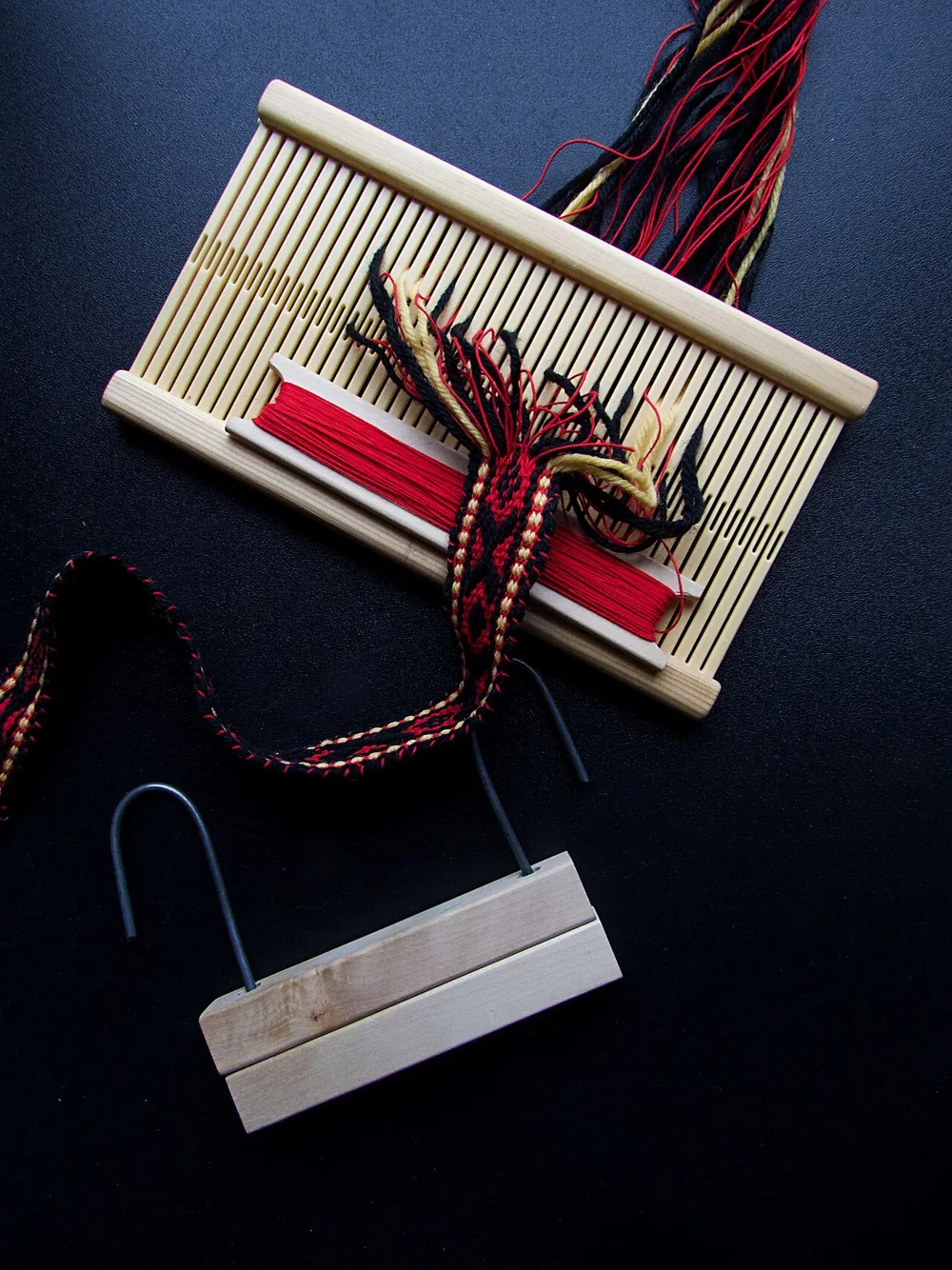
Band Weaving and What to Buy
North House's two-day pick-up band class woven backstrap style on a grindvev. The band heddle in Norwegian and Sámi life, the bands it made, heddles, shuttles, cotton and wool with suppliers, and a two-day plan toward a band of three to six feet.
- 3 min
- 5 steps
- 2 questions
- Lesson 193 of 204
In this lesson
- The band heddle
- The bands
- What to buy
- Try it
Picking up where you left off.
What you need
| Have it | Material | Spec | Qty | Where to get it |
|---|---|---|---|---|
| Band heddle | A rigid band heddle (grindvev) with holes and slots, about 6 1/2 in wide; one with pattern slots for pick-up | 1 | Vävstuga Weaving School (store) | |
| Ground yarn | 8/2 cotton, natural or white | 1 tube (1,680 yd) | The Woolery | |
| Pattern yarnPattern ends should be at least twice as thick as the ground. | Thicker wool in red or another strong color, such as Möbelåtta 8/2 | 1 skein (100 g) | Vävstuga Weaving School (store) | |
| Belt shuttle | A flat shuttle with a sharp edge for beating | 1 | Vesterheim store or the Woolery | |
| Band lock and pick-up stick optional | A band lock to hold the woven end; a thin pick-up stick | 1 each | Vävstuga Weaving School (store) |
Tools
Checkmarks are saved on this device.
The plan
-
Day 1 morning
A plain band
- The heddle and its history
- Wind a short plain-weave warp of 8/2 cotton
- Thread holes and slots; tie to a post and your belt; weave
-
Day 1 afternoon
A pick-up warp
- Wind a warp with thick pattern ends
- Start pick-up from a chart
-
Day 2
The band
- Weave a band 36-72 in long
- Try picking in pairs and around a center thread
- Design your own chart; finish the ends
This module reconstructs North House Folk School’s two-day Scandinavian (Pick Up) Band Weaving with Caroline Feyling: patterned bands woven “backstrap style on a grindvev (band heddle),” a sample and then a band of 36 to 72 inches, with the goal to “design, set up, and weave pickup bands independently” 1. The class plan isn’t published; this follows the sources cited.
The band heddle
The grindvev, also båndgrind or hoppeskei, is a plate with slots and holes; alternate warp ends go through a hole and a slot, and the number of them sets how wide the band can be. Heddles were made of bone, horn, or wood and were a traditional courting gift: keeping one meant accepting the suitor. They wove bunad bands and most Sámi bands, and probably reached the Nordic countries in the Middle Ages 2. A heddle is usually 12 to 24 cm high and about as wide, often chip-carved; the shed is made by lifting or lowering it 3.

Quick check
Alternate warp ends go through a hole and a slot.
Quick check
She might weave him stocking bands in return.
The bands
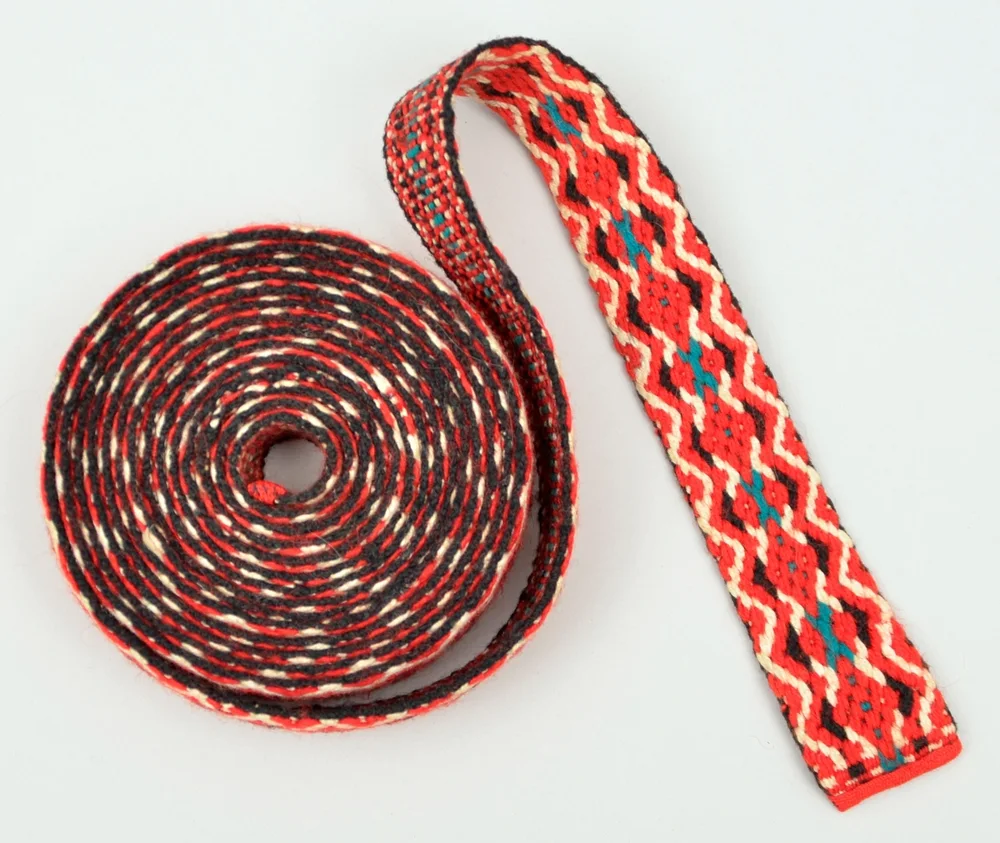
Bands tied hair, stockings, and babies. Hallingdal hairbands had a red wool pattern on unbleached cotton, 0.75 to 1.5 cm wide and about 3.7 m long 4. Bands were swaddling bands, stocking bands, belts, and suspenders, and in Nord-Østerdalen were sewn together into pillow covers 5. A Nordfjord swaddling band, woven on a heddle with the pattern picked up, is 372 cm long and 3.7 cm wide 6.
What to buy
- Heddle: Vävstuga sells a cherry band heddle, 6 1/2 by 3 1/2 inches and taking 59 ends, for $40; heddles with extra pattern slots from $50; a band lock, a band knife, and a pick-up stick 7.
- Ground: 8/2 cotton, 1,680 yards to a $9 tube 8.
- Pattern: a thicker wool. Heather Torgenrud’s hairband uses red Möbelåtta 8/2 wool for pattern ends on an 8/2 cotton ground 4; Vävstuga sells Möbelåtta 9.
Try it
Thread a dozen lengths of yarn through the heddle, alternating hole and slot, tie the ends together, and lift and lower the heddle. Watching the two sheds open is the whole mechanism.
Lesson complete
Nice work.
Sources for this lesson
- 1Scandinavian (Pick Up) Band Weaving. North House Folk School. verifiedCaroline Feyling, Apr 19-20, 2027, 9-5; tuition $230, materials $40. Patterned bands woven 'backstrap style on a grindvev (band heddle)'; a sample and a band 36-72 in; goal: 'design, set up, and weave pickup bands independently'; tool kit provided.
- 2Eivind Falk. Grindvev. Store norske leksikon. 2025. verifiedAlso båndgrind or hoppeskei: a plate with slots and holes; alternate warp threads go through hole and slot, and the number sets the band's width; of bone, horn, or wood. Used for bunad bands and most Sámi bands; a traditional courting gift: keeping it meant accepting the suitor. Oldest surviving examples Italian; in the Nordic countries probably from the Middle Ages.
- 3Båndgrind. Store norske leksikon. verifiedUsually 12-24 cm high and as wide; the shed is made by lifting or lowering the heddle; often decorated with chip carving.
- 4Heather Torgenrud. A New Book on Pick-up Bandweaving. Norwegian Textile Letter. 2014. verifiedBand heddle vs spaltegrind (extra slots for pattern ends). Hallingdal hairbands: red wool pattern on unbleached cotton, 0.75-1.5 cm wide, about 3.7 m long. Her hairband: 37 ends = 11 pattern ends of red Möbelåtta 8/2 wool + 24 background of 8/2 cotton + 2 red selvedge ends, natural cotton weft, 1/2 in wide. An even number of pattern ends is picked in pairs; an odd number gives a center pivot.
- 5Randi Hole. Plukkbånd på grindvev. Norges Husflidslag. 2023. verifiedA pick-up band of 37 ends with 9 pattern ends: edges of rust wool and green linen 16/2, ground of yellow linen 16/2, pattern of charcoal 2-ply wool embroidery yarn with a rose center thread, weft of green linen; warp the center thread first. Band pillows of Nord-Østerdalen; bands used as swaddling bands, stocking bands, belts, suspenders.
- 6Lindeband (NFM.2014-00039). Nordfjord Folkemuseum (DigitaltMuseum). verifiedSwaddling band 372 x 3.7 cm, 'vove på grind', the pattern picked up; black, red, and green wool and white cotton; 1800-1900. CC BY-SA.
- 7Band Looms and Heddles. Vävstuga Weaving School (store). verifiedBand heddle, cherry, 6.5 x 3.5 in, 59 ends, $40; heddles with pattern slots from $50; band lock from $20; band knife $30; pick-up stick $10; Torgenrud's book $25.
- 8Maurice Brassard Cotton 8/2. The Woolery. verified8/2 cotton, 1,680 yd per 8 oz tube, from $9.10. The Woolery also sells belt shuttles and Schacht and Ashford inkle looms.
- 9Bockens Möbelåtta 8/2 Wool. Vävstuga Weaving School (store). verifiedFirm 8/2 wool, 1,984 yd/lb, $18 per 100 g; Sätergläntan's rya class uses it as a wool warp.