Black Ash Splint Baskets
The Great Lakes and Northeast tradition of pounding black ash logs until the growth rings release as splints: choosing a basket tree, pounding, splitting and scraping, weaving a plaited basket over a form, and the emerald ash borer crisis threatening the material.
- 4 min
- 6 steps
- 3 questions
- Lesson 73 of 204
In this lesson
- The tradition
- Choosing a basket tree
- From log to splint
- Weaving a basket
- Emerald ash borer
- What to take from this
Picking up where you left off.
The tradition
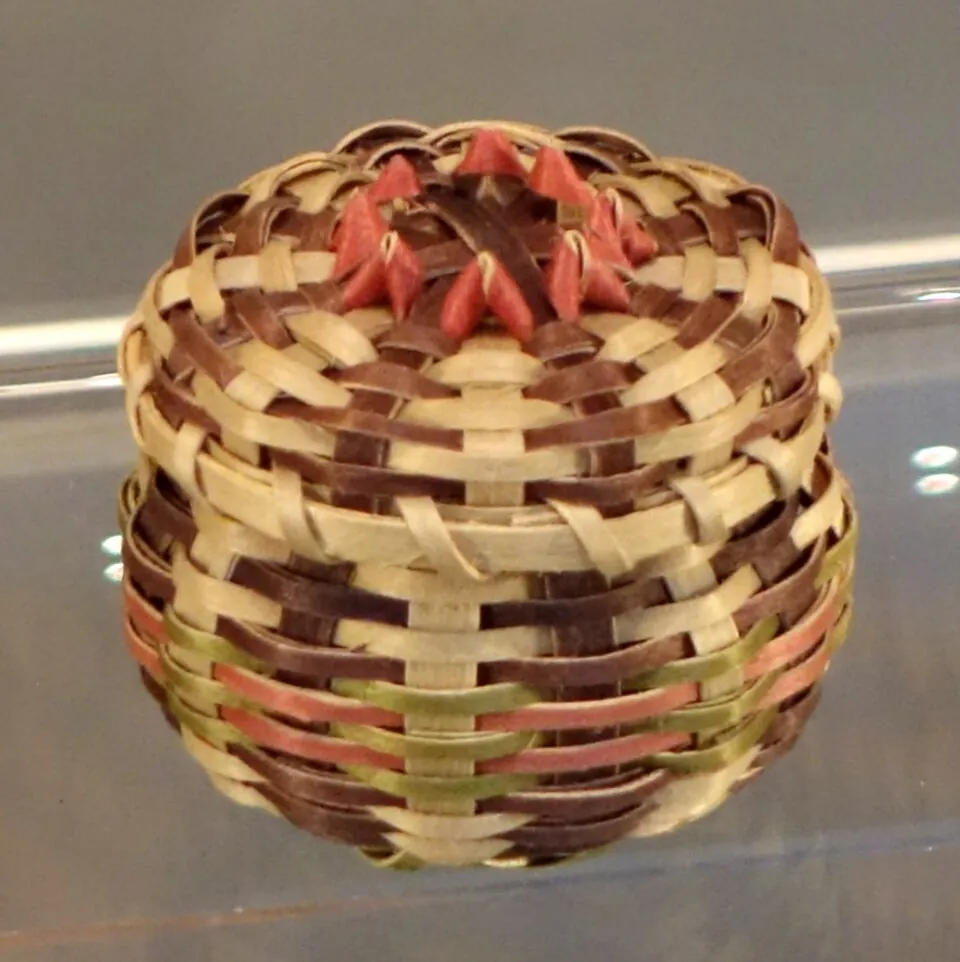
Black ash (Fraxinus nigra) grows in wet swamps and lowlands across the Great Lakes and the Northeast. For Anishinaabe (Ojibwe, Odawa, Potawatomi), Wabanaki (Penobscot, Passamaquoddy), and Haudenosaunee (Mohawk, Seneca) basket makers, it is the basket tree: pack baskets, berry baskets, and finely decorated “fancy baskets” with curls and twists 1. Harvest is often a family event passed down through generations.

Choosing a basket tree
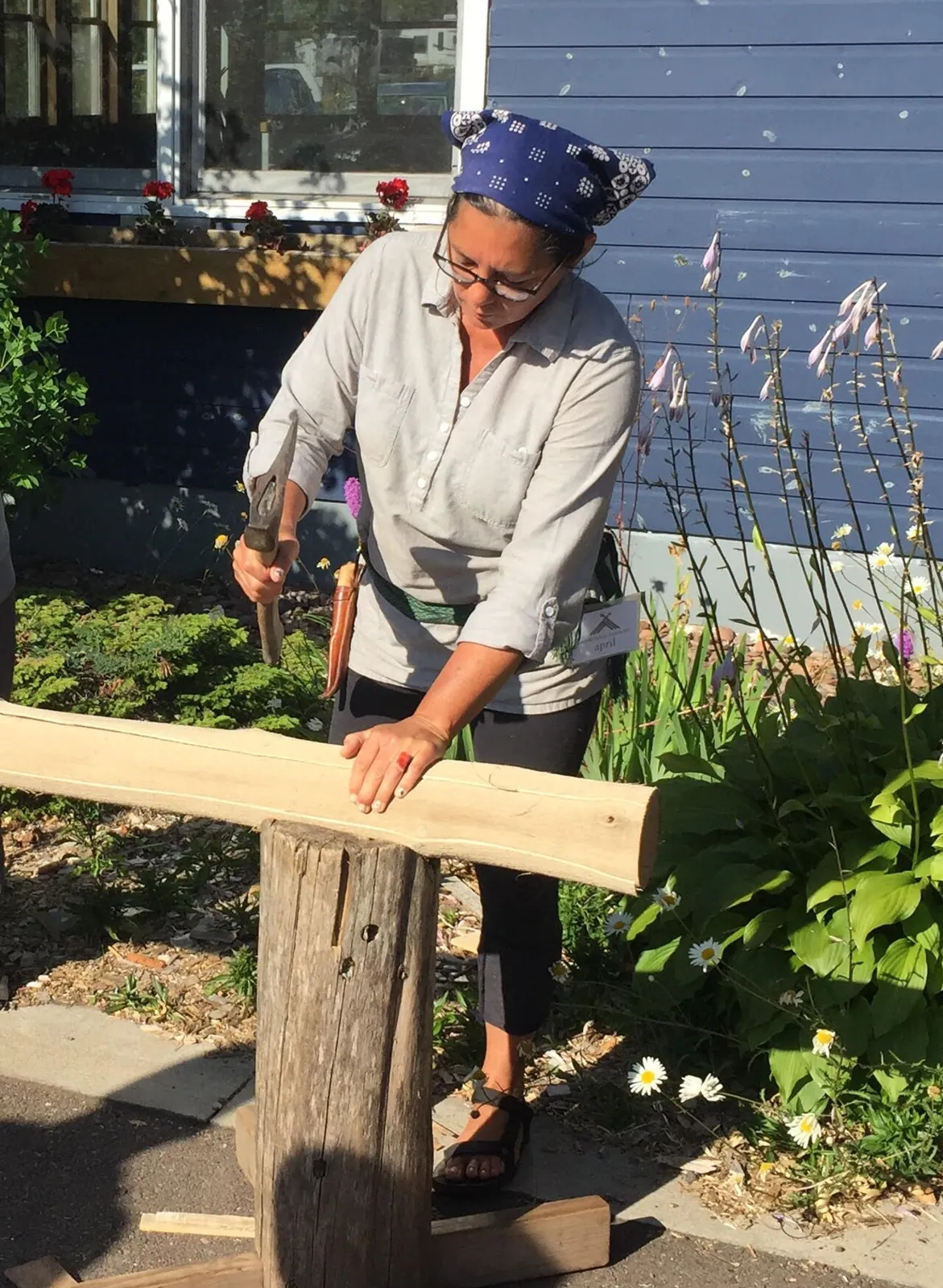
Makers look for basket-quality trees at least about 25 years old, straight, and free of knots, in the wet ground black ash likes - gatherers joke about losing boots to the muck 1. They check the growth rings by cutting a small wedge from the trunk: the rings need to be wide and even enough to make good splints 1.
From log to splint
- Fell and debark the log.
- Pound it along its length with the back of an axe or a maul. Black ash is ring-porous: each year’s soft, porous springwood crushes under the blows, so the denser summerwood of each ring lifts away from the next 1.
- Peel the loosened ring off in long strips, working around the log; a single log yields many layers.
- Split each thick strip into thinner splints by scoring and pulling apart, often through a wooden splitting tool; this reveals a rough face and a smooth face 1.
- Scrape the rough face smooth and cut splints to width with a gauge - a handle with set blades that cuts several even strips at once.

Darker heartwood and pale sapwood splints can be combined for color, and the thinnest splints are saved for curls on fancy baskets 1.
Playback is optional. If the player is unavailable, open the video at its source.
Quick check
Black ash’s ring-porous springwood crushes under pounding, letting each year’s ring lift away.
Weaving a basket
Splints are moistened to make them pliable before weaving 1.
- Base: lay wide stakes (spokes) in a crossed or parallel pattern and plait them together into a flat bottom.
- Upsett: bend the stakes up at the edge of the base, often around a wooden form (mold) that sets the basket’s shape.
- Sides: weave narrower weavers over and under the stakes, starting each row in a new place; an odd number of stakes, or a chase with two weavers, keeps the over-under pattern alternating row to row.
- Rim: cut the stakes, tuck alternate ones inside, and lash two hoops (inside and outside) over the top edge with a narrow splint.
- Decorative weaves, curls, and dyed splints make fancy baskets.
Perry’s 1917 Seat Weaving includes Native splint weaving for chair seats as well 2.
Playback is optional. If the player is unavailable, open the video at its source.
Emerald ash borer
The emerald ash borer, an invasive Asian beetle, has killed millions of ash trees across dozens of states and provinces; its larvae girdle trees under the bark for years before symptoms show 1. Black ash basketry depends on a tree that may largely disappear from the landscape.
Responses include education to stop the spread of infested firewood, collecting and freezing black ash seed for replanting, biocontrol with parasitic wasps, and adapting to materials like cedar and basswood 1. Forest Service researchers working with the Match-E-Be-Nash-She-Wish Band of Pottawatomi found that the traditional practice of storing logs underwater - for roughly 18 weeks in winter or 14 in spring - killed the larvae while keeping the logs usable 3.
Never move ash logs or firewood out of a quarantine area, and buy baskets directly from Native makers when you can.
Quick check
Makers are saving seed, supporting biocontrol, and adapting materials.
Quick check
Work with the Match-E-Be-Nash-She-Wish Band of Pottawatomi showed traditional knowledge doubling as pest control.
What to take from this
Black ash basketry belongs to Anishinaabe, Wabanaki, and Haudenosaunee makers. A straight, knot-free swamp ash is debarked and pounded until its growth rings separate; the strips are split, scraped, and gauged into splints, then plaited into a base, upset around a form, woven with alternating rows, and finished with lashed hoops. The emerald ash borer threatens the tree, and traditional underwater log storage turns out to kill the larvae.
Lesson complete
Nice work.
Sources for this lesson
- 1Anne Bolen. A Silent Killer: Black Ash Basket Makers are Battling a Voracious Beetle to Keep Their Heritage Alive. American Indian Magazine (Smithsonian National Museum of the American Indian). 2020. verifiedBasket-quality trees at least 25 years old, straight and knot-free; logs pounded to separate growth rings, splints scored and split; Anishinaabe, Wabanaki, and Haudenosaunee makers; emerald ash borer responses.
- 2L. Day Perry. Seat Weaving. The Manual Arts Press. 1917. verifiedPublic-domain manual on the seven steps of caning, cane webbing, rush seating (cattail and flag gathered in August, twisted strands, stuffing, filling rectangular and irregular seats), and reed and splint seats.
- 3Therese Poland and team publish study on basket-makers' traditional practices effects on emerald ash borer. Michigan State University College of Agriculture and Natural Resources. verifiedUSDA Forest Service researchers and the Match-E-Be-Nash-She-Wish Band of Pottawatomi found that the traditional practice of submerging black ash logs (about 18 weeks in winter or 14 in spring) killed emerald ash borer larvae.