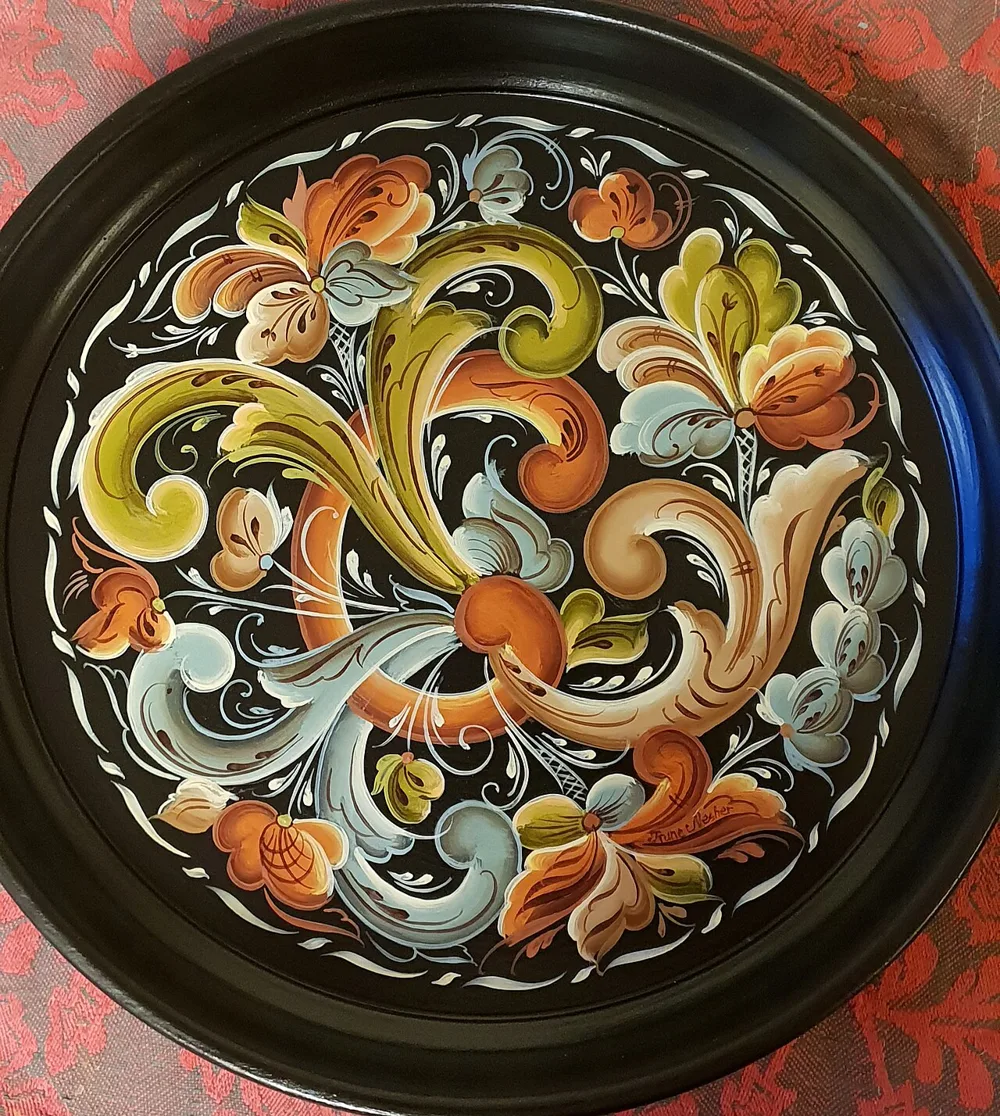
Rosemaling and What to Buy
Vesterheim's Telemark class paints a 16-inch scooped bowl after a piece in the Norsk Folkemuseum, and its Os class paints a tray. Where rosemaling comes from, how Telemark and Os differ, basswood woodenware, brushes, oils, mediums, and palettes with suppliers, and a plan for the class.
- 3 min
- 6 steps
- 2 questions
- Lesson 184 of 204
In this lesson
- Where rosemaling comes from
- Telemark and Os
- Woodenware
- Paint, brushes, and medium
- Try it
Picking up where you left off.
What you need
| Have it | Material | Spec | Qty | Where to get it |
|---|---|---|---|---|
| Woodenware | Basswood scoop plate or shallow bowl, 16 in (or 12 in to start) | 1, plus a practice board | Vesterheim Store | |
| Oil paintsFor Os, North House lists Cadmium Yellow Light and Deep, Thalo Blue, Crimson, Cadmium Red Light, Titanium and Zinc White, Ivory Black. | Telemark earth palette: Prussian Blue, Venetian Red, Yellow Ochre, Burnt Sienna, Burnt Umber, Terre Verte, Titanium White, Ivory Black | One 40 ml tube each | North House Folk School | |
| Medium and thinner | Walnut alkyd medium and odorless mineral thinner | 1 small bottle each | North House Folk School | |
| Background paint and sealer | Wood sealer; dark acrylic for the ground (blue, red, green, or black) | 1 small bottle each | Vesterheim Store | |
| Varnish | A satin or matte varnish for the finished piece | Small can | Art or hardware store | |
| Transfer supplies | Tracing paper and graphite transfer paper | 1 pad and 1 sheet | Vesterheim Store |
Tools
Checkmarks are saved on this device.
The plan
-
Thursday evening
Woodenware and background
- Sand and seal the plate or bowl
- First background coat; paint a practice board
-
Day 1
Strokes
- The style and the museum piece
- Second background coat
- Mix the palette; drill C-strokes, S-strokes, teardrops on the board
-
Day 2
Paint the design
- Transfer the design
- Paint the under-elements, then flowers and leaves, thin and transparent
-
Day 3
Liner work
- Outlines, highlights, tendrils, and border
- Erase transfer lines; sign and date
- Varnish at home when dry
This module reconstructs two Vesterheim Folk Art School classes. Nancy Odalen’s Telemark-Style Rosemaling starts on a Thursday evening “to give you time to purchase your wooden wear and paint the background,” then paints “a 16" scooped bowl using a Telemark design that is inspired by a piece found in Norway at the Norske Folk Museum in Oslo,” mainly flowers with “the lovely asymmetrical flow that typically represents Telemark” 1. Nancy Schmidt’s Rosemaling in the Os Style paints an Os tray and encourages students to design their own 2. Vesterheim’s online fundamentals class drills “the flowing C- and S-strokes, teardrops, scrolls, and leaves” 3. The class plans aren’t published; this follows the sources cited.
Where rosemaling comes from
Rosemaling is the rural decorative painting of 1700s and 1800s Norway, done by craftsmen outside the guilds, strongest in Hallingdal and Telemark. From the 1760s rococo C-forms produced a playful, asymmetrical style that fills fields of any shape freely, with bold, free brushwork. The Telemark masters include Ola Hansson, Thomas Luraas, Knut Mevasstaul, and Hans Glittenberg. Painters bought pigments as sticks or stones, ground them by hand, and bound them in linseed oil 4.
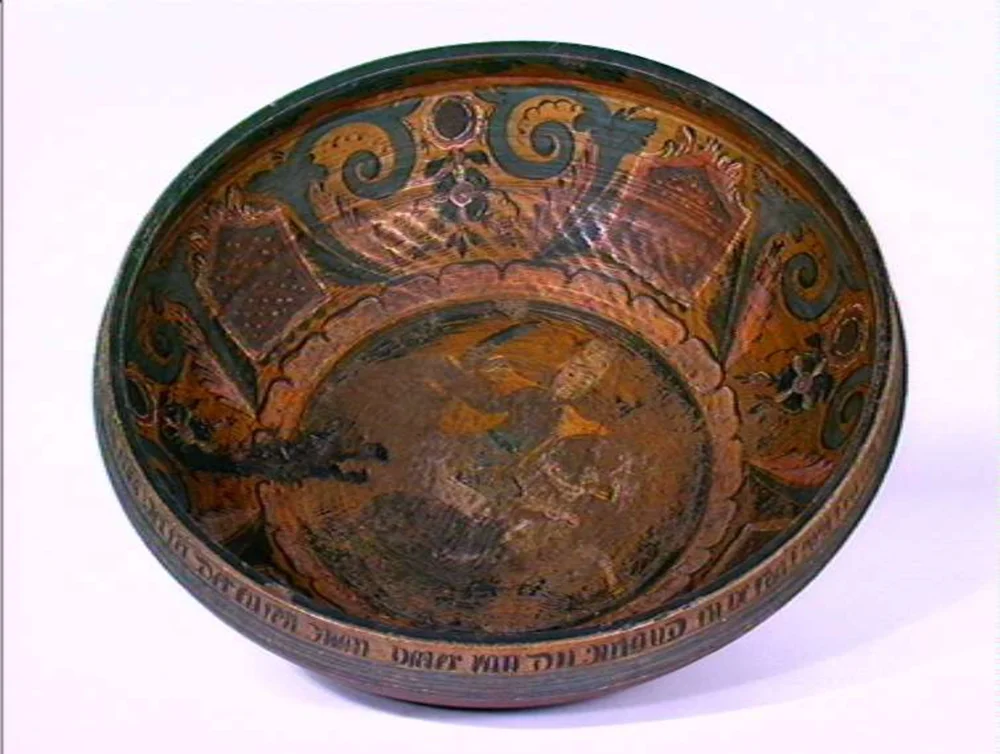
Hansson’s ale bowl of 1788 at the Norsk Folkemuseum is 63 cm across 5.
Telemark and Os
Telemark: motifs aren’t symmetrical; leaves and flowers spring or wind out of a scroll, in colors more transparent than dense 6. It is “one of few asymmetrical rosemaling styles, characterized by scrolls and branches spanning out from a root center”; transparent Telemark uses paint “thin enough to see through,” and American Telemark works “wet-on-wet” with “whiplash movements of the brush” 7.
Os, from Hordaland south of Bergen 2: fewer flowers and more leafwork, symmetrical or not, often with geometric forms, on red, black, or white grounds 6. Mary Schliep describes abstracted flowers, “heavy line-work for veins,” and “less dimensional” shading 8.

Quick check
It grew from rococo C-forms in the later 1700s.
Quick check
Os designs can be symmetrical or asymmetrical, often on black, white, or red grounds.
Woodenware
Vesterheim’s store sells basswood scoop plates from 6 to 16 inches (the 16-inch is $21) and shallow 16-inch bowls ($40) 9. Start on a 12-inch plate if this is your first piece.
Paint, brushes, and medium
North House’s shaded Telemark class paints in oils with a palette of Ivory Black, Titanium White, Venetian Red, Prussian Blue, Burnt Sienna, Burnt Umber, Terre Verte, Raw Sienna, Caput Mortuum, and Yellow Ochre, with #2 liner and #2 and #4 filbert brushes 10. Its Os class adds brighter colors, Cadmium Yellow Light and Deep, Thalo Blue, Crimson Lake or Alizarin, and Cadmium Red Light, noting “these paints are not typical Rosemaling colors,” with a #1 liner, #2 to #6 filberts, walnut alkyd medium, and odorless thinner 11. In 1964 Gladys Fossum of Racine suggested Prussian blue, vermilion, cadmium yellow, burnt umber, burnt sienna, black, and white, with sable brushes in sizes 1 and 3 or 4 12.
Try it
Paint a practice board with two coats of dark acrylic now: masonite or heavy cardboard about 12 by 15 inches, as North House uses 10. You’ll fill it with strokes in lesson 2 before touching the plate.
Lesson complete
Nice work.
Sources for this lesson
- 1Telemark-Style Rosemaling. Vesterheim Folk Art School. verifiedNancy Odalen, August 21-23, 2026, 9-5, advanced beginner through advanced; starts Thursday evening 'to give you time to purchase your wooden wear and paint the background.' Project: 'a 16" scooped bowl using a Telemark design that is inspired by a piece found in Norway at the Norske Folk Museum in Oslo'; the design 'is mainly flowers and lacks the Telemark scrolls' but has 'the lovely asymmetrical flow that typically represents Telemark.' Students visit the Vesterheim collection.
- 2Rosemaling in the Os Style. Vesterheim Folk Art School. verifiedNancy Schmidt, June 25-28, 2026, intermediate and advanced. Os is from the west coast of Norway south of Bergen in Hordaland, with a bright color palette; the class covers the elements of Os design and paints an Os-style tray, woodenware characteristic of the area; students are encouraged to design their own.
- 3Fundamentals of Telemark Style Rosemaling (online). Vesterheim Folk Art School. verifiedLise Lorentzen, three Thursdays Jan 21-Feb 4, 2027, on Zoom, $180-200 with a kit of paints, brushes, and bristol boards; brush control, paint consistency, and 'the flowing C- and S-strokes, teardrops, scrolls, and leaves.'
- 4Mats Linder. Rosemaling. Store norske leksikon. 2026. verifiedRural decorative painting of the 1700s-1800s by craftsmen outside the guilds, strongest in Hallingdal and Telemark; from the 1760s rococo C-forms gave 'en lekende, asymmetrisk stil som tvangløst fyller felter av enhver form'; brushwork 'djerv og fri'. Telemark masters Ola Hansson, Thomas Luraas, Knut Mevasstaul, Hans Glittenberg. Pigments bought as sticks or stones, ground by hand and bound in linseed oil; rust-red from bog earth. Vesterheim holds courses.
- 5Ølbolle (NF.1992-0299). Norsk Folkemuseum (DigitaltMuseum). verifiedAle bowl dated 1788 by Olav (Ola) Hansson, Telemark; 63 cm across, 21 cm high. CC BY-SA.
- 6Rosemaling. Norwegian Wikipedia (Bokmål). verifiedTelemark: motifs not symmetrical; leaves and flowers spring or wind out of a scroll; colors more transparent than dense. Os, from Hordaland: fewer flowers and more leafwork, symmetrical or asymmetrical, often with geometric forms; grounds often red, black, or white; clear, transparent colors.
- 7A Style of Their Own: Upper Midwestern Rosemalers. UW-Madison Nordic Folklife. verifiedTelemark is 'one of few asymmetrical rosemaling styles, characterized by scrolls and branches spanning out from a root center'; transparent Telemark uses paint 'thin enough to see through'; American Telemark uses 'wet-on-wet application of paint and whiplash movements of the brush'.
- 812" Os Rosemaled Plate #2 by Mary Schliep. North House Folk School store. verifiedOs: 'Flowers are abstracted and the use of geometric shapes is a hallmark of this style. Leaves have a characteristic use of heavy line-work for veins, and shading is less dimensional. Designs can be symmetrical or asymmetrical.' Backgrounds often black or white, occasionally red, green, or blue. Pronounced 'Oose.'
- 9Scooped Basswood Plates (Montzka). Vesterheim Store. verifiedBasswood scoop plates 6-16 in; the 16 in is $21. The store also sells shallow basswood bowls (16 in $40), Rosemary & Co. and Princeton brushes, Rembrandt oils, Jo Sonja acrylics, sealer and glaze medium, graphite transfer paper, and Telemark and Os pattern books.
- 10Rosemaling: Shaded Telemark Style Traditions. North House Folk School. verifiedMary Schliep and Kim Garrett. Brushes #2 liner and #2/#4 filberts. Palette: Ivory Black, Titanium White, Venetian Red, Prussian Blue, Burnt Sienna, Burnt Umber, Terre Verte, Raw Sienna, Caput Mortuum, Yellow Ochre, optional Cadmium Red Light. Practice board of masonite or cardboard with two coats of dark acrylic (blue, red iron oxide, black, or dark green) and matte spray varnish; tracing and transfer paper, palette knife.
- 11Rosemaling: Os Style. North House Folk School. verifiedKim Garrett, in oils. Brushes: #1 liner; #2, 4, 6 filberts (Princeton Velvetouch or Heritage, or Blick Masterstroke). M. Graham Walnut Alkyd Medium; odorless thinner. Os palette: Cadmium Yellow Light, Cadmium Yellow Deep, Thalo Blue, Crimson Lake or Alizarin Crimson, Cadmium Red Light, Titanium White, Zinc White, Ivory Black; 'These paints are not typical Rosemaling colors.' Woodenware $25-45.
- 12Gladys H. Fossum. Rosemaling: History, Instructions, and Designs. Gladys H. Fossum, Racine, Wisconsin. 1964. verifiedOld line work used brushes of a few squirrel-tail hairs; red, yellow, and green with black and white were the common colors. Suggested tubes: Prussian blue, vermilion, cadmium yellow, burnt umber, burnt sienna, black, white; pure sable brushes sizes 1 and 3 or 4. 'Outline one side of a leaf or petal with black, highlight the main color with white'; burnt umber and sienna in red give old rusty reds. Seal the wood with shellac, sealer, or varnish, sand, then paint one, two, or more background coats; red and green were common old grounds; transfer with carbon; varnish to finish.