Norwegian Acanthus Carving
How a Mediterranean leaf became Norway's signature carving: Baroque acanthus arriving in the 17th century, rural carvers like Jakob Klukstad in Gudbrandsdalen, painted instead of gilded, its link to rosemaling, the Norwegian-American revival, and carving the basic acanthus forms.
- 4 min
- 6 steps
- 3 questions
- Lesson 21 of 204
In this lesson
- From the Baroque to the valleys
- Carving and painting
- The acanthus forms
- Carving a leaf
- Try it
- What to take from this
Picking up where you left off.
From the Baroque to the valleys
The acanthus is a Mediterranean plant whose leaves ancient Greek stone carvers used on column capitals. Refined in the Baroque period, the motif reached northern Europe in the 17th century and became prominent in Scandinavian woodcarving in the 18th and 19th centuries 1.
In Norway it moved from church furnishings into the valleys. Jakob Klukstad (1705-1773), a self-taught carver and painter on the Klukstad farm in Lesja, influenced many carvers in Gudbrandsdalen; his altarpiece at Lesja Church (1742-45) and pulpit and altarpiece at Heidal Church (1753-54) are covered in continuous vines and large-leaved acanthus 2.
City carvings were usually gilded. Rural carvers didn’t have ready access to gold leaf, so they painted their carvings in the bright colors of traditional dress 3.
Quick check
City work was typically gilded.
Quick check
His altarpieces at Lesja (1742-45) and Heidal (1753-54) are his best-known work.
Carving and painting
Rosemaling is in a sense the two-dimensional counterpart of acanthus carving: its C and S curves come from Baroque and Rococo acanthus 3. Rosemaling flourished from the 1700s to the mid-1800s and declined as factory goods became cheap 3. In the U.S., Vesterheim in Decorah began exhibiting rosemaling in the late 1960s and brought Norwegian rosemalers over to teach, fueling a revival that peaked from the 1960s to the 1980s 3. Folk schools still teach it, including North House in Grand Marais 1.
Quick check
Both grew from Baroque and Rococo ornament.
The acanthus forms
An acanthus design is a scroll with leaves growing from it:
- The stem: a flowing C or S curve, the spine of the design.
- Leaves: each wraps around the stem and divides into lobes, with the tips rolling over toward or away from you.
- Overlap: leaves pass over and under each other and the stem; that layering is what gives acanthus depth.
- Flow: everything grows outward from a source, usually at the bottom or center, and the curves never break abruptly.
Learning acanthus means practicing the standard forms on blanks before designing your own 1. Copy a traditional leaf until the cuts are automatic.
Carving a leaf
- Draw the scroll and leaves full size, then transfer them.
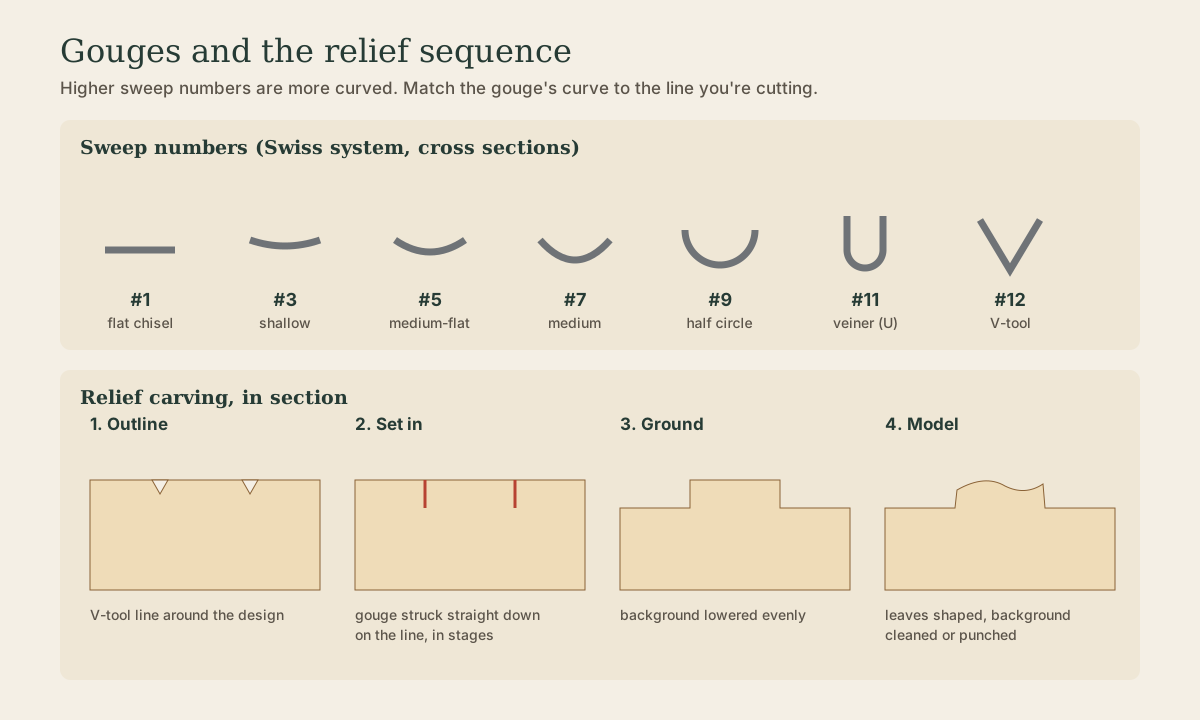
- Outline and set in around the whole design, then ground the background (see Gouges and Relief Carving).
- Rough the levels: decide what’s on top at each crossing and lower whatever passes underneath.
- Shape each lobe: hollow the lobe with a medium gouge, roll its edge, and let the tips curl. Use gouges that match each lobe’s curve; much of acanthus is the gouge’s own shape, stamped and sliced.
- Veins with a veiner, following the leaf’s flow back to the stem.
- Finish: oil, or paint in the rural manner with linseed oil paint (see Making Linseed Oil Paint in Traditional Paints).
Playback is optional. If the player is unavailable, open the video at its source.
Typical projects are plate shelves, candleholders, bread boards, and box lids 1.
Try it
Draw a single C-scroll with three leaves on a 6 x 10 in. basswood panel. Carve it in relief 3/16 in. deep, with at least one leaf overlapping the stem. Then paint one copy in rural colors and oil another, and compare.
What to take from this
The acanthus leaf came from ancient and Baroque ornament to Norway in the 17th century, where rural carvers like Jakob Klukstad of Gudbrandsdalen made it their own and painted it instead of gilding it; rosemaling is its painted twin. An acanthus design is a flowing scroll with lobed, overlapping leaves; carve it with the relief sequence, deciding the layers first and letting matched gouges shape each lobe.
Lesson complete
Nice work.
Sources for this lesson
- 1Acanthus Relief Carving. North House Folk School. verifiedThe acanthus motif, used by ancient Greek stone carvers and refined in the Baroque, reached northern Europe in the 17th century and became prominent in Scandinavian carving in the 18th and 19th centuries; course carves standard acanthus forms on shelves, candleholders, and bread servers.
- 2Jakob Klukstad. Wikipedia. verifiedSelf-taught carver and painter (1705-1773) on the Klukstad farm in Lesja, Gudbrandsdalen; acanthus altarpieces and pulpits at Lesja (1742-45), Heidal (1753-54), Skjåk (ca. 1750), and Kors Church (1769).
- 3Rose-painting. Wikipedia. verifiedRosemaling as the two-dimensional counterpart of acanthus carving; rural carvers painted rather than gilded; flourished 1700s to mid-1800s; Vesterheim revival from the late 1960s.