Stave Construction
Norway's medieval timber-framed churches: why posts moved from the ground onto sill beams on stone, how staves, sills, and wall plates work, the 28 survivors including Borgund (about 1180), and the 1893 Norway Building that stood at Little Norway in Blue Mounds.
- 3 min
- 6 steps
- 3 questions
- Lesson 62 of 204
In this lesson
- From earth-fast posts to staves
- How the frame works
- The survivors
- A stave building in Wisconsin
- The idea for small buildings
- What to take from this
Picking up where you left off.
From earth-fast posts to staves
Early Scandinavian timber buildings set their posts straight into the ground. Those posts rotted. Archaeologists find their postholes beneath several stave churches - under Urnes, the remains of two earlier churches 1.
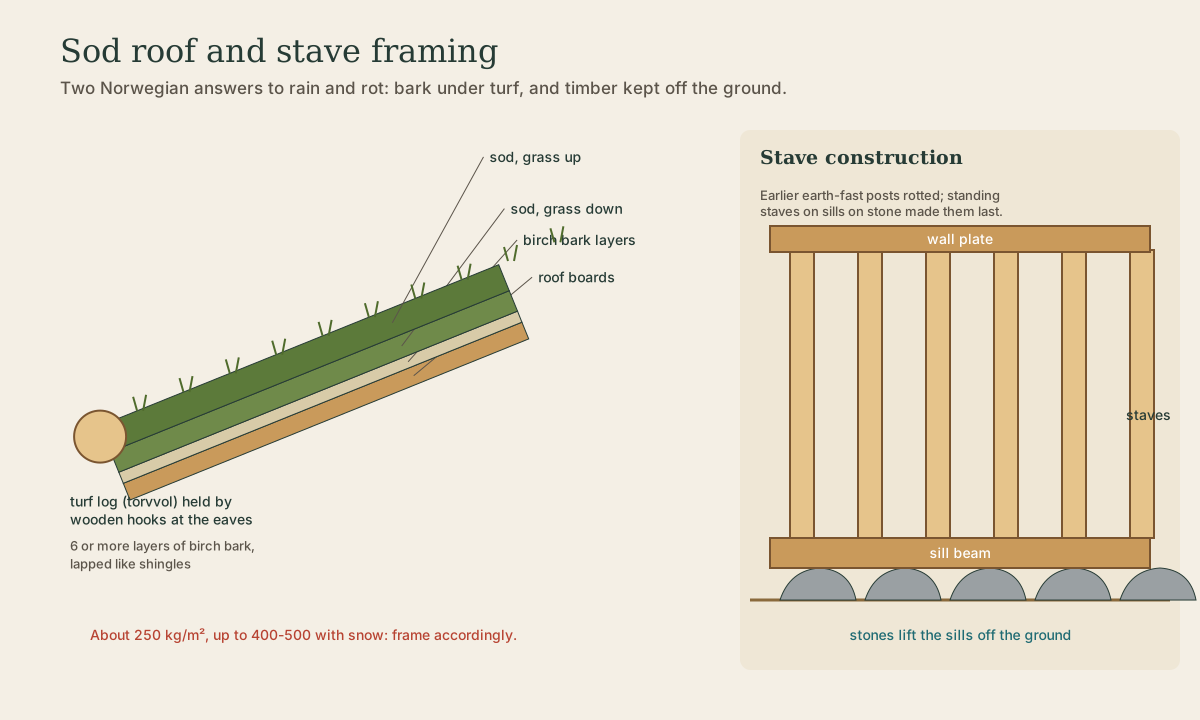
The stave church solved the problem by lifting the frame: vertical posts (staves) stand on sill beams, and the sills rest on stone foundations, keeping the timber off the damp ground and greatly extending the buildings’ lives 1.
Quick check
Archaeologists find postholes of earth-fast predecessors beneath several stave churches.
How the frame works
- Ground sills: heavy timbers laid in a frame on stone footings, often notched together at the corners.
- Staves: corner posts and intermediate posts standing on the sills.
- Wall planks: vertical boards slotted into grooves in the sills and the top plates, filling between staves.
- Wall plates: timbers across the tops tying the staves together and carrying the roof.
- Bracing: in the larger churches, inner rings of tall staves with scissor braces and arched knees create a raised central nave.
The result is a timber frame that sheds water from every surface, with only stone touching the ground.
Quick check
Perhaps 1,000-2,000 were built; most survivors date from 1150-1350.
A stave building in Wisconsin
Norway’s official exhibit building at the 1893 World’s Columbian Exposition in Chicago was a stave-church-style hall, prefabricated in Trondheim and shipped in panels 2. After the fair it went to a Lake Geneva estate later bought by William Wrigley Jr.; in 1935 his son Philip gave it to Isak Dahle, and it became the centerpiece of Little Norway in Blue Mounds, west of Madison, a folk-art museum until 2012 2. In 2015 the Norwegian municipality of Orkdal bought it, shipped it home, and rededicated it in 2017 2.
Quick check
Orkdal rebuilt it and rededicated it in 2017.
The idea for small buildings
The stave principle works for sheds, saunas, and outbuildings: set a frame of rot-resistant sills on stone or concrete piers, stand posts on the sills, and keep every board’s end grain off the ground and out of splash. It’s the same idea as the stone piers under a log cabin’s sills (see Stone Foundations).
What to take from this
Stave construction stands posts on sill beams that rest on stone, keeping timber out of the ground - an advance over earlier earth-fast posts that rotted. Staves, sills, wall plates, and slotted wall planks make a frame that sheds water. Of perhaps 1,000-2,000, 28 survive in Norway, Borgund (about 1180) the best known; Wisconsin hosted Norway’s 1893 exposition stave building at Little Norway until 2015.
Lesson complete
Nice work.
Sources for this lesson
- 1Stave church. Wikipedia. 2026. verifiedStaves set on sill beams on stone foundations replaced rot-prone earth-fast posts; 28 historical stave churches survive in Norway of perhaps 1,000-2,000; Borgund dated by dendrochronology to about 1180.
- 2Norway Building, Little Norway (property record). Wisconsin Historical Society. verifiedNorway's stave-church-style exhibit building from the 1893 World's Columbian Exposition, prefabricated in Trondheim; from 1935 the centerpiece of Little Norway in Blue Mounds; bought by Orkdal in 2015 and rededicated in Norway in 2017 as the Thams Pavilion.