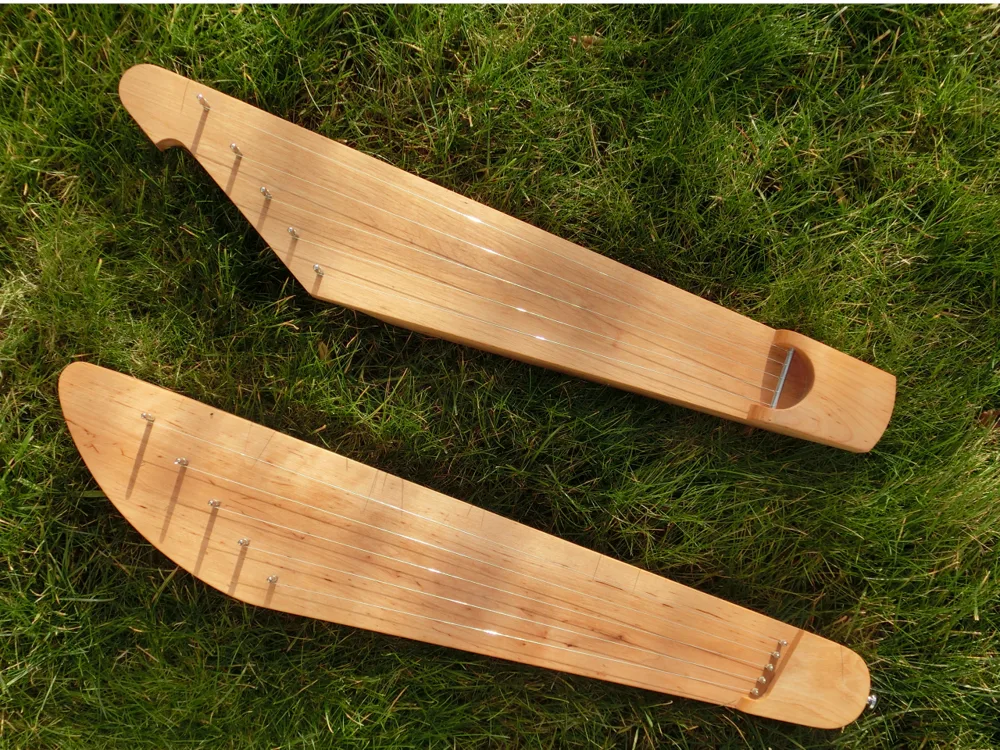
The Kantele and What to Buy
John C. Van Orman's four-day Folklore Village class builds the traditional five-string Finnish kantele and teaches its first tunes. The kantele in Finnish tradition, museum instruments and their sizes, a box-built design about 25 inches long, wood, zither pins, and steel strings with suppliers, a computed string layout, and a four-day plan.
- 4 min
- 6 steps
- 2 questions
- Lesson 169 of 204
In this lesson
- The kantele
- Museum kanteles
- A design to build
- Hardware
- Try it
Picking up where you left off.
What you need
| Have it | Material | Spec | Qty | Where to get it |
|---|---|---|---|---|
| Top | Spruce or western red cedar, about 1/8 in (3 mm) thick, 26 x 5 in | 1 | Luthier supply or a hardwood dealer | |
| Sides | Poplar, basswood, or cherry, about 3/8 in thick, 2 in wide | 2 pieces about 26 in | Lumberyard or hardwood dealer | |
| End blocks | Hard maple or birch, about 1 1/4 in thick, for the pin block and the ponsi | 2 pieces about 5 in | Hardwood dealer or offcuts | |
| BackKing makes open-backed kanteles too; a back is optional. | 1/8 in hardwood plywood or thin poplar | 1 piece 26 x 5 in | Hobby shop | |
| Zither pins | 1-5/8 in, for a 3/16 in hole | 5, plus spares | Musicmakers | |
| Tuning wrench | L-handle wrench or clock key that fits zither pins | 1 | Musicmakers | |
| StringsMusicmakers notes ball-end guitar strings also work. | Plain steel music wire or loop-end steel strings: .016 in for strings 1-3, .014 in for 4-5 | A few feet of each gauge | Musicmakers or a music store | |
| Varras | Steel or brass rod, about 1/8 in diameter, 3 in long | 1 | Hardware or hobby store | |
| Wood glue and finish | Yellow glue; shellac or an oil finish | Small amounts | Hardware store | |
| Kantele plans optional | Michael J. King’s full-size five-string plans and building ebook | 1 | Payhip |
Tools
Checkmarks are saved on this device.
The plan
-
Day 1
Design and the box
- History and anatomy; draw the kantele full size
- Mill the sides, end blocks, top, and back
- Glue the sides to the end blocks
-
Day 2
Top, pins, and varras
- Cut the soundhole; glue on the top and back
- Lay out and drill the pin holes
- Set the varras in the ponsi
-
Day 3
Shape and finish
- Shape the ends and the ponsi curl; sand
- Finish; fit the pins
-
Day 4
String, tune, and play
- String and tune; retune as the wire stretches
- Holding, the basic pattern, and chords
- D major and D minor
This module reconstructs Folklore Village’s four-day Making and Playing a Finnish Kantele in Dodgeville, Wisconsin, taught by John C. Van Orman, who has built folk instruments professionally since 1976. Students build “the traditional, 5-string small kantele”: first the sound box is constructed and finished, then the instrument is strung, and on the last day students learn the rudimentary techniques of playing it. The materials fee is $50 1. The class plan isn’t published; this follows the sources cited, and the string layout is a calculation, marked as such.
The kantele
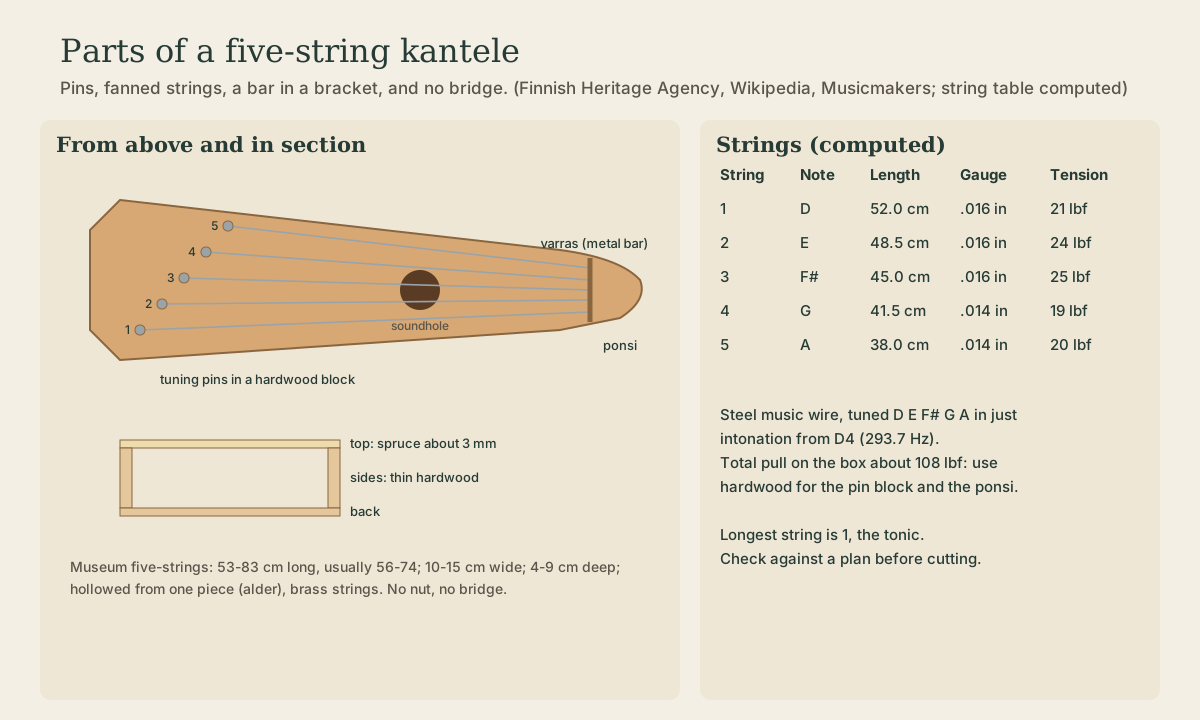
The kantele is Finland’s traditional plucked instrument. Its strings run straight from the tuning pins to a metal bar, the varras, held in a wooden bracket, the ponsi; there is no nut or bridge. Five-string kanteles are tuned in just intonation, usually D major or minor. In the Kalevala, Väinämöinen makes the first kantele from a pike’s jawbone strung with hair from Hiisi’s stallion, and the second of birch 2. Most kanteles had five strings until the 1600s and 1700s and accompanied the singing of epic poems 1.
Quick check
That direct path is part of the kantele’s ringing sound.
Museum kanteles
The National Museum of Finland’s five-strings:
- One made in 1698–1699 has a one-piece, flat-bottomed body hollowed from above with a top let in and nailed with iron and wood nails; strings run from an iron varras to slotted pegs. It is 73.2 × 10.8 × 7 cm and weighs 254 g; an old string remnant is brass wire 0.30 mm thick 3.
- Another has an alder body and birch pegs, its top held on by two birch-bark bands, 59.8 × 9.8 × 7 cm, with brass strings 0.3 mm thick 4.
Arja Kastinen’s research replicas include a northern type hollowed from below with an open bottom and bronze strings, and a southern type hollowed from above with a top and brass strings, both tuned lower than steel-strung kanteles 5.

A design to build
Van Orman’s class builds a sound box 1, which is quicker than hollowing a log. Michael J. King’s five-strings are 25 by 4.5 inches and 2 inches deep, of spruce with an open back, tulip poplar, or walnut or cherry with cedar, strung in steel and tuned D E F♯ G A or D minor 6. King offers full-size plans free for educational use 7.
This module’s design follows King’s size: a box about 25 inches long, about 4 1/2 inches wide at the pin end and narrower at the ponsi, 2 inches deep, with a 3 mm spruce top and hardwood blocks at both ends.
Strings (computed). For steel wire tuned D E F♯ G A in just intonation from the D above middle C, these lengths and gauges give each string 18 to 25 pounds of tension:
| String | Note | Length | Gauge |
|---|---|---|---|
| 1 | D | 52 cm | .016 in |
| 2 | E | 48.5 cm | .016 in |
| 3 | F♯ | 45 cm | .016 in |
| 4 | G | 41.5 cm | .014 in |
| 5 | A | 38 cm | .014 in |
That’s about 110 pounds of pull on the box in all, which is why the pins and the varras sit in hardwood. Check against a plan before cutting. Musicmakers’ ten-string kantele uses steel strings in a similar range, .014 to .020 inch 8.
Quick check
The pins hold by friction and the ponsi carries the whole pull through the varras.
Try it
Draw the kantele full size on paper with the five strings at the lengths in the table, fanning from the pins to the varras. Lay the zither pins on the drawing at their spots; if two sit closer than about 3/4 inch, spread the fan.
Lesson complete
Nice work.
Sources for this lesson
- 1Making and Playing a Finnish Kantele with John C. Van Orman. Folklore Village, Dodgeville, Wisconsin. verifiedStudents build the traditional five-string small kantele: first the sound box is constructed and finished, then the instrument strung; on the final day, rudimentary playing. Materials fee $50 to the instructor. Van Orman has built folk instruments professionally since 1976. The listing is for October 7-10, 2021, $320-350.
- 2Kantele. Wikipedia. verifiedStrings run from tuning pins to a metal bar, the varras, held in a wooden bracket, the ponsi; no nut or bridge. Five-string kanteles typically tuned in just intonation to D major or minor. In the Kalevala, Väinämöinen's first kantele is of pike jawbone strung with hair from Hiisi's stallion; the second of birch.
- 3Five-string kantele, 1698-1699. National Museum of Finland (Finna). verifiedOne-piece flat-bottomed body hollowed from above with a top let in and fixed with iron and wood nails; strings from an iron varras to slotted pegs; 73.2 x 10.8 x 7 cm, 254 g; an old string remnant of brass wire 0.30 mm; pegs 82-87 mm.
- 4Five-string kantele (alder). National Museum of Finland (Finna). verifiedBody of alder, pegs of birch; top held on by two birch-bark bands; 59.8 x 9.8 x 7 cm, 374 g; brass strings 0.3 mm; pegs 66-72 mm.
- 5Arja Kastinen. Soittaa omaa mahtia. Research Catalogue. 2025. verifiedReplica five-string kanteles: a northern type hollowed from below with an open bottom and bronze strings, and a southern type hollowed from above with a top and brass strings; both tuned lower than steel-strung kanteles.
- 6Michael J. King. 5 String Kantele. Michael J. King. verifiedFive-string kanteles 25 x 4.5 in, 2 in deep; spruce with an open back, tulip poplar standard, or walnut or cherry with cedar; steel strings tuned D E F# G A, or D minor D E F G A; pentatonic therapy tuning D E G A C.
- 7Michael J. King. 5 String Kantele plans and 2004 edition ebook. Payhip. verifiedFull-size plans and building ebook, offered pay-what-you-want and free for educational purposes since March 2020.
- 8Kantele finishing and stringing instructions. Musicmakers. 2012. verifiedTen-string kantele with loop-end steel strings .014-.020 in (D5 .014 down to A3 .020); restringing: trim 2-3 in long, pass the wire through the pin, turn about a half turn, then pull the string taut and wind it up with the tuning key; change strings yearly for tone.
- 9Standard Zither Pins. Musicmakers. verified1-5/8 in long, fit a 3/16 in hole, $1 each; turned with a clock key or L-handle tuning wrench.