Birch Bark Work
Paper birch bark as a craft material: when and how it's harvested without killing the tree, Ojibwe wiigwaas practice, permits in Wisconsin's forests, preparing and storing bark, and three containers - a folded bark box, a stitched makak-style basket, and woven Nordic work.
- 4 min
- 5 steps
- 3 questions
- Lesson 13 of 204
In this lesson
- The material
- Harvesting
- Preparing and storing
- Three containers
- What to take from this
Picking up where you left off.
The material
The bark of paper birch is waterproof, flexible when fresh or warmed, rot-resistant, and light. Across the North it has made canoes, houses, baskets, boxes, shoes, and cooking vessels. For the Ojibwe, wiigwaas (birch bark) was essential to wigwams, canoes, containers, and ceremony, and remains central to Ojibwe identity 1. Swedish sloyd uses it for woven baskets, boxes, and the lacing on bentwood containers 2.
.JPG)
Harvesting
Native Harvest, an Ojibwe enterprise of the White Earth Land Recovery Project, describes the practice 1:
- When: “when the flies start biting” - late June to early July, when bark separates cleanly.
- Which trees: mature trees, about 40 years or older; upland birch has stronger bark than swamp birch. Bark with short, closely spaced lenticels (the dark lines) is better; long, widely spaced lines crack more easily.
- How: a T-shaped cut, feeling for the moment the knife reaches the inner bark, and never damaging the inner bark - the tree’s health depends on it. The outer bark then peels around the trunk.
- Respect: an offering before harvesting, giving away the first basket you make, and returning scraps to the woods rather than wasting them.
Better still for most of us: take bark from freshly felled or fallen trees, firewood, or logging slash, where the tree is gone already. Bark resists decay and stays usable for a long time.
Permits: on the Chequamegon-Nicolet National Forest, birch bark, boughs, and firewood are forest products that require a permit, while edibles gathered for personal use do not 3. State forests have their own rules, and private land needs the owner’s permission.
Quick check
In early summer the bark separates cleanly from the tree.
Quick check
Cut only the papery outer bark; a cut into the inner bark can girdle and kill the tree.
Quick check
Edibles for personal use need no permit there, but boughs, firewood, and birch bark do.
Preparing and storing
- Use fresh bark right away, or store sheets flat under weight in a cool, dry place.
- Dry bark becomes stiff; warm it over a fire, in hot water, or in sun to make it pliable again.
- Bark tears easily along its lenticels, the dark horizontal lines, so plan folds and stitch holes with them in mind and keep holes back from edges.
Three containers
Folded box. A single rectangle of bark scored and folded at the corners into a tray or box, held with split sticks or stitches. The Swedish kåd-ryve folds a box from one sheet with no sewing at all.
Playback is optional. If the player is unavailable, open the video at its source.
Stitched basket (makak). The Ojibwe wiigwaas makak folds bark into a box or basket and stitches the corners and rim with spruce root or other roots such as red willow, punching holes with an awl 1. A rim hoop of split ash or willow, lashed on, stiffens the top.
Playback is optional. If the player is unavailable, open the video at its source.
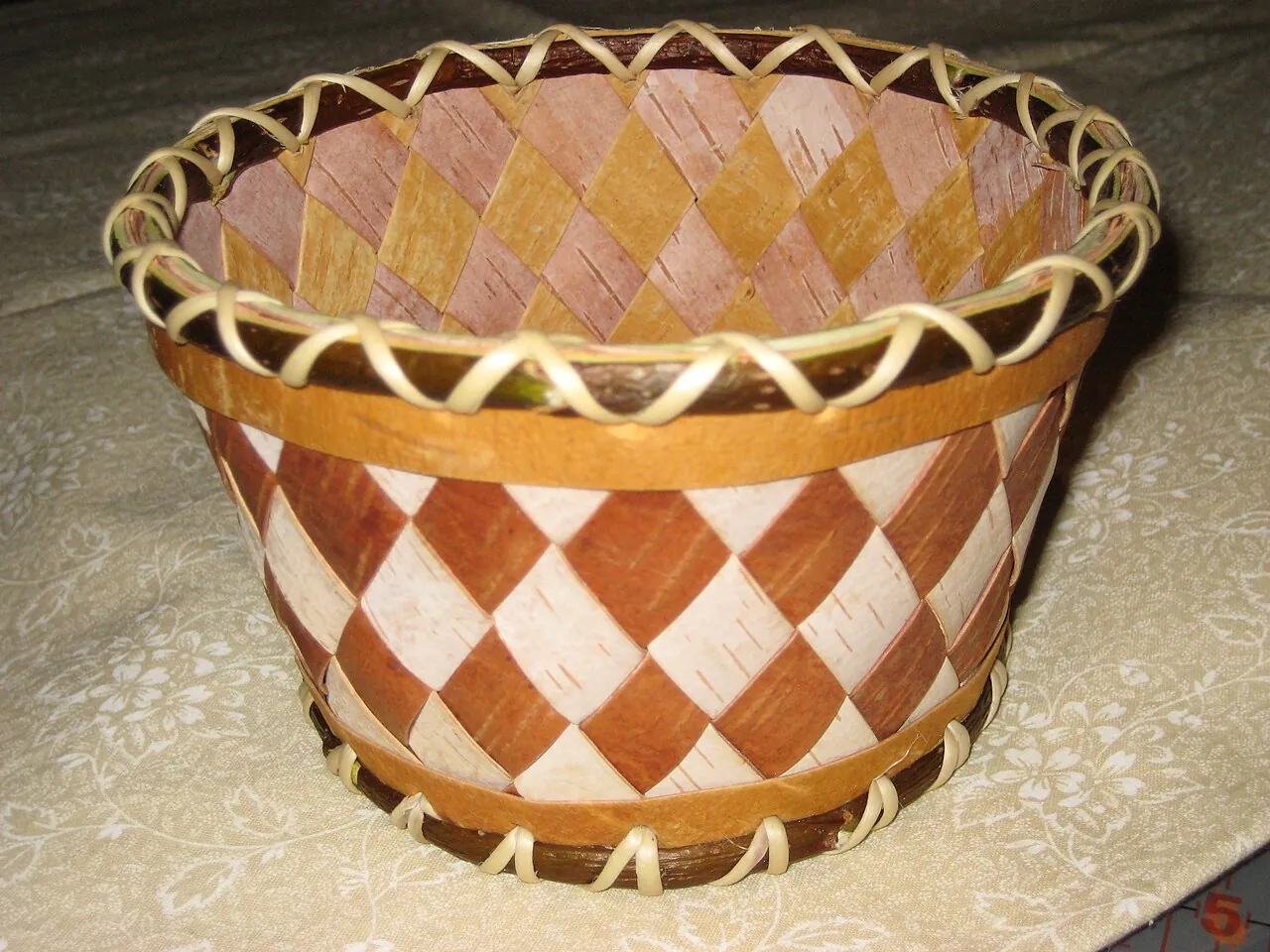
Woven work. Nordic baskets, backpacks, and salt boxes are plaited from long strips of bark cut in a spiral around a log, woven in a checkerboard or twill. It’s the bark version of the plaiting in the Weaving, Basketry, and Caning course.
What to take from this
Paper birch bark is waterproof, flexible when warm, and long-lasting. Harvest in late June or early July if you harvest live bark at all, cut only the outer bark, never the inner bark, and better yet use bark from felled trees; you need a permit on the Chequamegon-Nicolet. Store sheets flat, warm stiff bark before folding, and mind the lenticels, along which bark tears. Folded boxes, root-stitched makak baskets, and plaited Nordic work are the three main forms.
Lesson complete
Nice work.
Sources for this lesson
- 1Harvesting Birch Bark. Native Harvest (White Earth Land Recovery Project). 2026. verifiedOjibwe practice of gathering wiigwaas when the flies start biting (late June to early July), cutting without damaging the inner bark, with offerings and respect.
- 2Jögge Sundqvist. Slöjd in Wood. Lost Art Press. 2018. verifiedPublisher excerpt (PDF) of the English translation of the Swedish classic; butter knife, spoons, bowls, sheath, hooks, and painted decoration in the Västerbotten tradition.
- 3Chequamegon-Nicolet National Forest: Permits. USDA Forest Service. verifiedNo permit needed to gather edible material such as morels for your own consumption; boughs, firewood, birch bark, and other forest products need a permit.