Forge Welding
Joining two pieces of steel in the fire: welding heat, why scale stops a weld and how borax and sand flux fix it, keeping a clean reducing fire, upsetting and scarfing ends, the lap scarf weld, faggot welds, and how to tell a weld took.
- 4 min
- 5 steps
- 3 questions
- Lesson 90 of 204
In this lesson
- Welding heat
- Scale and flux
- The fire
- The lap scarf weld
- What to take from this
Picking up where you left off.
Welding heat
Iron and mild steel heated near white heat become soft enough that two clean pieces pressed together stick and become one - the welding heat 1. Before arc welding, this was the only way to join iron, and it’s still used for chain, tool steel laminated onto iron, Damascus, and tongs.
Scale and flux
Heated steel grows scale (iron oxide), and scale between two surfaces prevents a weld 1. Two ways around it:
- With wrought iron or mild steel, heat high enough that the scale itself melts and is squeezed out by the blows 1.
- With carbon steels that would burn at that heat, use a flux 1.
Flux - borax or sand most commonly - is sprinkled on the joint at about a yellow heat. It melts, flows over the surface to shield it from air, and dissolves the oxide, lowering its melting point so it squeezes out at a lower welding heat 1. Bacon notes anhydrous borax (borax glass) foams less, and a mix of one part sal ammoniac to four parts borax cleans better than borax alone 1. Sand suits iron; borax, steel.
Quick check
Bacon: flux forms a protecting covering and lowers the melting point of the oxide.
The fire
Bacon warns against an oxidizing fire with too much air going through it: extra oxygen scales and burns the steel 1. For welding:
- Build a deep, clean fire of coke, free of clinker.
- Keep the work in the heart of the fire, covered, not above the tuyere’s blast.
- Heat slowly enough that the inside reaches heat with the outside - a fast fire leaves a hot skin over a cold core 1.
- Watch for white star sparks: they mean burning, and the steel is going past welding heat 1.
Quick check
Keep a deep, clean fire with the work covered by coke and a moderate blast.
The lap scarf weld
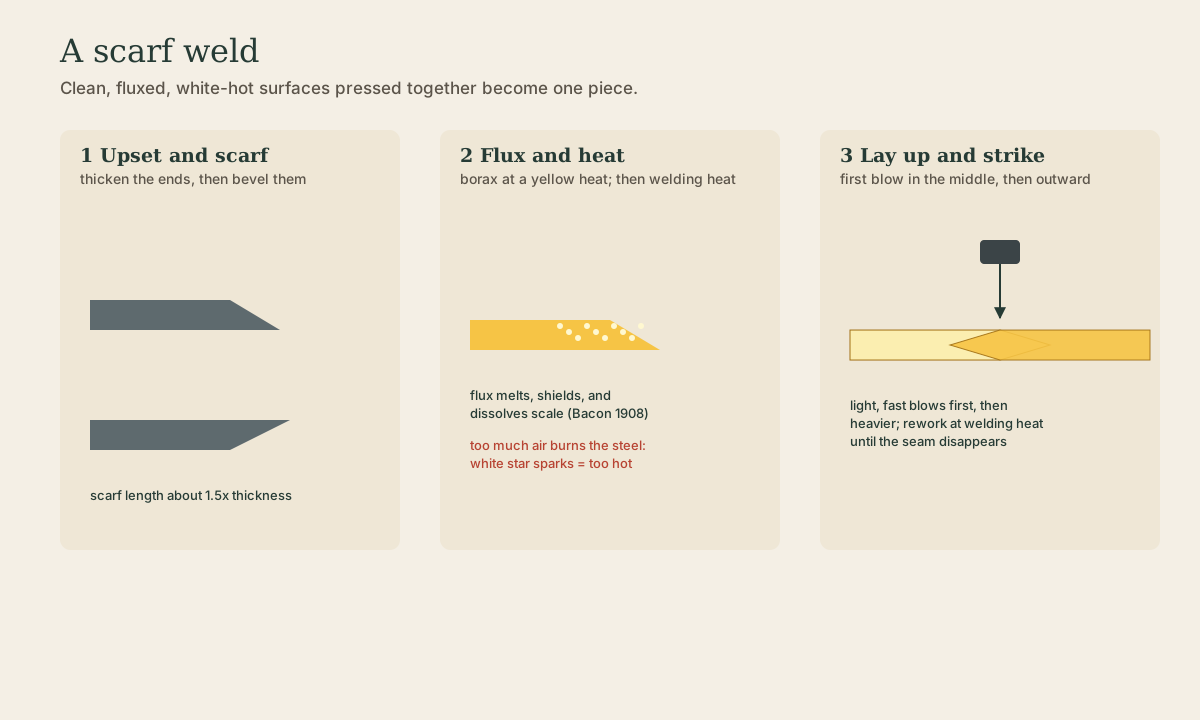
- Upset both ends so the finished joint will be full size.
- Scarf: forge each end to a bevel about one and a half times as long as the stock is thick, slightly convex so the center touches first and scale squeezes out to the sides.
- Flux at a yellow heat, then bring both pieces to welding heat together, turning them.
- Lay up quickly: scarfs together on the anvil, scarf faces down-and-up as planned.
- Strike the center first with light, fast blows to tack it, then work outward with heavier blows 1.
- Return to welding heat and work the joint down to size until the seam disappears.
Faggot weld: fold a bar over on itself (or bundle several), flux, and weld - the start of tongs reins and laminated steel.
Did it take? A sound weld rings, shows no seam after cleanup, and survives bending in a vise. A cold shut shows a line that opens when bent. Practice on scrap and test-break your welds.
Playback is optional. If the player is unavailable, open the video at its source.
Quick check
A weld drawn back to size from thicker stock is also sounder.
What to take from this
At welding heat, clean steel surfaces fuse. Scale stops a weld, so flux with borax (steel) or sand (iron) at a yellow heat: it shields and dissolves oxide. Use a deep, clean, non-oxidizing fire and watch for star sparks. Upset, scarf, flux, heat both pieces together, lay up fast, strike the center first, and test-bend your welds.
Lesson complete
Nice work.
Sources for this lesson
- 1John Lord Bacon. Forge-Practice: Elementary. John Wiley & Sons. 1908. verifiedPublic-domain trade-school text from the Lewis Institute; fire building with coking coal, welding heat and fluxes (sand, borax, sal ammoniac), upsetting, drawing out, bending, punching, and tool-steel hardening and tempering colors (430 F pale yellow to 570 F blue, temper gone near 650 F).