Flax, Linen, and What to Buy
Two classes rebuilt as a year's project: Sätergläntan's five days of breaking, hackling, and spinning linen, and North House's flax-to-linen weekend with a Madison grower. Fiber flax and where to get seed, how big a bed and what it yields, the tools and their plans, and a season's plan for southern Wisconsin.
- 3 min
- 5 steps
- 2 questions
- Lesson 178 of 204
In this lesson
- Fiber flax
- How big a bed
- Tools
- Try it
Picking up where you left off.
What you need
| Have it | Material | Spec | Qty | Where to get it |
|---|---|---|---|---|
| Fiber flax seedSeed packets are small; buy the largest size offered or order a 1 lb package, as Landis Valley sells. | A fiber variety (Sussex, Linore, Cascade), not a seed or oil flax | About 1/4-1/3 lb for a 100 sq ft bed | Fedco Seeds | |
| Strick flax for practiceLearn to spin while your own crop grows. | Dressed line flax, ready to spin | 4 oz | The Woolgatherers | |
| Flax tool plans | Brake, scutching board and knife, ripple, and hackles | 1 set | The Woolgatherers | |
| Lumber for the tools | Hardwood or 2x lumber per the plans; long nails or steel pins for the hackles and ripple | Per the plans | Lumberyard and hardware store | |
| Distaff | A wheel-mounted or hand distaff | 1 | The Woolery | |
| Twine and stakes | To fence the bed with string if the flax starts to lodge | 1 roll | Garden store |
Tools
Checkmarks are saved on this device.
The plan
-
Fall before
Prepare the bed
- Choose a sunny bed that hasn’t grown flax in years
- Clear the weeds; work in compost
-
Mid-April
Sow
- Sow thickly when you plant peas
- Rake the seed in lightly
-
May
Weed
- Hand-weed while the flax is a few inches tall
- String the bed if it starts to lean
-
Late June
Bloom
- Watch the blue flowers open in the morning, about day 55-65
-
Mid to late July
Pull and dry
- Pull by the roots when a third to half the bolls are brown
- Bundle and stand in stooks to dry
-
August-September
Ripple and ret
- Comb off the seed heads
- Dew-ret on grass 1-3 weeks, turning once; test, dry, and store
-
Fall and winter
Process and spin
- Break, scutch, and hackle on dry days outdoors
- Spin line wet from a distaff; spin the tow; boil the skeins
This module rebuilds two classes as one project. Sätergläntan’s five-day Lin – beredning, spånad och materiallära with Marie Ekstedt Bjersing spins linen on spindle and wheel, spins tow and line of different qualities, tries breaking, scutching, and hackling, makes one- and two-ply yarn, and works out yarn counts; it starts from prepared flax and doesn’t cover growing 1. North House’s three-day Flax to Linen has Leslie Schroeder of Midwest Linen Revival in Madison teach seed selection, planting, and retting, then breaking, scutching, and hackling, with distaff and spindle spinning and a woven hand towel 2. Schroeder trialed 53 USDA flax varieties on southern Wisconsin farms and kept 16, chosen for germination, height, and lodging resistance 3. Neither class plan is published; this follows the sources cited, and the Wisconsin timing is an estimate.
Fiber flax
The USDA’s 1940 bulletin on fiber flax names “locations… around the Great Lakes” as ideal, where fogs and dews add moisture; flax wants a cool, moist spring, and dry weather gives short, woody, harsh fiber. It likes a medium-heavy, well-drained silt loam 4. The plant grows 60 to 120 cm tall in 90 to 100 days; line flax is 60 to 90 cm long and tow 20 to 25 cm, and linen is 20 to 25 percent stronger wet 5.
Grow a fiber variety, tall and unbranched, not a seed or oil flax. Spin Off lists Hera, Ariane, Natasja, Viking, Cascade, Regina, and Norfolk Queen 6. Small packets are sold in the US: Fedco’s Sussex fiber flax, which it says to “sow more heavily” for fiber 7, Truelove’s Linore from Oregon 8, and the Woolery’s Cascade 9.

Quick check
Dry conditions give short, woody, harsh fiber.
How big a bed
A pound of seed plants 300 to 400 square feet 10; the USDA’s field rate of 84 pounds an acre 4 is thinner, about a pound per 520 square feet, and hand-sown beds need more. So a 100 square foot bed takes about a quarter to a third of a pound.
From an 80 square foot bed, Cindy Conner got 5.6 pounds of retted flax, which gave 6 ounces of line and 19 ounces of tow, plus 6 ounces of seed 11. Scaled up, a 100 square foot bed gives about 7 1/2 ounces of line and 1 1/2 pounds of tow: enough line to spin a towel’s worth of fine yarn, with tow for coarser cloth.
Quick check
Most of the fiber is tow; the long line is the prize.
Tools
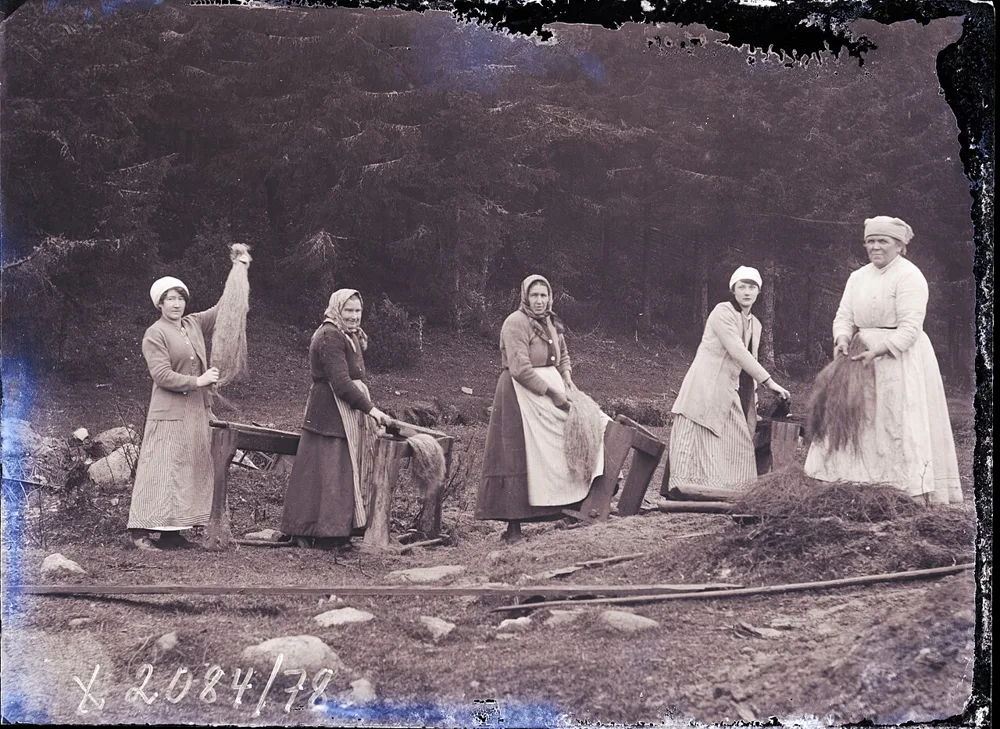
Flax needs a brake to shatter the woody core, a scutching board and knife to knock out the bits, a ripple to comb off seed heads, and hackles, combs of nails, in coarse, medium, and fine. Commercial tools are rare; the Woolgatherers sells paper plans for the full set for $45, and strick flax for practice at $2.25 an ounce 12. With only one hackle, make it medium 11. For spinning you need a wheel or spindle and a distaff 9.
Try it
Buy a few ounces of strick flax and spin it before your crop is in. Knowing how good line flax feels in the hand tells you, a year later, whether your own retting and hackling worked.
Lesson complete
Nice work.
Sources for this lesson
- 1Lin - beredning, spånad och materiallära 2026. Sätergläntan Institutet för slöjd och hantverk. verifiedMarie Ekstedt Bjersing, July 20-24, 2026, 8:40-16:00, ending with lunch day 5; 7,600 SEK with meals, materials up to 1,200 SEK. Spin linen on spindle and wheel; spin tow and line of different qualities; try breaking, scutching, and hackling; one- and two-ply yarn; calculate yarn count and judge quality; history, study-collection textiles and tools; care of linen. Bring an apron, a working wheel (loaners available), and a 1 m band about 1 cm wide.
- 2Flax to Linen: Break, Hackle, Spin, & Weave. North House Folk School. verifiedMay 14-16, 2027; tuition $375, materials $60. Leslie Schroeder (Midwest Linen Revival, Madison) covers seed selection, planting, and retting, then breaking, scutching, and hackling; Josie Cooke teaches distaff and drop-spindle spinning; students weave a hand towel from handspun and purchased linen.
- 3Maureen McCollum. The flax-to-linen dream weaves its way into Wisconsin. Wisconsin Life (PBS Wisconsin / WPR). 2025. verifiedLeslie Schroeder trialed 53 USDA germplasm flax varieties on southern Wisconsin farms and kept 16, selected for germination, height, and lodging resistance; seed heads rippled through a wood-and-nail comb; the brake is 'like a large dull, wooden paper cutter'; then scutching and hackling.
- 4B. B. Robinson. Flax-Fiber Production (Farmers' Bulletin 1728). U.S. Department of Agriculture. 1940. verifiedIssued 1934, revised 1940. Ideal locations around the Great Lakes, with a cool, moist spring; medium-heavy well-drained silt loam. Sow early, with oats or barley; 'a very common rate is 84 pounds' per acre. Season 85-100 days, bloom at 55-65 days. Pull 'when one third to one half of the seed bolls are brown or yellow' and the leaves have fallen from two thirds of the stem; fiber runs from the ground to the lowest branches. Dew retting 1-3 weeks, spread thin and turned, lifted when 'the bark containing the fiber separates readily from the woody inner part'; tank retting 6-8 days at 80 F. Yield per acre about 1 ton retted straw to 400 lb scutched fiber with tow.
- 5Ingun Grimstad Klepp. Lin. Store norske leksikon. verifiedPlant 60-120 cm tall, season 90-100 days; in Norway sown in May and harvested August-September, pulled up by the roots, bundled, and dried; seed capsules stripped with a comb; retted on grass or in ponds; line 60-90 cm, tow 20-25 cm; linen fiber 20-25% stronger wet.
- 6A Guide to Spinning Flax. Spin Off (Interweave). verifiedFiber flax varieties include Hera and Ariane (Holland), Natasja and Viking (Sweden), Cascade (Washington State), Regina (Canada), and Norfolk Queen (Virginia).
- 7Sussex Flax 5081. Fedco Seeds. verifiedFiber flax, 110 days; 'If growing for fiber, sow more heavily'; larger packets in 14, 28, and 112 g sizes when in stock.
- 8Linore Flax. Truelove Seeds. verifiedOregon fiber flax of 1962 grown with the Pennsylvania Flax Project, 115 seeds $5; for fiber sow 3-4 in apart, don't cover the seed, and lay out stems to ret about 3 weeks.
- 9Fiber Flax Seed Pack. The Woolery. verifiedCascade fiber flax seed (Oregon State), about 2 g, $5.25. The Woolery also sells flax top, a Kromski distaff, and Heinrich's Linen: From Flax Seed to Woven Cloth.
- 10Cindy Conner. Grow Flax for Linen in Your Garden. Mother Earth News. 2017. verifiedLandis Valley's 1 lb package plants 400 sq ft (Heinrich's Linen: From Flax Seed to Woven Cloth says 300); plant 'about the time you plant peas'; harvest in 90-100 days.
- 11Cindy Conner. Flax to Linen: Hackling. Mother Earth News. 2017. verified'From an 80 sq. ft. bed, I started with 5.6 pounds of retted flax, which yielded 6 ounces of line fiber… and 19 ounces of tow,' plus 6 oz seed. Hackle tine spacing about 1 in coarse, 1/2 in medium, 1/4 in fine; with only one hackle, make it medium.
- 12Flax Tools. The Woolgatherers. verifiedPaper plans for flax tools: full set $45; brake $15; scutching board and knife $7.50; ripple $7.50; coarse, medium, and fine hackles $15; also strick flax at $2.25 an ounce. Their strick page: put no more than 2-3 oz on the distaff at once; spun with water it smooths into a yarn.