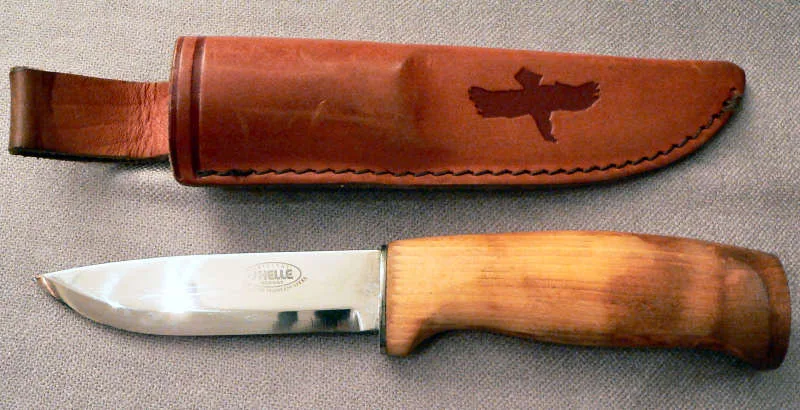
The Norwegian Knife and What to Buy
Two Vesterheim classes rebuilt as one project: Scott Johnson's four-day brukskniv with a wood-lined leather sheath and a braided hanger, and KJ Groven's beginner class that carves the handle by hand. How a Norwegian knife is made, sizes from museum knives, blades, bolsters, birch, and leather with US suppliers, the tools, and a four-day plan.
- 4 min
- 6 steps
- 2 questions
- Lesson 163 of 204
In this lesson
- The Norwegian knife
- Sizes from museum knives
- Blades and fittings
- Leather and liner
- Try it
Picking up where you left off.
What you need
| Have it | Material | Spec | Qty | Where to get it |
|---|---|---|---|---|
| BladeHelle (Norwegian), Lauri (Finnish), or Mora (Swedish); Ragweed Forge in Wisconsin stocks all three. | A hidden-tang Scandinavian blade, about 3-4 in, with a long tang | 1 | Ragweed Forge | |
| Bolster | Brass or nickel-silver, sized to the blade, e.g. 19 x 30 x 3 mm | 1 | Ragweed Forge | |
| Butt end | Small brass end to peen the tang over, about 10.5 mm | 1 | Ragweed Forge | |
| Handle block | Curly (masur) birch or straight birch, about 1 1/4 x 1 1/2 x 5 in | 1 | Ragweed Forge or another knife-supply house | |
| Birch-bark spacers optionalFor a birch-bark handle instead of a wood block. | Stacked birch bark for a hidden tang | 1 set | Knifemaking.com | |
| Sheath leather | Vegetable-tanned leather about 3 mm (7-8 oz) thick | A piece about 6 x 10 in | A leather supplier | |
| Liner woodOr a Lauri plastic insert from Ragweed Forge. | Thin, straight-grained pine or basswood, 1-3 mm sheets | Scraps | Hobby shop | |
| Waxed linen thread and two harness needles | For the back seam | About 3 yd | A leather supplier | |
| Slow-setting epoxy | For the handle, if you glue it | 1 small pack | Hardware store | |
| Antler tine or hardwood | For the hanger cap or toggle | 1 small piece | Craft or knife supply | |
| Complete kit optionalBrusletto’s Norwegian Jerven kit is sold by Knife Country USA. | Karesuando kit (blade, curly birch, bolster, antler spacer, leather, liner, thong) or a Brusletto DIY kit | 1 | Ragweed Forge |
Tools
Checkmarks are saved on this device.
The plan
-
Day 1
Fit the bolster and bore the handle
- Choose the blade; fit the bolster to a tight slot
- Draw side and top views on the block
- Drill the tang hole from both ends and rasp it to fit
-
Day 2
Fix and rough-shape
- Glue with slow epoxy, or fit dry; peen the tang over the butt end
- Let it cure overnight; rough-shape with knife and rasp
-
Day 3
Finish the handle; make the liner
- Final shaping; sand to 600; oil
- Make and carve the wooden sheath liner
- Cut the leather pattern
-
Day 4
The sheath
- Wet-form the leather; stitch the back seam from the tip
- Decorate; braid the hanger and fit its cap
- Dye, oil, and burnish
This module reconstructs two Vesterheim Folk Art School classes as one project:
- Scott Johnson’s four-day Making a Norwegian Brukskniv with Wood and Leather Sheath: a Norwegian work knife whose sheath is “constructed of wood and German leather (half tanned)” and “will include one piece of leather braided and capped with antler or wood.” It’s intermediate to advanced and expects some knife and sheath experience 1.
- KJ Groven’s three-day Beginner Knifemaking and Hand Tools: a handle carved by hand on a pre-made blade, “more of a knife for carving than a fancy belt knife,” a traditional Norwegian sheath of vegetable-tanned leather, and simple tools made from hardware-store stock: an awl, a leather modeling tool, and two tang saws, one with push-and-pull teeth cut from scratch. No forging 2.
Neither class’s plan is published; this follows the sources cited.
The Norwegian knife
A traditional Norwegian blade has a tang, a grinding bevel, an edge, and a spine, and was forged with soft steel around a hard edge steel. Handles were fixed with glue or rivets and made of wood, horn, bone, birch bark, leather, or metal, with metal bands at the ends. Sheaths were usually leather, carved, stamped, or embossed; Tinn, Toten, and Gjerstad were known centers 3. The everyday carving knife is the tollekniv, from Old Norse talguknifr, carving knife 4.

Quick check
The everyday Norwegian knife for whittling and work.
Sizes from museum knives
- A Telemark knife by Hallstein Kroken Midbø is 20 cm long with a 9.1 cm blade, a curly (masur) birch handle, and a sheath of thick, dark-brown ornamented leather 25.7 cm long 5.
- A tollekniv is 24 cm overall with a blade 7.2 cm long and 4.5 mm thick, a brass ferrule with acanthus, and masur birch 6.
- An 1899 knife is 17.5 cm long and its sheath 15 cm, but only 21 cm long sheathed: the sheath swallows part of the handle, the deep Norwegian style 7.
A blade of 3 to 4 inches and a handle of 4 to 4 1/2 inches covers most of these.
Quick check
Knife 17.5 cm plus sheath 15 cm, but only 21 cm long together.
Blades and fittings
Ragweed Forge in Wisconsin sells Scandinavian blades and fittings:
- Helle blades from Norway, such as the Skog blade, triple-laminated with a Scandi grind, 3 1/16 inches long and 2.45 mm thick, $30 8.
- Bolsters in brass or nickel-silver, such as 19 × 30 × 3 mm, $3.50 to $4.50 9.
- Butt ends to peen the tang over, 10.5 mm, $1.25 10.
- Plastic sheath inserts if you’d rather not carve a liner, $1 to $2.50 11.
- A Karesuando kit with a carbon-steel blade, curly birch block, brass bolster, antler spacer, sheath leather, liner, thong, and thread, $149.99 12.
Norway’s Brusletto sells a DIY kit with blade, ferrule, wood block, leather, needle, and thread, $59.26 from Knife Country USA 13. For a birch-bark handle, stacked bark spacers are sold for hidden-tang blades 14.
Håvard Bergland’s Norwegian Knife Making, with about 400 illustrations, is $56 at the Vesterheim store 15.
Try it
Lay the blade on paper and draw the whole knife full size around it: the handle’s side view, then its top view. Hold the drawing in your hand as if gripping the knife. Change the outline until it fits your hand before buying a handle block.
Lesson complete
Nice work.
Sources for this lesson
- 1Making a Norwegian Brukskniv with Wood and Leather Sheath. Vesterheim Folk Art School. verifiedScott Johnson, July 18-21, 2026, intermediate to advanced; a Norwegian work knife whose sheath 'will be constructed of wood and German leather (half tanned) and will include one piece of leather braided and capped with antler or wood.' Prerequisite: some experience making a knife and sheath.
- 2Beginner Knifemaking and Hand Tools. Vesterheim Folk Art School. verifiedKJ Groven, Nov 13-15, 2026, beginner friendly, $290/$320: hand-carve a handle on a pre-made blade, without power tools, 'more of a knife for carving than a fancy belt knife'; a traditional Norwegian sheath of vegetable-tanned leather, with or without a belt hoop; make an awl, a leather modeling (pauting) tool, and two tang saws, one from scratch with push-and-pull teeth. No forging.
- 3Audun Dybdahl, Eivind Falk. Kniv - tradisjonell bruk. Store norske leksikon. 2026. verifiedBlade parts: tang, grinding bevel, edge, spine; traditionally soft steel forged around a hard edge steel. Handles fixed with glue or rivets; of wood, horn, bone, birch bark, leather, or metal, with metal bands at the ends. Sheaths usually leather, carved, stamped, or embossed; centers at Tinn, Toten, and Gjerstad.
- 4Knut A. Rosvold. Tollekniv. Store norske leksikon. 2026. verifiedFrom Old Norse talguknifr, carving knife.
- 5Kniv med slire (SJF.02197). Norsk Folkemuseum (DigitaltMuseum). verifiedTelemark, by Hallstein Kroken Midbø, Børtegrend: knife 20 cm, blade 9.1 cm, sheath 25.7 cm; curly (masur) birch handle; thick dark-brown ornamented leather sheath.
- 6Tollekniv (VHV0190). DigitaltMuseum. verified24 cm overall; blade 7.2 cm long and 4.5 mm thick; sheath 3.46 cm wide; brass ferrule with acanthus; masur birch.
- 7Kniv med slire (KVB.0283). DigitaltMuseum. verified1899: knife 17.5 cm, sheath 15 cm, 21 cm overall sheathed, so the sheath covers part of the handle; leather loop with a buttonhole on the back.
- 8Helle Blade 83 (Skog Knife Blade). Ragweed Forge. verifiedNorwegian Helle triple-laminated blade with a Scandi grind, 3 1/16 in blade, 7 3/8 in overall, 2.45 mm thick, $30; Ragweed Forge in Wisconsin also stocks other Helle, Lauri, and Mora blades, bolsters, and butt ends.
- 9Fittings. Ragweed Forge. verifiedLauri brass and nickel-silver bolsters, e.g. 18 x 28 x 3 and 19 x 30 x 3 mm straight, $3.50-4.50.
- 10Lauri Butt End 10.5 mm. Ragweed Forge. verifiedSmall butt ends to peen the tang over, 10.5 mm diameter and 3.8 mm tall, $1.25.
- 11Sheath Inserts. Ragweed Forge. verifiedLauri plastic sheath inserts, $1-2.50, e.g. 110 x 24 mm for blades up to 110 mm long and 24 mm wide.
- 12Karesuando Blade Kit 3526. Ragweed Forge. verified$149.99: carbon-steel blade about 3 1/2 x 0.72 x 0.098 in, curly birch block, brass bolster, reindeer antler spacer, sheath leather, plastic liner, thong, thread, English instructions.
- 13Brusletto 82001 Jerven DIY Knife Kit. Knife Country USA. verifiedNorwegian Brusletto kit, $59.26: blade blank, ferrule, wood block, leather, needle, thread, booklet.
- 14SL101 Birch Bark Spacers for Hidden Tang Blades. Knifemaking.com. verifiedStacked birch-bark spacer set, about 4 1/2 in, $21.95.
- 15Håvard Bergland. Norwegian Knife Making. Vesterheim Store. verifiedA how-to with about 400 illustrations, $56.
- 16Scandi style sheath step by step. BushcraftUK. 2012. verifiedLiner of three pine layers, the middle 1 mm thicker than the blade with the blade profile cut out, total thickness equal to the bolster; glue and carve. Wrap the knife in cling film, soak the leather, form over knife and liner with a bone folder; stitch from the tip about 10 stitches at a time, molding as you go; punch for a thong belt loop, trim, dye, oil-wax, burnish; about 3 hours.