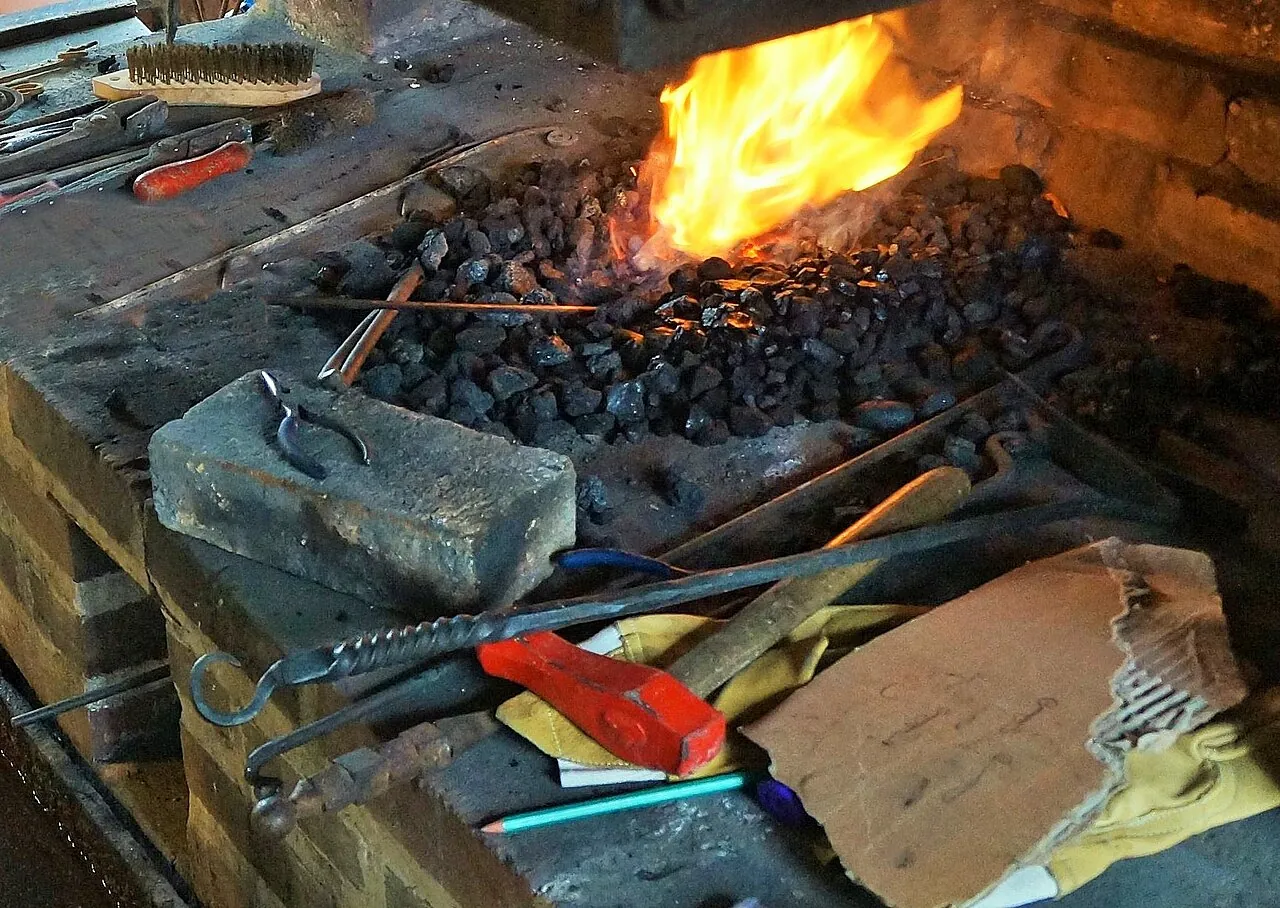
Coal, Coke, and Gas Forges
How a forge makes forging heat: the coal forge's firepot, tuyere, and blower, building and managing a coke fire, clinker, gas forges and their trade-offs, and the ventilation and carbon monoxide rules that come with any fire.
- 4 min
- 6 steps
- 3 questions
- Lesson 83 of 204
In this lesson
- What a forge does
- The coal forge
- The coal fire
- Gas forges
- Ventilation and carbon monoxide
- What to take from this
Picking up where you left off.
What a forge does
A forge heats steel to a working temperature - roughly orange to yellow for most forging - quickly and controllably. Three types are common:
| Forge | Fuel | Strengths | Weaknesses |
|---|---|---|---|
| Coal | bituminous smithing coal, burned to coke | localized heat exactly where you want it; forge welds easily; traditional | smoke, clinker, fire management takes practice |
| Gas (propane) | propane through a venturi or blower burner into a lined chamber | clean, quiet, steady heat; easy to start and stop | heats a long section at once; harder to localize; liner care |
| Charcoal | lump charcoal | no smoke from coal; available anywhere | burns fast; sparky |
North House Folk School’s smithy uses coal forges with hand-crank blowers 1.
The coal forge
- Firepot: a cast-iron bowl in the middle of the hearth where the fire sits.
- Tuyere (tweer): the air inlet at the bottom of the firepot, with a clinker breaker or ash dump below.
- Blower: hand-crank, electric fan, or bellows - more air means more heat.
- Hood and chimney to carry smoke away.

The coal fire
Bacon’s 1908 instructions still apply 2:
- Use good smithing coal: it should coke easily - dampened and placed on the fire it cakes together - and burn without much clinker 2. Poor coal makes a dirty fire with lots of clinker.
- Start with paper and kindling over the tuyere, add a little air, then pile coal around.
- Make coke: pack dampened coal around the burning center; heat drives off smoke and volatiles and turns it into coke, which you rake into the center as fuel 2.
- Keep the fire deep and compact: the work should sit in the heart of the fire with burning coke below and over it, not in the oxygen-rich zone right above the tuyere, where steel scales and burns.
- Clinker: the glassy waste that collects at the bottom of a working fire; when the fire fades despite air, lift it out with a poker.
- Bank the fire between heats rather than blasting air constantly 2.
Playback is optional. If the player is unavailable, open the video at its source.
Quick check
Dampened coal packed around the fire bakes into coke, which is raked into the center as fuel.
Quick check
Clinker blocks the air from the tuyere; lift it out when the fire starts to fade.
Gas forges
A propane forge is an insulated box (ceramic fiber blanket coated with a hard refractory, or firebrick) heated by one or more burners. It reaches forging heat in minutes and holds it. Use a regulator and hose rated for propane, keep cylinders outside or well away from the heat, and coat ceramic fiber so loose fibers aren’t breathed in.
Ventilation and carbon monoxide
Every forge makes carbon monoxide - colorless, odorless, and tasteless; OSHA lists forges as a source 3.
- Work outdoors, under a proper hood and chimney, or with strong cross-ventilation. Never forge in a closed garage.
- Install a CO alarm in the shop.
- Symptoms: headache, fatigue, dizziness, and nausea, then confusion and collapse 3. If they start, get to fresh air.
- Keep a fire extinguisher and a water bucket, wear natural-fiber clothing, and clear flammables from around the forge.
Quick check
OSHA lists forges among CO sources; headache, dizziness, and nausea are early warnings.
What to take from this
Coal forges give localized heat and easy welding; gas forges are clean and steady but heat a broad zone. Use good smithing coal, coke it around the fire, keep a deep, clean fire with the work in its heart, and clear clinker when the fire fades. Every forge makes carbon monoxide: ventilate well and run a CO alarm.
Lesson complete
Nice work.
Sources for this lesson
- 1Blacksmithing at North House. North House Folk School. verifiedCoal forges and hand-crank blowers in a timber-framed shop on Lake Superior; classes from forge welding and toolmaking to bladesmithing and Viking-era smelting.
- 2John Lord Bacon. Forge-Practice: Elementary. John Wiley & Sons. 1908. verifiedPublic-domain trade-school text from the Lewis Institute; fire building with coking coal, welding heat and fluxes (sand, borax, sal ammoniac), upsetting, drawing out, bending, punching, and tool-steel hardening and tempering colors (430 F pale yellow to 570 F blue, temper gone near 650 F).
- 3Carbon Monoxide Poisoning (Fact Sheet). Occupational Safety and Health Administration. verifiedCO is colorless and odorless, from incomplete combustion of coal, propane, and other fuels; forges are a named source; headache, dizziness, and nausea progress to collapse; ventilate and use CO detectors.