Carbon Steel and Hardening
What makes steel hardenable: carbon content and the AISI numbering (1018 versus 1084 versus 1095), mild steel that won't harden, spark testing scrap, Bacon's two laws of hardening, the magnet test, choosing water, brine, or oil, and avoiding cracks and warps.
- 4 min
- 6 steps
- 3 questions
- Lesson 91 of 204
In this lesson
- Carbon is the key
- Scrap and spark testing
- Two laws of hardening
- Hardening step by step
- Choosing a quench
- What to take from this
Picking up where you left off.
Carbon is the key
Iron with a little carbon is steel. With enough carbon, steel can be hardened: heated until its structure changes, then cooled fast enough to lock in a hard structure (martensite) 1.
The common AISI/SAE numbering puts the carbon content in the last two digits (hundredths of a percent):
| Steel | Carbon | Hardens? | Use |
|---|---|---|---|
| 1018 / A36 mild steel | ~0.18% | barely | hooks, hardware, brackets, most decorative work |
| 1045 | ~0.45% | moderately | hammers, axes |
| 1084 | ~0.84% | yes, simple to heat treat | knives, chisels, punches |
| 1095 | ~0.95% | yes, needs a fast quench | knives, files, springs |
| 5160 | ~0.6% + chromium | yes, oil quench, very tough | springs, axes, big blades |
| O1, W1 | ~0.9-1.0% | yes (oil, water) | cutting tools, chisels |
Mild steel is what most hardware and practice is forged from. For anything that must cut or hold an edge, use a known high-carbon steel.
1084 is a good first tool steel: a eutectoid steel (about 0.84% carbon) with a simple heat treatment 2.
Quick check
10xx is plain carbon steel; 1018 has 0.18% carbon (won’t harden much), 1095 has 0.95%.
Scrap and spark testing
Unknown scrap (“junkyard steel”) varies: leaf and coil springs are often 5160 or similar; old files are high carbon (but may be case-hardened); rebar is unpredictable. A spark test on a grinder helps sort: mild steel throws long, straight, few-branched sparks; high-carbon steel throws bushy sparks that burst into many forks. Test-harden a scrap sample before committing a project.
Two laws of hardening
Bacon gave two general laws of hardening 3:
- The more carbon a steel contains, the lower the heat at which it may be properly hardened.
- The faster steel is cooled from the hardening heat, the harder it becomes.
Quick check
The other: the more carbon a steel contains, the lower the heat at which it may be properly hardened.
Hardening step by step
- Normalize first (next lesson) to refine grain after forging.
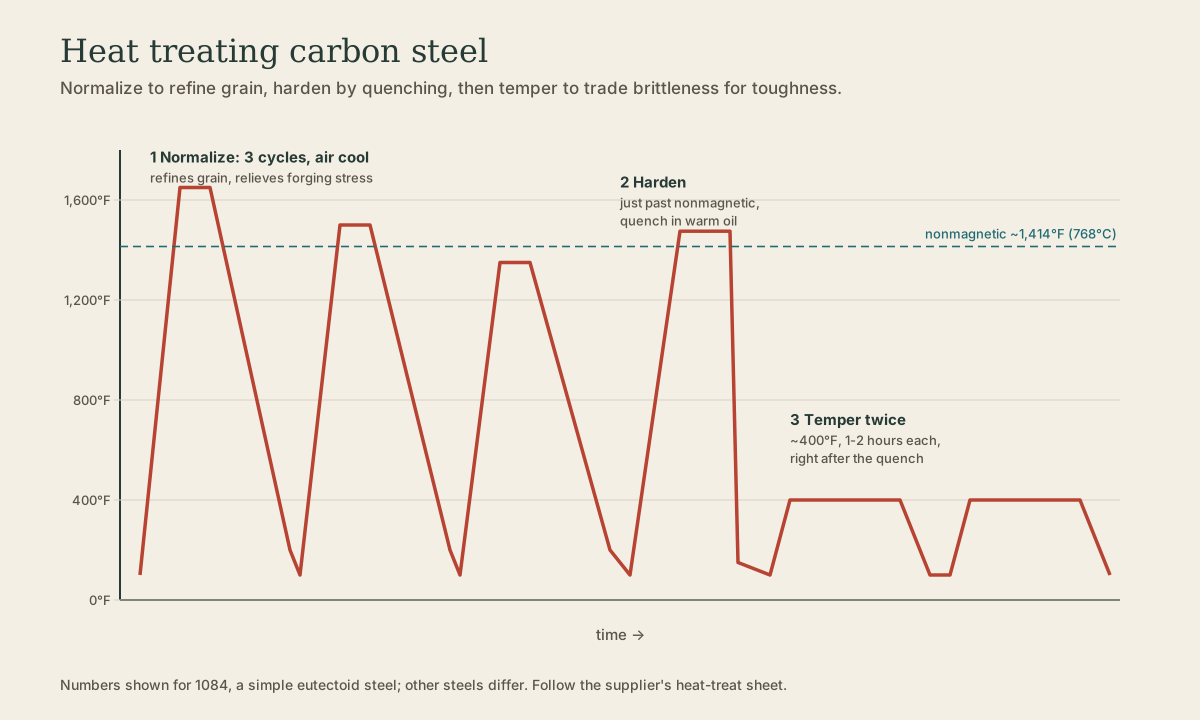
- Heat evenly to just past nonmagnetic. For 1084 the supplier gives 1,450-1,480°F with a 5-15 minute soak in a controlled furnace 2; in a forge, bring it slowly and evenly past the point where a magnet no longer sticks (about 1,414°F) and a little beyond. Don’t overheat: it coarsens the grain, causes cracks and warps, and makes the steel brittle.
- Quench immediately, moving the piece up and down (not side to side) in the quenchant, edge first.
- Check with a file: a properly hardened edge skates over a file without biting. As quenched, 1084 reaches about 64-65 HRC 2.
- Temper right away - quenched steel is brittle and can crack just sitting on the bench 1.
Quick check
Overheating coarsens the grain and causes cracking and brittleness.
Choosing a quench
| Quenchant | Speed | Notes |
|---|---|---|
| Water / brine | fastest | for water-hardening steels (W1); high risk of cracking and warping in others |
| Fast quench oil (Parks 50 type) | fast | the supplier’s choice for 1084 2 |
| Warm canola or mineral oil (about 120-130°F) | moderate | common hobby choice for 1084, 5160, O1 |
| Air | slowest | only for air-hardening steels (A2) |
Use enough oil (a gallon or more for a knife), in a metal container with a lid to smother flare-ups. Never quench oil-hardening steel in water.
Playback is optional. If the player is unavailable, open the video at its source.
What to take from this
Carbon makes steel hardenable; the AISI 10xx number’s last two digits give the carbon. Mild steel (1018, A36) barely hardens; 1084 and 1095 do. Bacon’s laws: more carbon means a lower hardening heat, and faster cooling means harder steel. Heat 1084 evenly just past nonmagnetic (1,450-1,480°F), quench in fast oil with an up-and-down motion, file-test, and temper immediately.
Lesson complete
Nice work.
Sources for this lesson
- 1Tempering (metallurgy). Wikipedia. 2026. verifiedQuenched steel is at its hardest and most brittle; tempering trades some hardness for toughness. Temper color table from faint yellow (about 349 F) through straw, brown, purple, and blues.
- 21084 Knife-Making Blade Steel. Blacksmiths Depot. verifiedSupplier heat-treat guidance for eutectoid 1084 - normalizing cycles stepping down from about 1,650 F, hardening at 1,450-1,480 F with a 5-15 minute soak, a fast oil quench (Parks 50), about 64-65 HRC as quenched, and tempering from 300 F (about 65 HRC) to 650 F (about 50 HRC).
- 3John Lord Bacon. Forge-Practice: Elementary. John Wiley & Sons. 1908. verifiedPublic-domain trade-school text from the Lewis Institute; fire building with coking coal, welding heat and fluxes (sand, borax, sal ammoniac), upsetting, drawing out, bending, punching, and tool-steel hardening and tempering colors (430 F pale yellow to 570 F blue, temper gone near 650 F).