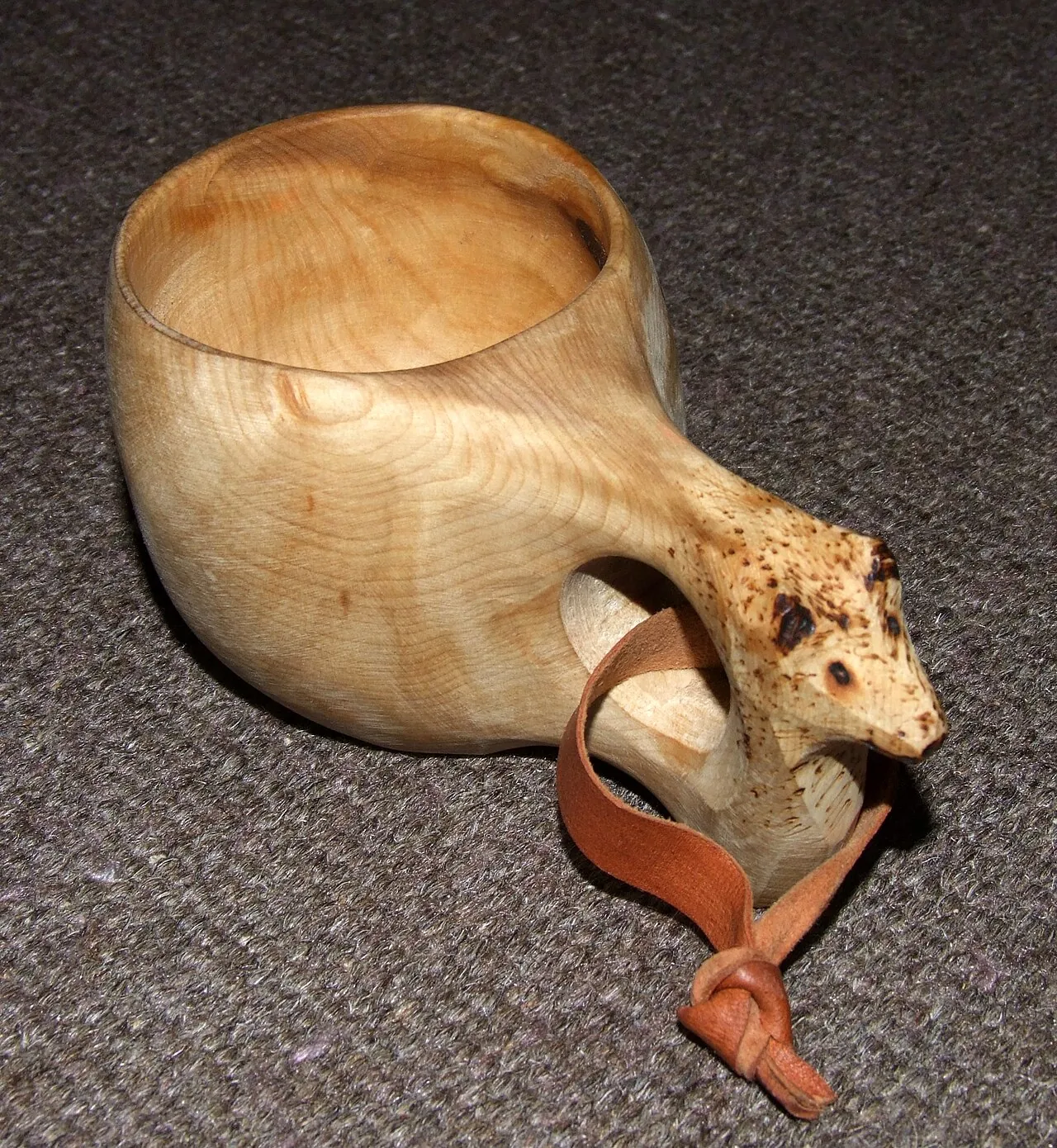
The Kuksa
The Sámi guksi, a drinking cup carved from birch burl: finding and harvesting a burl, why burl resists cracking, roughing with axe and saw, hollowing with hook knife or gouge, slow drying, the handle, and the plain care that keeps one for a lifetime.
- 4 min
- 6 steps
- 3 questions
- Lesson 8 of 204
In this lesson
- The cup
- The burl
- Carving
- Drying
- Care
- What to take from this
Picking up where you left off.
The cup
A kuksa (Finnish; guksi in Northern Sámi, kåsa in Swedish) is a personal drinking cup carved from birch burl, a traditional Sámi duodji (handicraft) of northern Scandinavia and Finland 1. Hung from a belt, it served for coffee, broth, and water on the trail. A well-made burl cup lasts a lifetime; plain birch versions crack far sooner 1.

Quick check
Burl’s swirling, interlocked grain resists splitting, so the cup survives drying and hot drinks for decades.
The burl
A burl is a rounded growth on a trunk or branch where the grain swirls and interlocks. That tangled grain is the point: green straight-grained birch checks along its rays as it dries, but burl has no single plane for a crack to run along.
- Finding one: birch burls are uncommon; look on dead or fallen trees, storm damage, and firewood piles. Get the landowner’s permission (state and national forests usually require a permit for forest products; see the Midwest Foraging course on permits).
- Harvesting: cut the burl off with a saw, leaving the tree’s wound as small as possible if it’s alive; on standing trees it’s kinder to wait for one on a felled or dead tree.
- Size: a burl about 12-15 cm across makes a cup, with room for a handle.
Without a burl, a kuksa can be carved from a straight-grained birch half-log with the bowl hollowed from the split face and the pith removed. It’s more likely to crack, and many first kuksas are made this way.
Quick check
Straight birch splits along the rays as it dries; burl’s tangled grain doesn’t.
Carving
- Rough the shape with a saw and axe: the cup’s outside, the flat top, and a stub for the handle. Leave walls thick at first, about 2 cm.
- Hollow with a hook knife or a bent gouge and mallet, working from the rim toward the center and across the grain, as with a spoon bowl 2. Burl tears unpredictably - keep tools very sharp and take small cuts.
- Shape the outside with the knife, matching the inside so the wall is even, ending at about 5-8 mm.
- Handle: a thumb loop or a single or double finger hole, carved through. Leave the wood thick around holes; that’s where short grain lurks.
- Decorate if you like: Sámi and Nordic cups often carry carved or kolrosed lines, or an antler or reindeer-bone inlay on the handle 3.
Drying
Dry it slowly. After roughing, let the cup rest in a paper bag with shavings for a week or more, out of sun and away from stoves, then let it finish drying at room conditions before final cuts. Some carvers also boil or soak the roughed cup in salted water; the evidence that it helps is anecdotal, and careful, slow drying is what the tradition stresses 1.
Care
Traditionally a guksi was only rinsed with clean water and wiped dry after use - no detergent 1. Many carvers oil the outside with a food-safe drying oil and leave the inside bare, or oil both and let it cure fully before use. Don’t leave it soaking, and keep it away from the dishwasher.
Playback is optional. If the player is unavailable, open the video at its source.
Quick check
Plain water and a cloth; detergent is thought to dry and damage the wood.
What to take from this
The kuksa is a Sámi drinking cup traditionally carved from birch burl, whose interlocked grain resists cracking. Rough the outside and handle with saw and axe, hollow across the grain with a hook knife or gouge, even the walls to 5-8 mm, keep wood thick around the handle hole, dry slowly, and care for it with plain water and a cloth.
Lesson complete
Nice work.
Sources for this lesson
- 1Guksi. Wikipedia. 2026. verifiedSámi drinking cup carved from birch burl, dried carefully to avoid cracking; traditionally only rinsed with water and wiped dry.
- 2Wille Sundqvist. Swedish Carving Techniques. Taunton Press (reissued by Abrams). 1990. verifiedAxe and knife grips, sharpening, and household woodenware such as butter paddles, spoons, ladles, and dough bowls.
- 3Jögge Sundqvist. Slöjd in Wood. Lost Art Press. 2018. verifiedPublisher excerpt (PDF) of the English translation of the Swedish classic; butter knife, spoons, bowls, sheath, hooks, and painted decoration in the Västerbotten tradition.