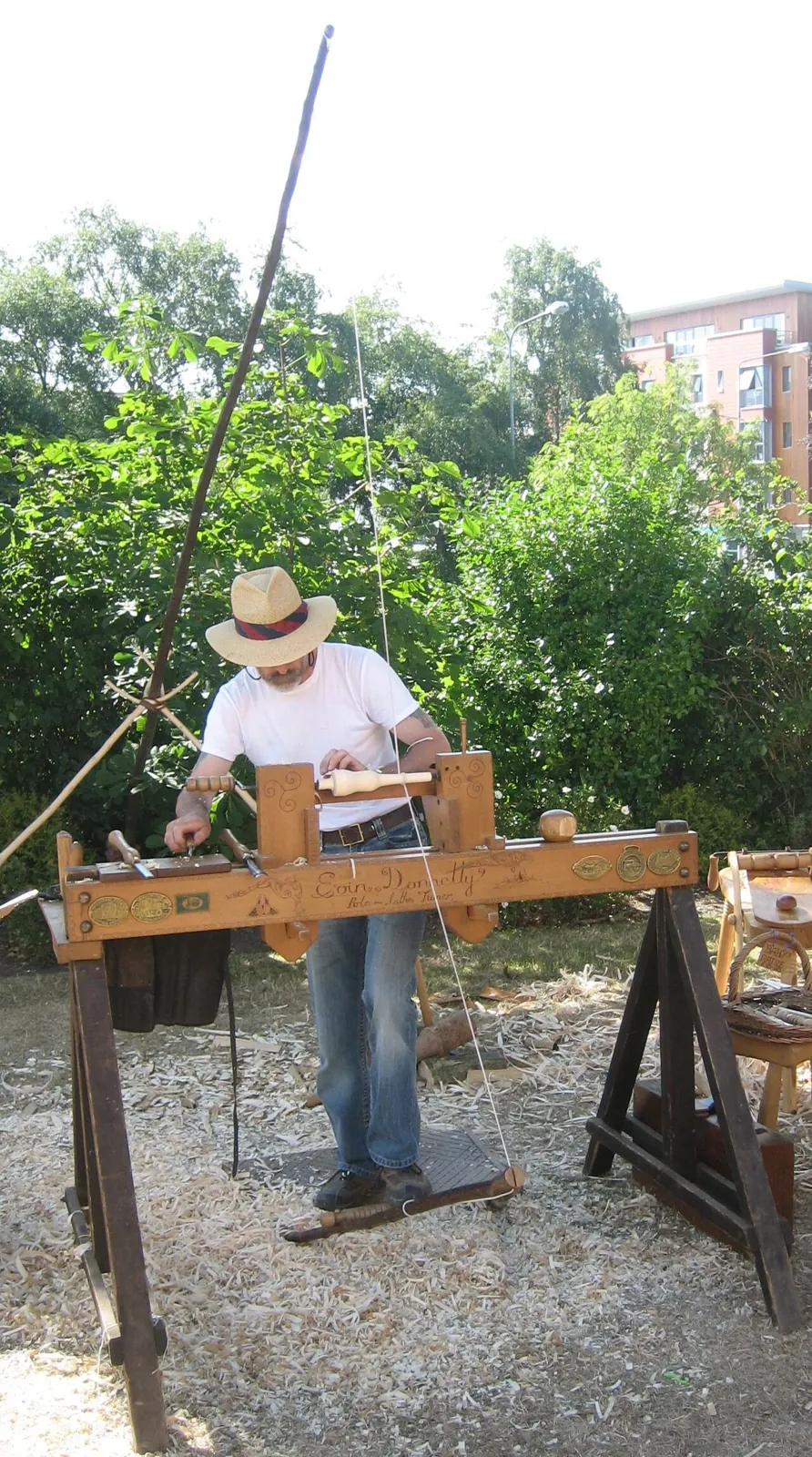
The Pole Lathe
The foot-powered spring-pole lathe: how the reciprocating drive works, building one from timber and a sapling or bungee, chisel and gouge technique for spindles, turning bowls on a mandrel with hook tools, and the English bowl-turning tradition of George Lailey and Robin Wood.
- 4 min
- 5 steps
- 3 questions
- Lesson 14 of 204
In this lesson
- How it works
- Building one
- Spindle turning
- Bowls on a mandrel
- What to take from this
Picking up where you left off.
How it works
A pole lathe uses a springy pole (or a bungee) as a return spring. A cord runs from the pole’s tip, wraps around the work, and ties to a treadle. Press the treadle and the work spins toward you while the pole bends; let up and the pole pulls the cord back, spinning the work the other way 1.

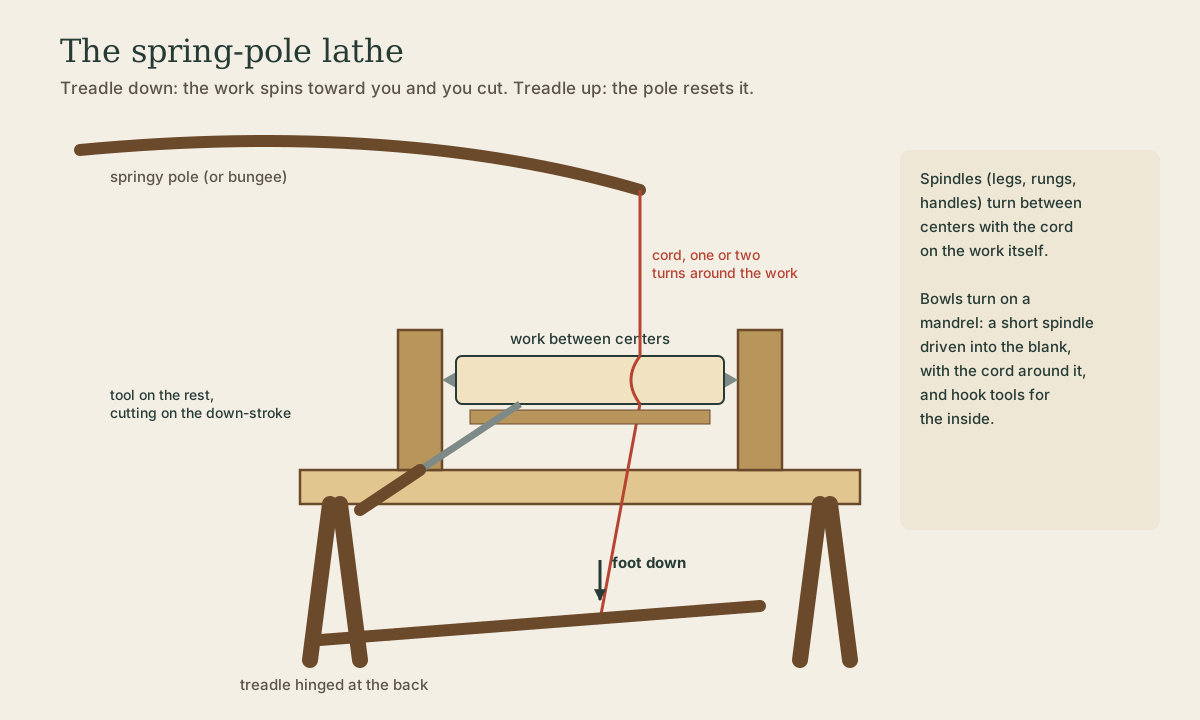
So the rotation is reciprocating, and you cut only on the down-stroke; on the up-stroke you ease off and wait 1. That halves your cutting time, but the machine is quiet, safe (it stops the moment your foot does), and costs almost nothing. Joshua Klein calls it accessible, safe, quiet, and humane, and compares a steady rhythm to a casual bicycle ride; once your foot keeps time on its own, your attention goes to the cut 2.
Its origins are ancient; the Vikings used pole lathes at Jórvík (York) 1. In England, “bodgers” turned chair legs in the beech woods of the Chilterns on pole lathes into the 20th century.
Quick check
On the return stroke the work spins backward, so you ease the tool off and wait.
Building one
The classic lathe is shop-made from green or air-dried timber 2:
- Bed: two heavy rails (or a split log) with a gap between them.
- Poppets: two uprights wedged through the bed, one fixed, one sliding, each with a steel center (a sharpened bolt).
- Tool rest: a bar along the front of the work.
- Treadle: a long board hinged at the back on the floor.
- Spring: an ash or hazel sapling 3-4 m long anchored overhead, or a bungee cord on a frame, which fits in a garage.
- Cord: leather thong, braided nylon, or rope.
Klein built his in white oak over a weekend 2.
Spindle turning
Spindles - chair legs, rungs, tool handles, rolling pins - turn between centers with the cord wrapped once or twice around the work itself.
- Rive and drawknife the blank roughly octagonal (see The Shaving Horse and Drawknife).
- Mount it between centers, cord around the middle (move it as you go).
- Rough with a gouge; plane smooth and cut beads and coves with a skew chisel.
- Work green. Dry wood turns slowly and roughly on a pole lathe 1.
Pole-lathe tools are ground nearer a carpenter’s chisel than power-lathe tools and honed and stropped keen. Never use a pole-lathe tool on a power lathe - the forces there could break it 1.
Playback is optional. If the player is unavailable, open the video at its source.
Quick check
Pole-lathe tools are honed keen for slow, green work; power lathes need stout, coarser-ground tools.
Bowls on a mandrel
Bowls turn face-on on a mandrel: a short spindle driven into the back of the bowl blank, with the cord wrapped around the mandrel rather than the bowl. The mandrel’s small diameter gives speed and leaves the bowl’s face free. The outside is shaped with a gouge; the inside is hollowed with hook tools - hand-forged, hook-ended blades that reach around the curve 3.
England’s last professional pole-lathe bowl turner, George Lailey (1869-1958) of Bucklebury Common in Berkshire, turned elm bowls in nests, one inside the next, from a single blank; his lathe and tools are at the Museum of English Rural Life 4. Robin Wood later revived it, working out the technique partly by studying Lailey’s surviving tools; he wrote the history of the wooden bowl over four thousand years 3, and now makes carving tools in Sheffield.
Playback is optional. If the player is unavailable, open the video at its source.
Quick check
The mandrel gives the cord a small diameter to grip, for speed, and leaves the face free for hook tools.
What to take from this
The pole lathe uses a springy pole and a treadle cord for reciprocating rotation, cutting only on the down-stroke; it’s quiet, safe, and cheap to build from timber and a sapling or bungee. Turn spindles between centers with gouge and skew, green, from a drawknifed octagon, and never take pole-lathe tools to a power lathe. Bowls turn face-on on a mandrel with hook tools, the English tradition of George Lailey and Robin Wood.
Lesson complete
Nice work.
Sources for this lesson
- 1Pole lathe. Wikipedia. 2026. verifiedSpring pole returns the treadle; cutting only on the downstroke; reciprocating rotation; tools ground closer to carpenter's chisel angles; Viking use at Jórvík; best with green wood.
- 2Joshua A. Klein. The Spring Pole Lathe: Design, Construction, and Use. Mortise & Tenon Magazine, Issue 3. 2017. verifiedA heavy white oak spring-pole lathe built in a weekend; accessible, safe, and quiet; on rhythm, the effort is like a casual bicycle ride.
- 3Robin Wood. The Wooden Bowl. Stobart Davies. 2005. verifiedHistory of the turned wooden bowl over 4,000 years, lathe technology, tools, and timbers, by the English pole-lathe bowl turner.
- 4George Lailey. Wikipedia. 2026. verifiedLast professional pole-lathe bowl turner in England (1869-1958), of Bucklebury Common, Berkshire; turned elm bowls in nests; tools now at the Museum of English Rural Life.