Notches: Saddle, Dovetail, and Lock
How log corners lock together: saddle, V, half-dovetail, full dovetail, and square notches, crowns, why notch type hints at but doesn't prove a builder's origin, and how notches shed water.
- 3 min
- 5 steps
- 3 questions
- Lesson 60 of 204
In this lesson
- What notches do
- The notches
- Shedding water
- Reading notches
- What to take from this
Picking up where you left off.
What notches do
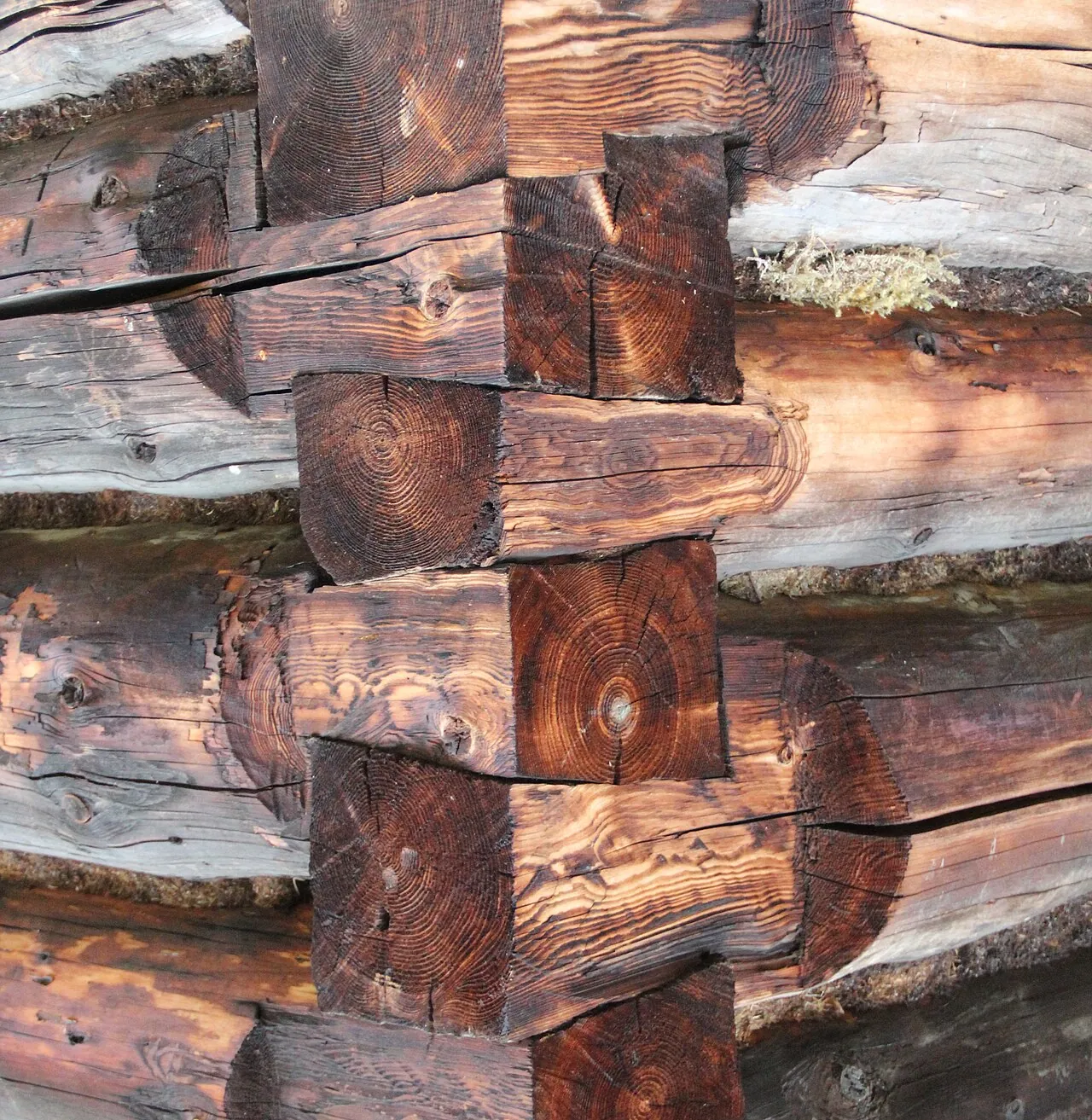
Corner notches lock log ends together, giving the walls rigidity without nails or pegs 1. Each course crosses the course below at the corners.

The notches
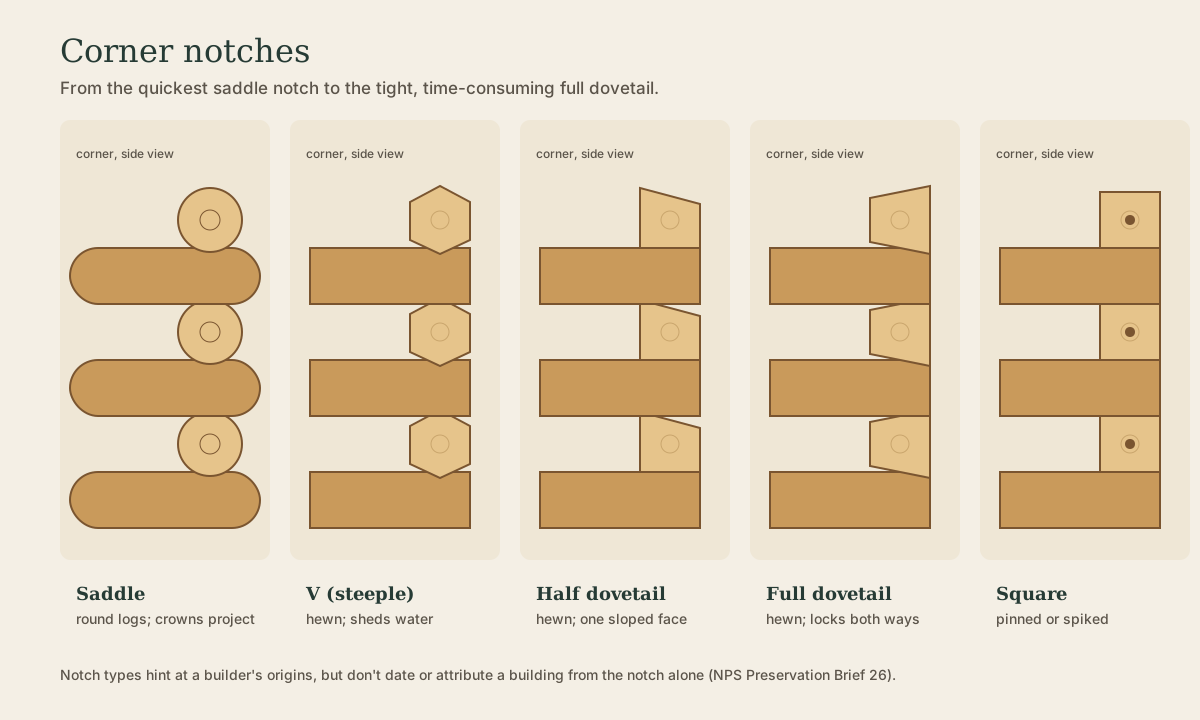
The NPS identifies five common historic notches 1:
| Notch | Logs | Character |
|---|---|---|
| Saddle | round | simplest; minimal time and skill; leaves projecting log ends (“crowns”) |
| V (steeple) | hewn | very common; the end is shaped like a roof peak |
| Half-dovetail | hewn | probably one of the most common; one sloped face locks one direction |
| Full dovetail | hewn | one of the tightest; slopes lock both directions; slow to cut |
| Square | hewn | simple butt corner, held with pegs or spikes |
Crowns: saddle notches usually leave the log ends projecting past the corner; Rustic-style buildings exaggerate them, sometimes cutting them shorter as the wall rises for a buttressed look 1.
Scribe-fit round-log builders use a refined saddle (round) notch, sometimes with compression-fit details that tighten as the logs settle 2. The lock notch (or Scandinavian cope) in modern full-scribe work combines a saddle with the long groove so the corner seals as tightly as the wall.
Some buildings skip notches (“false notching”): log ends are tenoned into vertical corner posts, or pegged to corner planks 1.
Playback is optional. If the player is unavailable, open the video at its source.
Quick check
The saddle needs minimal time and skill; the half-dovetail is probably the most common.
Shedding water
A notch must drain. Water that sits in a cupped notch rots logs from the inside out.
- Saddle notches cut into the underside of the upper log, not the top of the lower one, so the lower log keeps a rounded crown that sheds water.
- V and dovetail notches slope downward and outward so water runs out of the joint.
- Long overhangs and gutters keep corners dry.
Quick check
A notch that cups water rots from the inside.
Reading notches
Notch type can be a clue to a builder’s ethnic craft origin, but the NPS warns against drawing conclusions from notching alone 1. Builders learned from neighbors, and one region often shows several notch types side by side.
Quick check
Builders borrowed freely; use floor plans, tools marks, and records too.
What to take from this
Saddle, V, half-dovetail, full dovetail, and square notches lock log corners; the saddle is quickest, the full dovetail tightest and slowest, the half-dovetail among the most common. Cut notches so they shed water - saddle notches in the upper log, dovetails sloping out - and treat notch type as a clue, not proof, of who built a building.
Lesson complete
Nice work.
Sources for this lesson
- 1Bruce D. Bomberger. Preservation Brief 26: The Preservation and Repair of Historic Log Buildings. National Park Service, Technical Preservation Services. verifiedFinnish and Swedish settlers introduced horizontal log building in New Sweden in 1638; Scandinavian and Finnish immigrants brought techniques to the Upper Midwest; saddle, V, full dovetail, half-dovetail, and square notches; chinking and daubing; stone foundations and sill logs; few tools needed.
- 2Robert Wood Chambers. Log Construction Manual: The Ultimate Guide to Building Handcrafted Log Homes. Deep Stream Press. 2016. verifiedScribe-fit round-log construction from sill logs up - log selection rules, compression-fit saddle notches, scribing and cutting long grooves and notches, and log roof systems.