Indigo, and Dyeing One Color over Another
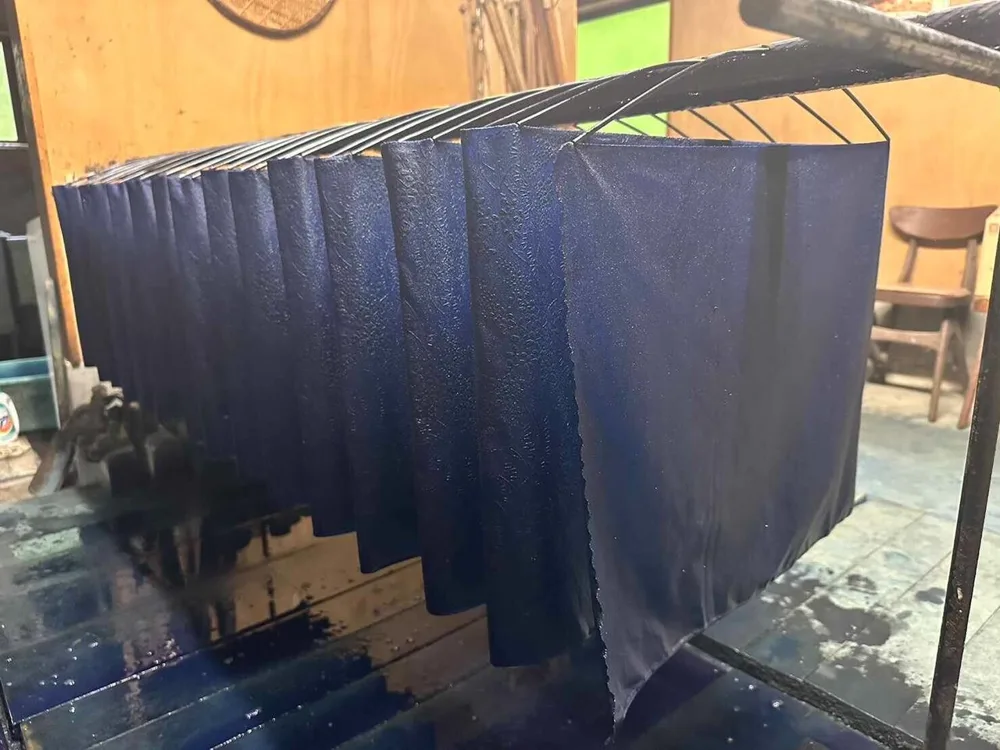
Indigo is the only natural blue in this course, and it works differently from every other dye: it won't dissolve in water, so it has to be chemically reduced in an alkaline vat, where it turns yellow-green, and it turns blue only when the dipped yarn meets the air. The USDA's fermentation blue-pot and hydrosulphite vat. Then top-dyeing: goldenrod and indigo for green, indigo and walnut for black, goldenrod and madder for terra cotta.
- 5 min
- 6 steps
- 3 questions
- Lesson 111 of 204
In this lesson
- How a vat works
- The fermentation vat
- The hydrosulphite vat
- Top-dyeing
- Try it
Picking up where you left off.
Every dye so far dissolves in water and soaks into mordanted wool. Indigo doesn’t, and that makes it one of the most interesting things you can do in a dye pot.
How a vat works
Indigo is one of the oldest dyes known, probably first used in India and Egypt. When it reached Europe in the 1500s it met much opposition from growers of a similar native dye, woad. On wool and cotton alike it gives a dark blue, very fast to light and washing, and it needs no mordant 1.
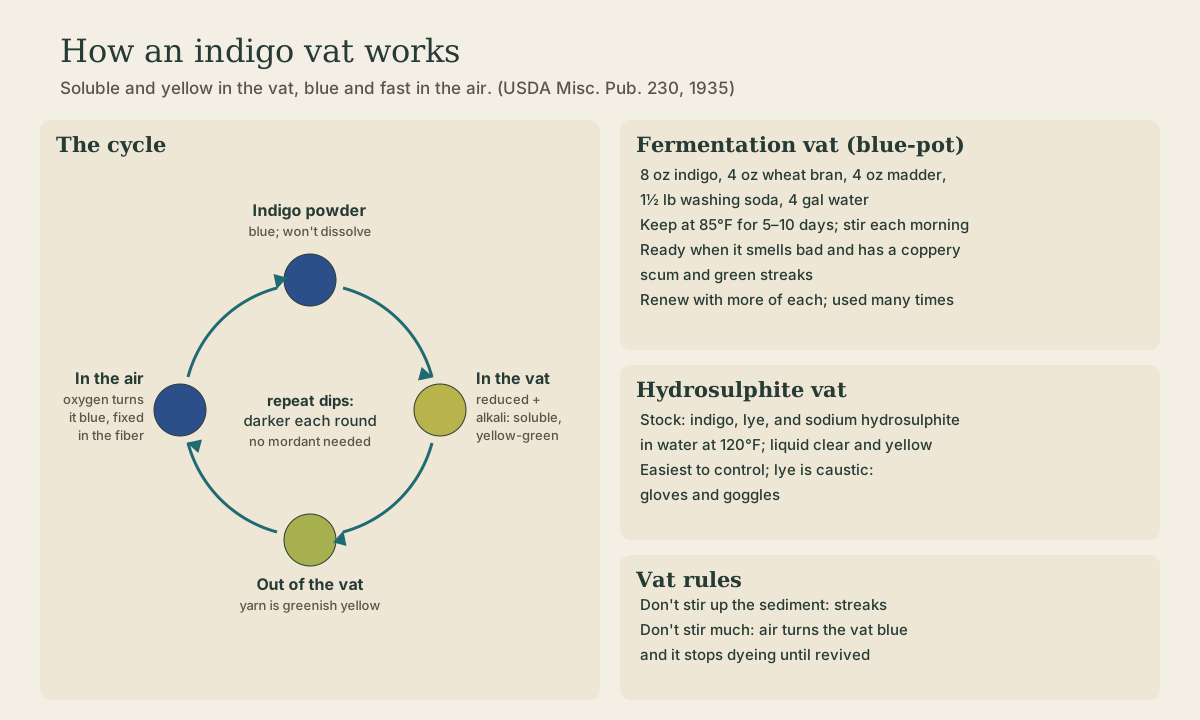
The trick is that indigo won’t dissolve in water. It’s a vat dye: it has to be chemically reduced and dissolved in an alkali before fiber can take it up. Yarn dipped in a working vat comes out greenish yellow, and turns blue in the air. You build the color by dipping and airing over and over until it’s dark enough 1.
Quick check
Repeated dipping and airing builds the blue.
The fermentation vat
The fermentation vat, or blue-pot, is the oldest method. Bacteria growing in the vat do the reducing. It takes patience, but the USDA found no difficulty getting a fast dark blue on wool or cotton from a well-made one 1.
For each pound of wool or cotton 1:
- 8 ounces finely powdered indigo
- 4 ounces wheat bran
- 4 ounces madder
- 1½ pounds washing soda (sodium carbonate)
- 4 gallons water
Mix them and keep the pot in a warm place, about 85°F, for 5 to 10 days, stirring it well each morning. It’s ready when it develops a disagreeable odor, a bluish, coppery scum on top, and green streaks through it 1.
To dye, wet the yarn thoroughly and dip it in the lukewarm vat, lifting it into the air at intervals. Keep dipping and airing for 30 minutes, squeeze out the dye, and let it air half an hour. Repeat, leaving the yarn in longer each time, until the blue is dark enough; fewer rounds give medium and light blues. Then rinse in lukewarm water and dry 1.
Two vat rules. Don’t disturb the sediment at the bottom, or the yarn streaks. And don’t stir too much, or the vat turns blue and won’t dye. If that happens, add more indigo, bran, madder, and soda; in a day or two it’s ready again. Kept up this way, a blue-pot can be used many times 1.
Quick check
A blue-pot can be revived with more indigo, bran, madder, and soda.
The hydrosulphite vat
The USDA called the hydrosulphite vat the easiest to regulate, and in 1935 it was the one in wide commercial use. It uses a chemical reducer, sodium hydrosulphite, and lye (sodium hydroxide) instead of bacteria and soda. The stock solution is 4½ ounces of powdered indigo mixed with 3 ounces of lye dissolved in water, made up to a gallon and heated to 120°F, with the hydrosulphite stirred in slowly; after half an hour it should be clear and yellow 1. Lye is caustic. If you make this vat, wear gloves and eye protection.
The USDA’s dipping routine for this vat: wet the cloth, keep it under the surface for 30 minutes, hang it in the air for 30 minutes without rinsing, and repeat until the color is right. Then rinse, wash in soapsuds, and rinse again 1.

Playback is optional. If the player is unavailable, open the video at its source.
Top-dyeing
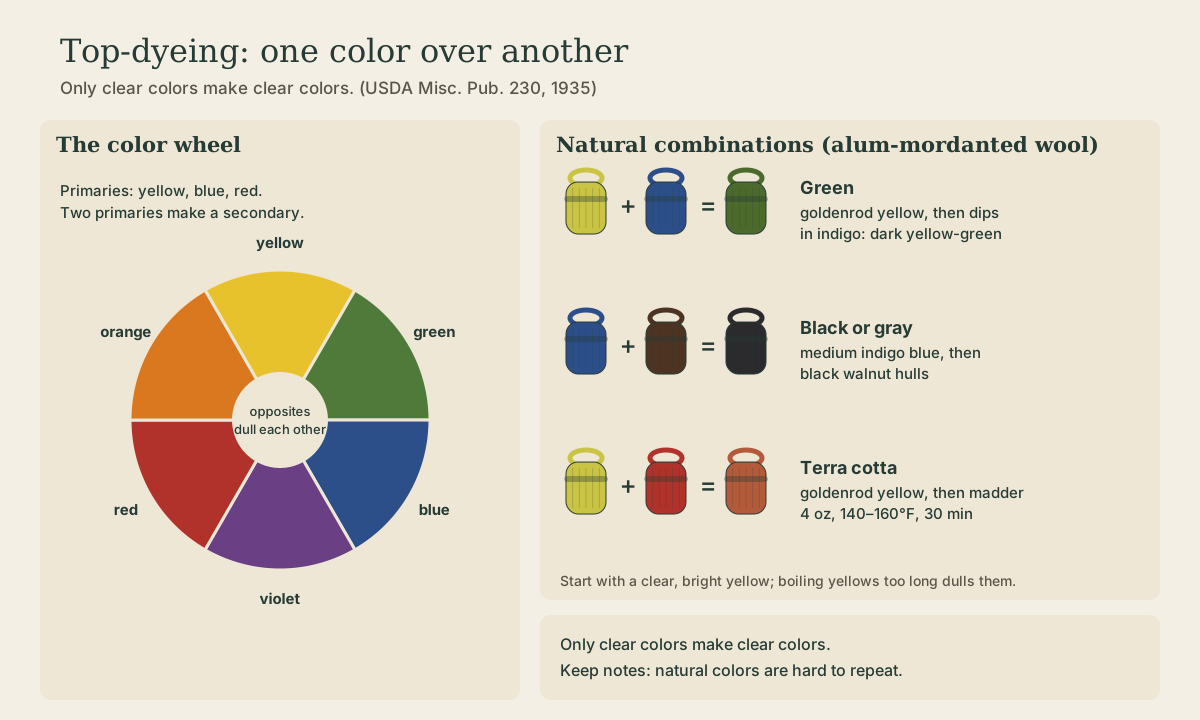
Top-dyeing, dyeing one color over another, is how natural dyers get greens, purples, and blacks. The USDA’s rule: only clear colors make clear colors. For a good green, start with a bright, clear yellow, not a muddy yellow-tan, and top it with a good blue. Long boiling dulls yellows, so don’t overdo them 1. The bulletin’s color wheel explains the rest: yellow and blue make green, blue and red make violet, red and yellow make orange, and a little of a color’s opposite on the wheel softens it 1.
Three combinations that need nothing but alum, all from the bulletin 1:
- Green. Mordant wool with alum and dye it with goldenrod. Rinse well and dip it in either indigo vat until the green is dark enough: a dark yellow-green. You can also dye the indigo first and the yellow second; if so, mordant with alum before or after the indigo.
- Black or gray. Mordant with alum and dye a medium blue in indigo. Rinse, then dye with black walnut hulls following the dark brown recipe. The result is black or gray, depending on how deep each color went.
- Terra cotta. Mordant with alum and dye with goldenrod. Rinse, then put the yarn in a bath of 4 ounces of madder, soaked overnight, heat gradually to 140–160°F, and hold it there 30 minutes.
The USDA’s red-purple, indigo topped with cochineal, used its tin-based cochineal recipe 1, so it’s not listed here.
Quick check
Goldenrod on alum, then indigo, gives a dark yellow-green.
Try it
Take one of the goldenrod skeins from the yellows lesson and divide it. Leave one half yellow; top-dye the other in madder for terra cotta. If you set up an indigo vat, dip a third piece for green. Hang the three together; that’s the whole idea of top-dyeing.
Lesson complete
Nice work.
Sources for this lesson
- 1Margaret S. Furry, Bess M. Viemont. Home Dyeing with Natural Dyes (Miscellaneous Publication No. 230). U.S. Department of Agriculture, Bureau of Home Economics. 1935. verifiedTests of about 65 natural dye materials on cotton and wool; only colors fast to light and washing were given recipes. Wool dyes most easily; cotton only by complicated processes. Home light test: dyed cloth between two cards with matching 2-inch windows, outdoors tilted toward the sun a few days. Home wash test: 2 by 4 inch dyed piece sewn to undyed cloth. Equipment: scales, enamel or copper kettles (iron darkens, tin makes colors harsh), measures, cheesecloth, smooth sticks, thermometer, rubber gloves, line in the shade, soft water. Weigh dry first. Wool scour: 3/4 oz neutral soap per pound in 5 gal at 95 F, 30 min, again with 1/4 the soap, rinse 3 or 4 times at the same temperature; never wring; sudden temperature changes shrink wool. Mordants: alum, chrome (potassium dichromate), copperas, tannin. Wool alum mordant: 4 oz potash alum and 1 oz cream of tartar per pound in 4 to 4 1/2 gal, heat gradually, boil gently 1 hour, cool overnight. Cotton: alum with washing soda, or alum-tannin-alum. Dye baths: at least 4 to 4 1/2 gal per pound or streaks; wool in lukewarm, heat gradually, keep moving; rinse until clear (crocking from poor rinsing); dry in shade; dye all of a color at once because natural colors can't be matched. Not fast: annatto, barberry root, beets, crab-apple peel, blackberry, blueberry, cranberry, pokeweed, purple iris, mosses, peach leaves, red roses, sumac leaves, turmeric, willow leaves. Bark colors combined with tannin often darken in light. Butternut hulls (alum) fast brown, iron darkens to black. Cochineal from an insect of Mexico and Central America; alum, 1 oz per pound, American beauty red; not for cotton. Goldenrod flowers picked coming into bloom: with alum, greenish yellow not fast to light; with indigo dark greens; with madder terra cotta. Indigo needs no mordant; vat dye reduced and dissolved in alkali; greenish yellow in the vat, blue in air; fermentation blue-pot (8 oz indigo, 4 oz bran, 4 oz madder, 1 1/2 lb washing soda, 4 gal, 85 F, 5 to 10 days) and hydrosulphite vat. Madder: Egyptians, Moors, Netherlands; replaced by synthetic alizarin; 8 oz per pound with alum, lacquer red, very fast; dark red at 140-160 F without boiling. Onion skins 10 oz dry, alum: burnt orange, fair. Black walnut hulls on unmordanted wool: dark brown, good; long boiling makes wool harsh. Lichens used by peasant dyers of Sweden, Scotland, and Ireland. Top-dyeing: clear colors make clear colors; goldenrod plus indigo green; indigo plus walnut black or gray; goldenrod plus madder terra cotta.