Yellows and Oranges: Goldenrod, Onion Skins, Marigolds
Yellow is the easiest natural color and the most common. Goldenrod from the roadside, the dry skins of yellow onions, and garden marigolds, with the USDA's recipes and an honest note on what you give up by using alum instead of the chrome those recipes relied on.
- 4 min
- 6 steps
- 3 questions
- Lesson 108 of 204
In this lesson
- Onion skins
- Goldenrod
- Marigolds
- Yellows and iron
- Try it
Picking up where you left off.
Yellow comes from more plants than any other color. In the USDA bulletin’s index of colors, the yellow list has about twenty entries, from apple bark to zinnias 1. Three are especially easy to get.
Onion skins
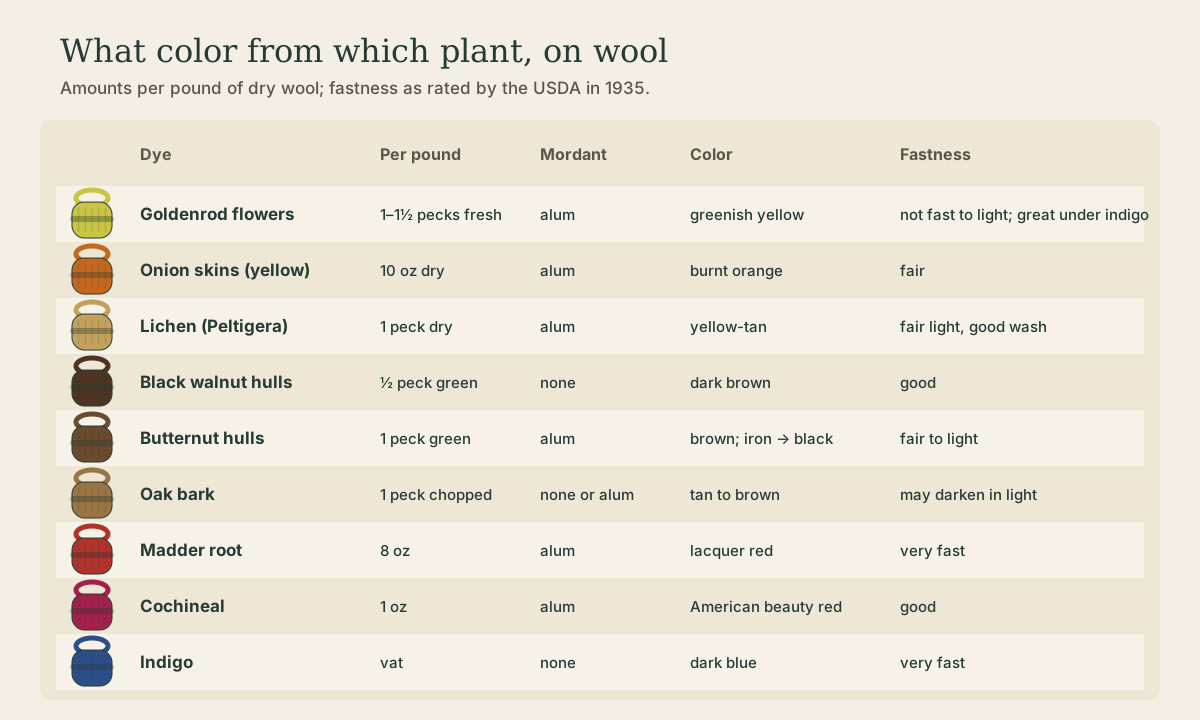
The dry, papery outer skins of onions have long been used to color cloth. On wool, the skins of yellow onions give a burnt orange with an alum mordant, rated fair for fastness 1. They’re free, they keep, and a kitchen produces them steadily: save them in a paper bag until you have enough.
Burnt orange, for 1 pound of alum-mordanted wool 1:
- Boil 10 ounces of dry yellow onion skins in water to cover for 15 minutes.
- Strain, and add cold water to make 4 to 4½ gallons.
- Put in the wet, rinsed wool, stir carefully, and boil for 30 minutes. Rinse and dry.
On cotton, onion-skin colors are poor 1, so save them for wool.
Quick check
The USDA rated it fair; 10 ounces of dry skins dye a pound of wool.
Goldenrod
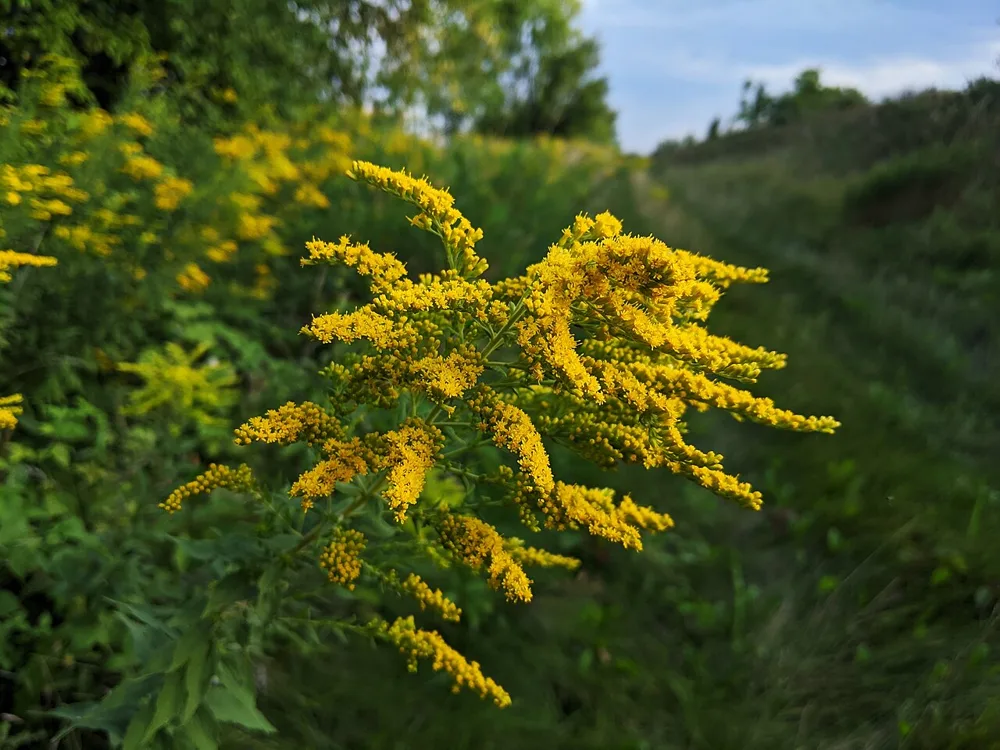
Goldenrod grows wild in fields and along roadsides. Pick the flowers as they’re coming into bloom and use them fresh 1.
.jpg)
Here’s the catch. The USDA’s best goldenrod colors, a brass and a yellow-brown fast to light and washing, both used chrome. On alum alone, goldenrod gives a greenish yellow, and the bulletin found that color not fast to light 1. It’s a cheerful yellow for yarn that stays out of strong sun, and run your own light test before you decide. Its real value is as a base for other colors: goldenrod with indigo gives dark greens, and with madder, terra cotta and rose-brown, all fast to light and washing 1. The last lesson covers top-dyeing.
Greenish yellow, for 1 pound of alum-mordanted wool, following the USDA’s goldenrod method 1:
- Boil 1 to 1½ pecks of fresh goldenrod flowers in water to cover for 10 to 15 minutes.
- Strain, and add cold water to make 4 to 4½ gallons.
- Put in the wet wool and boil for 20 minutes. Rinse and dry.
Long boiling dulls goldenrod’s yellow 1, so don’t overdo it.
Playback is optional. If the player is unavailable, open the video at its source.
Quick check
It’s still a fine yellow for things kept out of strong sun, and an excellent base for green under indigo.
Quick check
The USDA recipes call for fresh flowers just opening.
Marigolds
Garden marigolds (Tagetes) carry a coloring matter similar to that in black oak bark. Fresh or dry flower heads work; if dry, use a third to a half as much 1. Both of the USDA’s marigold recipes used chrome, either as the mordant or in an afterbath, to get a fast brass and a dark yellow-tan 1. With alum alone you’re outside the bulletin’s tested recipes, so dye a sample skein, try the light test, and judge for yourself.
Yellows and iron
A pinch of iron shifts yellows toward olive and green. Earth Guild’s method: dye alum-mordanted wool, then add iron to the bath a little at a time, dissolve it, and return the wool. Iron “saddens” colors, and too much hardens wool and makes it streak 2.
Try it
Dye one 4-ounce mordanted skein with onion skins, using a quarter of the recipe: 2½ ounces of skins in about a gallon of water. When it’s done, put a few strands in your light-test frame next to a strand of any goldenrod yellow you dye, and see which holds up better.
Lesson complete
Nice work.
Sources for this lesson
- 1Margaret S. Furry, Bess M. Viemont. Home Dyeing with Natural Dyes (Miscellaneous Publication No. 230). U.S. Department of Agriculture, Bureau of Home Economics. 1935. verifiedTests of about 65 natural dye materials on cotton and wool; only colors fast to light and washing were given recipes. Wool dyes most easily; cotton only by complicated processes. Home light test: dyed cloth between two cards with matching 2-inch windows, outdoors tilted toward the sun a few days. Home wash test: 2 by 4 inch dyed piece sewn to undyed cloth. Equipment: scales, enamel or copper kettles (iron darkens, tin makes colors harsh), measures, cheesecloth, smooth sticks, thermometer, rubber gloves, line in the shade, soft water. Weigh dry first. Wool scour: 3/4 oz neutral soap per pound in 5 gal at 95 F, 30 min, again with 1/4 the soap, rinse 3 or 4 times at the same temperature; never wring; sudden temperature changes shrink wool. Mordants: alum, chrome (potassium dichromate), copperas, tannin. Wool alum mordant: 4 oz potash alum and 1 oz cream of tartar per pound in 4 to 4 1/2 gal, heat gradually, boil gently 1 hour, cool overnight. Cotton: alum with washing soda, or alum-tannin-alum. Dye baths: at least 4 to 4 1/2 gal per pound or streaks; wool in lukewarm, heat gradually, keep moving; rinse until clear (crocking from poor rinsing); dry in shade; dye all of a color at once because natural colors can't be matched. Not fast: annatto, barberry root, beets, crab-apple peel, blackberry, blueberry, cranberry, pokeweed, purple iris, mosses, peach leaves, red roses, sumac leaves, turmeric, willow leaves. Bark colors combined with tannin often darken in light. Butternut hulls (alum) fast brown, iron darkens to black. Cochineal from an insect of Mexico and Central America; alum, 1 oz per pound, American beauty red; not for cotton. Goldenrod flowers picked coming into bloom: with alum, greenish yellow not fast to light; with indigo dark greens; with madder terra cotta. Indigo needs no mordant; vat dye reduced and dissolved in alkali; greenish yellow in the vat, blue in air; fermentation blue-pot (8 oz indigo, 4 oz bran, 4 oz madder, 1 1/2 lb washing soda, 4 gal, 85 F, 5 to 10 days) and hydrosulphite vat. Madder: Egyptians, Moors, Netherlands; replaced by synthetic alizarin; 8 oz per pound with alum, lacquer red, very fast; dark red at 140-160 F without boiling. Onion skins 10 oz dry, alum: burnt orange, fair. Black walnut hulls on unmordanted wool: dark brown, good; long boiling makes wool harsh. Lichens used by peasant dyers of Sweden, Scotland, and Ireland. Top-dyeing: clear colors make clear colors; goldenrod plus indigo green; indigo plus walnut black or gray; goldenrod plus madder terra cotta.
- 2The Mordant Riff. Earth Guild (Asheville, North Carolina). 1998. verifiedSubstantive dyes (lichens, walnut hulls) need no mordant; adjective dyes do: the mordant enters deeply into the fiber and the dye combines with it. Wool is easiest. Non-reactive pot, unchipped enamel or stainless; brass, copper, or iron pots mordant on their own. Soak wool several hours; never put dry fiber in a mordant or dye pot. Simmer an hour, do not boil; heat and agitation cause felting; cool overnight. Mordanted wool can be stored wet or dry. Never use the same pots for cooking and dyeing; don't breathe fumes. Alum with cream of tartar: 3 oz alum and 1 oz cream of tartar per pound, 4 for heavy wool; too much makes wool sticky. Iron saddens; tin blooms but is caustic and makes wool brittle; blue vitriol is poisonous. Test colorfastness; fading happens with berries and some flowers.