Pick-Up Patterns
Day one afternoon and day two: wind a warp with thick pattern ends, read a pick-up chart one row per pick, bring up the pattern ends the row calls for and drop the rest, the pairs-or-pivot rule for even and odd pattern counts, Torgenrud's Hallingdal hairband draft, and finishing the band.
- 2 min
- 4 steps
- 2 questions
- Lesson 195 of 204
In this lesson
- The pick-up warp
- Read the chart
- The band
- Finish
Picking up where you left off.
The pick-up warp
Pick-up bands have two kinds of warp: thin ground ends and thicker pattern ends. “The pattern threads… need to be at least twice as large as the background threads” 1.
Torgenrud’s Hallingdal hairband draft 2:
- 37 ends: 11 pattern ends of red Möbelåtta 8/2 wool, 24 background ends of 8/2 cotton, and 2 red selvedge ends.
- Natural cotton weft; the band is 1/2 inch wide.
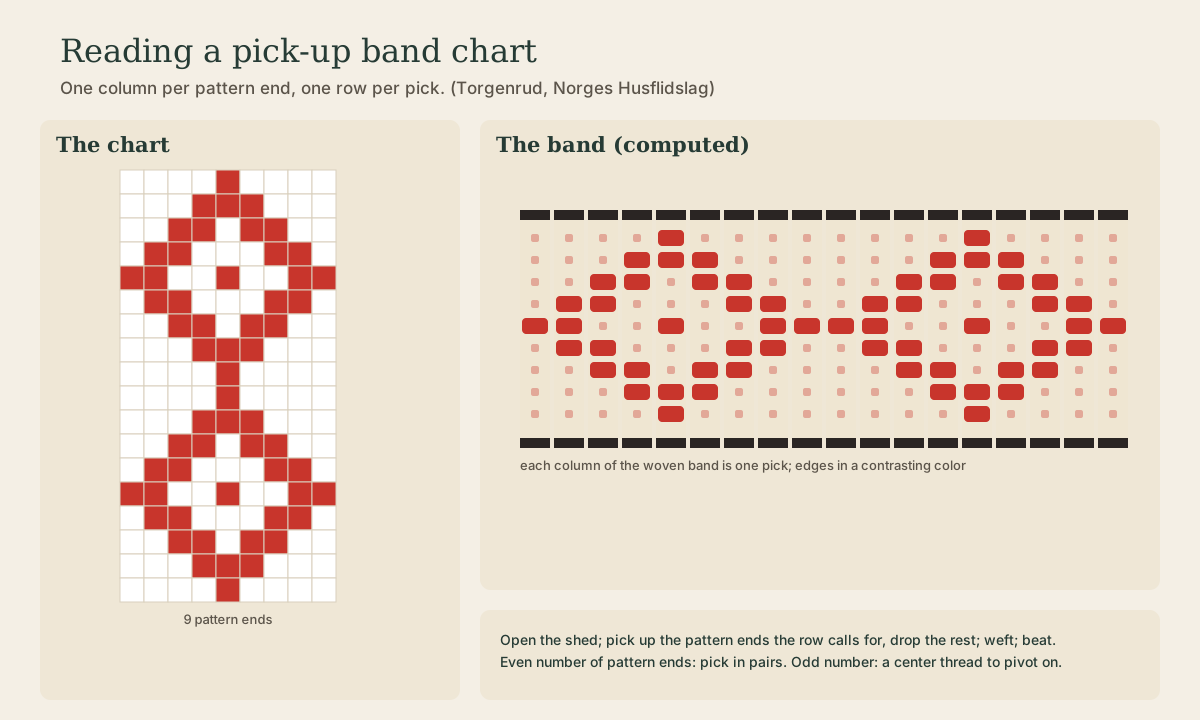
Norges Husflidslag’s band has 37 ends with 9 pattern ends, warped center first 3. Wind about 2 meters of each end for a band of a meter or more.
Quick check
Thick pattern ends stand out on the face and cover the ground.
Read the chart
A pick-up chart has one column per pattern end and one row per pick. A filled square means bring that pattern end up to float on the face; an empty square means leave it down.
- Open the shed.
- With a pick-up stick or your fingers, bring up the pattern ends the row calls for and push the others down.
- Pass the weft and beat.
- Change sheds and do the next row.
Torgenrud’s rule: an even number of pattern ends is picked in pairs; an odd number gives a center thread for the design to pivot on 2.
Playback is optional. If the player is unavailable, open the video at its source.
Quick check
An even number of pattern ends is picked in pairs instead.
The band
North House’s class weaves a band of 36 to 72 inches and aims to have students design their own 4. Once a chart is in your hands, draw your own on graph paper with the same number of columns as pattern ends: diamonds, zigzags, and crosses are the old forms.
Finish
Cut the band off, leaving 6 inches of warp at each end. Knot the warp in small groups against the last weft, or braid it into ties, or fold the end and stitch it, as on the Nordfjord swaddling band’s bound end.
Try it
Before weaving the hairband, chart one repeat on graph paper and weave it once slowly, saying each row’s picks aloud. Speed comes on the second repeat.
Lesson complete
Nice work.
Sources for this lesson
- 1Kate Larson. Backstrap Rigid Heddle Basics. Spin Off. 2023. verified'The pattern threads… need to be at least twice as large as the background threads'; 'tie the far end of the warp to something secure and the near end of the warp to your belt.'
- 2Heather Torgenrud. A New Book on Pick-up Bandweaving. Norwegian Textile Letter. 2014. verifiedBand heddle vs spaltegrind (extra slots for pattern ends). Hallingdal hairbands: red wool pattern on unbleached cotton, 0.75-1.5 cm wide, about 3.7 m long. Her hairband: 37 ends = 11 pattern ends of red Möbelåtta 8/2 wool + 24 background of 8/2 cotton + 2 red selvedge ends, natural cotton weft, 1/2 in wide. An even number of pattern ends is picked in pairs; an odd number gives a center pivot.
- 3Randi Hole. Plukkbånd på grindvev. Norges Husflidslag. 2023. verifiedA pick-up band of 37 ends with 9 pattern ends: edges of rust wool and green linen 16/2, ground of yellow linen 16/2, pattern of charcoal 2-ply wool embroidery yarn with a rose center thread, weft of green linen; warp the center thread first. Band pillows of Nord-Østerdalen; bands used as swaddling bands, stocking bands, belts, suspenders.
- 4Scandinavian (Pick Up) Band Weaving. North House Folk School. verifiedCaroline Feyling, Apr 19-20, 2027, 9-5; tuition $230, materials $40. Patterned bands woven 'backstrap style on a grindvev (band heddle)'; a sample and a band 36-72 in; goal: 'design, set up, and weave pickup bands independently'; tool kit provided.