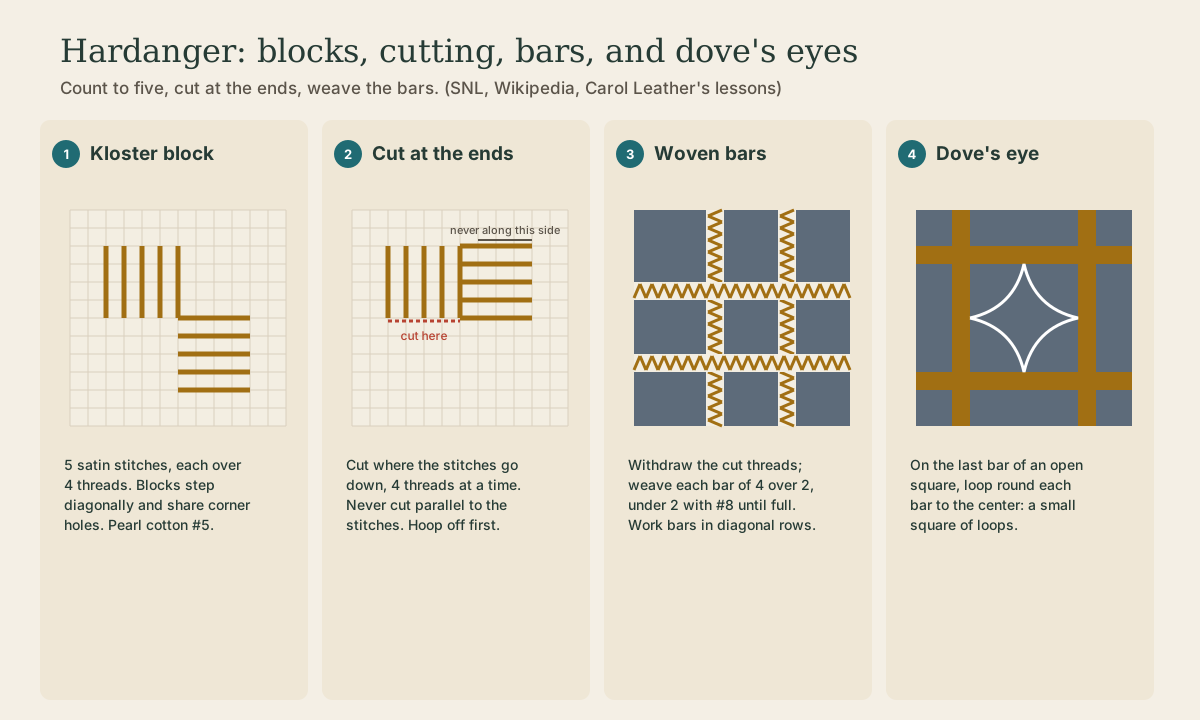
Kloster Blocks and Cutting
Day one: start without a knot, stitch kloster blocks of five satin stitches over four threads in a stepped diamond, follow the numbers so the stitches hold when cut, end threads by weaving under, and cut only at the ends of the blocks, four threads at a time.
- 2 min
- 3 steps
- 2 questions
- Lesson 191 of 204
In this lesson
- Kloster blocks
- Cutting
- Try it
Picking up where you left off.
Kloster blocks
A kloster block is five satin stitches side by side, each over four threads 1. On the front the stitches run straight with the grain; on the back they cross diagonally 2. Work them in pearl cotton #5:
- Start with a waste knot on the front, away from where you’ll stitch, and cut it off once later stitches have caught the tail 3.
- Count 18 threads up from the center for the first block, as in Leather’s first lesson 3.
- Stitch five stitches over four threads, each one thread along from the last.
- Step to the next block at right angles, reusing the corner hole so no diagonal thread crosses the back 3.
- “Follow the numbers” in the pattern so the stitches lie the way that holds them when the threads are cut 3.
- End a thread by weaving under three blocks on the back, turning, and weaving back 3.
On 22-count fabric each stitch spans 4/22 inch, about 4.6 mm.
Playback is optional. If the player is unavailable, open the video at its source.
Quick check
Blocks outline every area that will be cut.
Cutting
Cutting is what makes it Hardanger: the cloth between kloster areas is cut away close to the stitches 2 4. Leather’s rule: cut “always along the edge where stitches go down… Never cut parallel to the stitches,” snipping four threads at a time 3.
- Take the work out of the hoop 3.
- Slide the scissor point under the four threads right at the foot of a block’s stitches, and cut.
- Cut the same four threads at the opposite block, and pull them out.
- Leave the threads running the other way: they become the bars you weave in lesson 3.
Check every cut twice before you make it; a wrong cut is the one mistake that can’t be stitched over.
Quick check
Cutting at the ends leaves the stitches anchoring the cut threads.
Try it
Stitch a small diamond of eight kloster blocks on scrap and cut its center square. If the cut threads pull out cleanly and the blocks stay tight, your counting and stitch direction are right.
Lesson complete
Nice work.
Sources for this lesson
- 1Hardanger embroidery. Wikipedia. verifiedFlourished 1650-1850; on the bunad shirt's cuffs, collar, and yoke, the apron, and sometimes the headband. Historic linen 36 count or finer; modern Hardanger fabric is cotton woven in pairs at 22 per inch; pearl cotton #5 for kloster blocks and #8 for fillings. Kloster block = 5 satin stitches over 4 x 4 threads; woven and wrapped bars, wheels, dove's eyes, picots, buttonhole and hemstitch edges.
- 2Solveig Lønmo. Klostersøm. Store norske leksikon. 2025. verifiedGroups of equal-length stitches side by side over, for example, 4 ground threads; straight with the grain on the front, crossing diagonally over one thread on the back. In hardangersøm the cloth between kloster areas is cut away close to the stitches.
- 3Carol Leather. Hardanger Embroidery: free lessons. Needlework Tips and Techniques (X-Calibre Designs). verifiedLesson 1: a 6 in square of 22-count fabric, pearl cotton #8 ball and #5 skein, tapestry needles 22 and 24, small hoop; waste knot; each satin stitch covers 4 threads; reuse the corner hole; end threads by weaving under blocks; cut 'always along the edge where stitches go down… Never cut parallel to the stitches', 4 threads at a time; needleweave with #8 'over two, under two', bars in diagonal rows. Later lessons: wrapped bars, dove's eye (wrap half a bar, 4 buttonhole loops, finish the bar); a bookmark on 6 x 10.5 in fabric worked klosters, buttonhole edge, eyelets, cut, weave, trim from the back; pairings 22 ct with #5 and #8, 28 ct with #8 and #12, 32 ct linen with #12; needles 20 for #5, 22 for #8, 24 for #12; remove the hoop before cutting.
- 4Barbro Tronhuus Storlien. Hardangersøm. Store norske leksikon. 2025. verifiedArose in its present form in western Norway, especially Hardanger, continuing Italian reticella cutwork; a form of white embroidery (hvitsøm) worked as geometric counted embroidery, originally on finer textiles such as bridal and groom shirts and bridal aprons; today on the shirts and aprons of the Hardanger bunad, where a wide apron border can take up to 180 hours. Traditionally on local linen with linen thread; the essential requirement is a plain weave whose threads can be counted. Spread widely among Norwegian Americans in the Midwest.