Tillering, the String, and Finishing
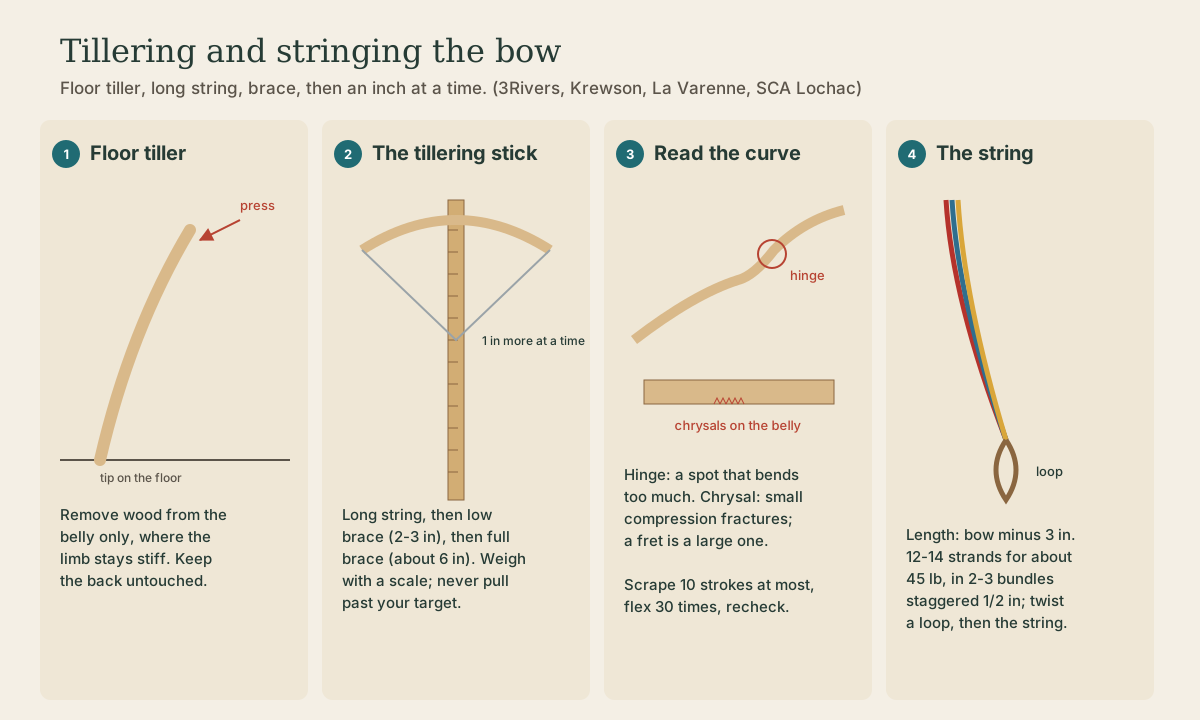
Days two through four: tiller on a stick from a long string to a low brace to full brace, an inch at a time with a scale, using a tillering gizmo and a straightedge to find stiff spots and hinges; read chrysals and frets; make a Flemish twist string; finish the nocks, scrape, seal, and shoot the bow in.
- 4 min
- 5 steps
- 2 questions
- Lesson 174 of 204
In this lesson
- On the tillering stick
- Read the curve
- The string
- Finish
- Try it
Picking up where you left off.
Wear safety glasses for every pull: an unfinished bow can break.
On the tillering stick
The 3Rivers sequence 1:
- Long string. Fit a tillering cord longer than the bow so the limbs bend only slightly when the string is pulled. Set the handle on the top of the tillering stick and pull the string down to the first notch.
- Find stiff places. Slide Eric Krewson’s tillering gizmo, a small block with a pencil set about 1/8 inch off the limb, along each limb: where the pencil draws no line, that part of the limb is bending too little 2.
- Scrape and exercise. Take no more than ten scrapes from the belly at a stiff spot, flex the limb 30 times, and check again 2.
- Low brace. When the limbs bend evenly on the long string, brace the bow low, 2 to 3 inches from string to handle 1.
- An inch at a time. Pull the string 1 inch further on the stick at each check, stepping back to look at the curve. Hang a bow scale on the string, or set a bathroom scale under the stick, and never pull past your target weight 1. A first milestone is about 30 pounds at 20 inches.
- Full brace. Brace to about 6 inches; longbows are rarely braced lower 1. Keep tillering to full draw.
On a Holmegaard, aim for the inner limbs to bend in a circular arc, not an elliptical one, and judge the tiller with a straightedge laid between the steps, not by the tips 3. Reduce the handle hump in stages until it looks as if it is just beginning to bend 3.
Quick check
Overdrawing an unfinished bow causes set or breakage.
Read the curve
- Hinge: a short section bending more than the rest. Slide a block along the limb against a straightedge: a gap that grows and then shrinks marks it 1. Leave the hinge alone and remove wood on either side of it.
- Chrysals and frets: a chrysal is a set of small, faint compression fractures on the belly; a fret is a large one 4. They show overstrained wood, often at a hinge. La Varenne lost two bows to frets 3.
- Set: the bow staying bent toward the belly after unstringing, from compression of the belly 4. Some set is normal; a lot means the limbs are working too hard.
Quick check
Frets and chrysals show where the belly is overstrained, often at a hinge.
The string
Stephen Anderson’s Flemish twist string 5:
- Length: the bow’s length minus 3 inches.
- Strands: 14 strands of B-50 “is plenty strong enough for a 45# traditional bow,” in 2 or 3 bundles.
- Bundles: stagger the ends of the bundles by 1/2 inch so the loop tapers.
- Loop: about 7 to 8 inches from one end, twist the bundles into a loop, then twist the rest of the string down its length and make the bowyer’s knot or a second loop at the other end.
Playback is optional. If the player is unavailable, open the video at its source.
Finish
Finish the nocks to the string’s size. Scrape the whole bow smooth, round the edges of the belly, and sand. Seal it with an oil or wax finish, because wood that swings between dry indoor air and damp outdoor air changes its moisture, and with it its strength 6. Wrap the handle with leather or cord.
Shoot it in with a few dozen arrows at a short draw, working up to full draw, then unstring it and check the set. Store it unstrung.
Try it
Make the gizmo before tillering: a 1-inch block 6 inches long with a pencil threaded through a hole in the middle. Run it along a straight board and a curved one first, so you can read the line it draws.
Lesson complete
Nice work.
Sources for this lesson
- 1Beginner's Guide to Building a Hickory Longbow. 3Rivers Archery. 2015. verifiedNever pull the bow past the desired weight. Start with a 2-3 in low brace; exercise the limbs 30-50 times after each removal; pull 1 in more at a time on the tillering stick; a bathroom scale works without a bow scale; first milestone about 30 lb at 20 in; a block slid along the limb finds hinges; longbows rarely braced below 6 in.
- 2How to Make and Use Eric Krewson's Tillering Gizmo. 3Rivers Archery. 2015. verifiedA 1 in square, 6 in block with a pencil set through a tapped hole about 1/8 in off the limb; slide it along to mark stiff spots; use from the long string to about 20 in of draw; no more than ten scrapes, flex the limb 30 times, recheck.
- 3Dennis La Varenne. Tillering the Holmegaard Bow. Fiarc forum (archived). 2005. verifiedFive sections: a non-bending handle, two bending inner limbs, two stiff outer levers. The inner limb must be of parallel thickness; a taper running into it causes frets; aim for a circular bend. Reduce the handle hump in stages. For a 50 lb+ bow, a stave 45-50 mm wide and about 10-12 mm thick at the crown; one 60-75 mm log can give two staves. Judge tiller with a straightedge between the steps. His bows 62-64 in.
- 4Glossary. SCA Lochac Archery. verifiedChrysal: small, faint compression fractures; fret: a large chrysal. Set (string follow): deflex from compression of the belly. Fistmele: brace height.
- 5Stephen P. Anderson. How to Build a Flemish Twist Bow String. 3Rivers Archery. 2016. verifiedString length: bow length minus 3 in for longbows; 2 or 3 bundles; '14 strands of B-50 is plenty strong enough for a 45# traditional bow'; bundles staggered 1/2 in; loop formed 7-8 in from the end.
- 6Wood Handbook: Wood as an Engineering Material (FPL-GTR-190). USDA Forest Service, Forest Products Laboratory (copy hosted by California Air Resources Board). 2010. verifiedTable 5-3b, clear wood at 12% MC (SG / MOR psi / MOE Mpsi / work to max load in-lbf/in3): American elm 0.50 / 11,800 / 1.34 / 13.0; rock elm 0.63 / 14,800 / 1.54 / 19.2; slippery elm 0.53 / 13,000 / 1.49 / 16.9; white ash 0.60 / 15,000 / 1.74 / 16.6; shagbark hickory 0.72 / 20,200 / 2.16 / 25.8; sugar maple 0.63 / 15,800 / 1.83 / 16.5; yellow birch 0.62 / 16,600 / 2.01 / 20.8; paper birch 0.55 / 12,300 / 1.59 / 16.0. Table 13-1: outdoor EMC at Madison, Wisconsin 12.5-15.7% by month; Table 13-2: interior wood about 8% (6-10%).