Threading, Sheds, and Color Order
Tuesday: thread rosepath at 4 ends per inch with floating selvedges, tie up for krokbragd by treating shafts 2 and 4 as one, and for bound rosepath on the four twill sheds. Why each krokbragd pick shows only over one shaft's ends, how that lets color order alone draw dots, zigzags, and lines, and a sampler that tests it all.
- 3 min
- 5 steps
- 2 questions
- Lesson 158 of 204
In this lesson
- Thread the warp
- One warp, two weaves
- Why color order is the pattern
- Weave a sampler
- Try it
Picking up where you left off.
Thread the warp
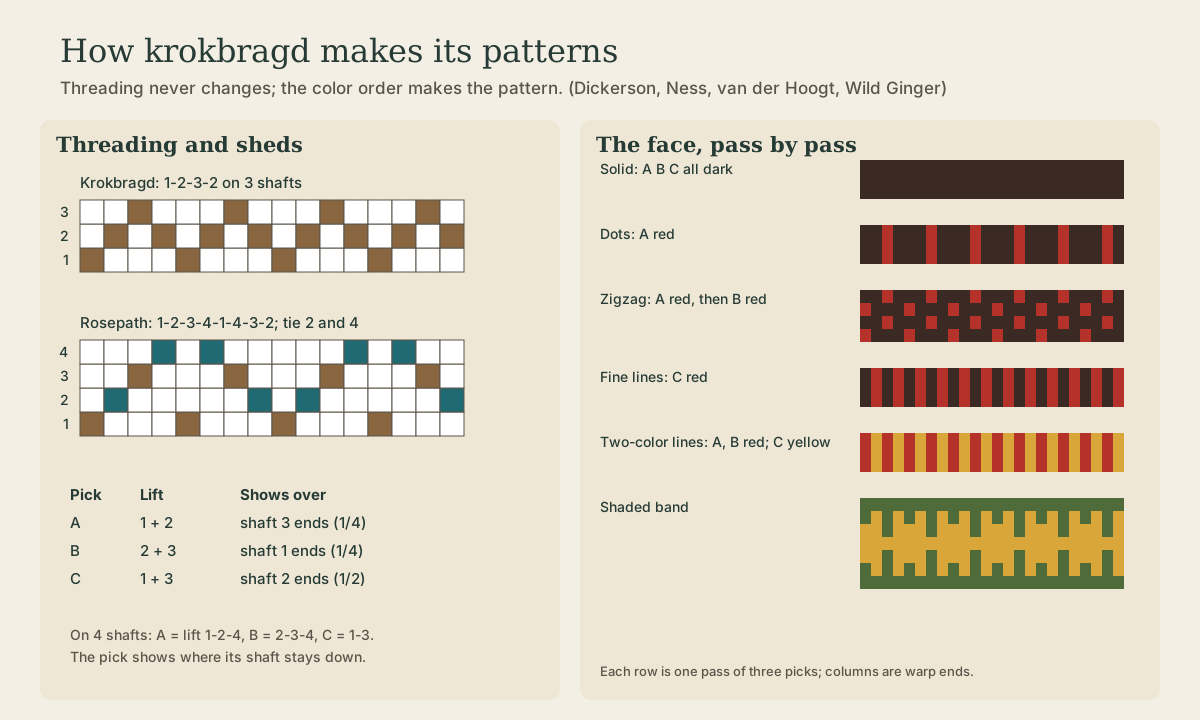
Rosepath on four shafts threads 1-2-3-4-1-4-3-2, a point twill carried one end past the shaft count 1. Krokbragd on three shafts threads 1-2-3-2, with every other end on shaft 2 2.
Thread 112 ends in rosepath, centered, and add a floating selvedge at each side: an end through the reed but not through any heddle, as in Schuster’s rosepath rug 3. Sley at 4 ends per inch.
One warp, two weaves
On a rosepath or straight threading, tie shafts 2 and 4 together and you have krokbragd 4: 1-2-3-4-1-4-3-2 reads 1-2-3-2-1-2-3-2. So a single rosepath warp weaves both of the class’s structures.
Krokbragd sheds. Lift 1-2, then 2-3, then 1-3, repeated without change 5. On four shafts with 2 and 4 tied, tie three treadles: 1-2-4, 2-3-4, and 1-3. Krokbragd is usually woven three colors at a time 6.
Bound rosepath sheds. Tie up a 2/2 twill (1-2, 2-3, 3-4, 4-1) and treadle the four sheds in rotation; three colors on four sheds shift position by themselves, and only floats over two or more ends show 7. Vävstuga teaches bound rosepath with three treadles for geometric patterns, four for pictures, and six for detailed pictorial work 8.
Six treadles cover it: three for krokbragd, four for twill, sharing where they can, or retie between sections.
Quick check
Rosepath 1-2-3-4-1-4-3-2 with 2 and 4 joined reads 1-2-3-2: krokbragd.
Why color order is the pattern
The rule: “If one shaft is down for a pick, the weft color shows over the threads on that shaft” 9. In krokbragd:
- The 1-2 pick shows over shaft-3 ends, a quarter of the warp.
- The 2-3 pick shows over shaft-1 ends, another quarter.
- The 1-3 pick shows over all the shaft-2 ends, half the warp. It is a plain-weave pick 9.
So three picks of the same color make a solid line, and changing the color of one pick puts dots or dashes exactly where that pick shows. Shifting the accent from one pick to another from pass to pass moves the dots sideways into zigzags. A Norwegian weaver notes that four picks are normally needed for a colored square 6. The threading never changes 5; everything is in the order of colors, which is why the class designs on graph paper with colored pencils.
Quick check
‘If one shaft is down for a pick, the weft color shows over the threads on that shaft.’
Weave a sampler
Weave about 6 inches before the rug:
- A header of plain weave in warp yarn.
- Krokbragd: a solid band, then dots, a zigzag, fine lines, and a shaded band, all three colors at a time.
- Bound rosepath: a few repeats of the four twill sheds with three colors rotating.
- A few picks of plain weave to finish.
Beat firmly enough that no warp shows. Measure picks per inch (Schuster’s rug ran 28) and the draw-in at the fell against the reed width.
Playback is optional. If the player is unavailable, open the video at its source.
Try it
Before weaving the sampler, color six rows of the krokbragd grid on graph paper: one square per warp end, every fourth square for the 1-2 pick, the next fourth for 2-3, and every other square for 1-3. Then weave those six passes and compare.
Lesson complete
Nice work.
Sources for this lesson
- 1Andrea Deck. Rosepath Border Motif Design. Handwoven. 2025. verifiedRosepath is a point twill extended one end past the shaft count: 1-2-3-4-1-4-3-2 on four shafts.
- 2Katherine Dickerson. Flesberg Bound Weave System (retro reprint). Norwegian Textile Letter. 2006. verifiedKrokbragd has every even end on shaft 2 and shows three-block patterns on the face, two-block on the back. The Flesberg variant threads 1,3,2,1,2,3 at 8-10 epi on black 12/6 cotton (historically linen, hemp, or wool) with soft 2-ply wool weft; Buskerud, 1850-1920.
- 3Lynn Stracka Schuster. Rosepath Rug (weaving pattern). Long Thread Media. verified4 shafts, 154 ends with 2 floating selvedges; 4-ply rug warp at 560 yd/lb, 385 yd; 3-ply rug wool at 266 yd/lb, eight colors totaling 1,705 yd; 4 epi, 28 ppi, 38 1/2 in in the reed, finished 33 x 48 1/2 in; take-up and shrinkage 14% in width, 8% in length.
- 4Krokbragd on 2, 3, or 4 Shafts. Wild Ginger Handweaving. 2023. verifiedOn a rosepath or straight 4-shaft threading, link shafts 2 and 4 and you get krokbragd.
- 5Judy Ness. Krokbragd Tapestry. Norwegian Textile Letter. 2018. verifiedKrokbragd lifts 1-2, 2-3, 1-3 repeated without change; the pattern comes only from color.
- 6Krokbragd. All Fiber Arts. 2011. verifiedUsually woven in stripes of 3 colors, at most 3 at a time, treadled 12, 23, 31; a Norwegian weaver notes four picks are normally needed for a colored square; a 2-shaft tabby for borders by alternating treadles; krokbragd also works on 4 shafts and on a rosepath threading.
- 7Exploring 2/2 Boundweave. Wild Ginger Handweaving. 2023. verifiedRosepath threading with a 2/2 twill tie-up; four sheds in rotation make one line; three colors on four sheds shift position automatically; only floats over two or more ends show.
- 8The Rosepath Family. Vävstuga Weaving School. verifiedRosepath on opposites (4 treadles, the most common in Sweden), single- and double-pointed krokbragd (3 treadles each), bound rosepath (3 treadles geometric, 4 for pictures, 6 for detailed pictorial); rug warp 8/3 linen with Mattgarn weft.
- 9Madelyn van der Hoogt. Determining Warp Sett for Boundweave. Handwoven. 2017. verifiedBoundweave needs a much more open sett than plain weave; carpet warp or 8/2 linen. Krokbragd is a 3-shaft point-twill boundweave in which every third pick (lift 1-3) is plain weave. 'If one shaft is down for a pick, the weft color shows over the threads on that shaft.'