Making Up the Pocket
Day three: line the embroidered front with white cotton, finish the U-shaped opening, bind the edges in red wool, join the back, and attach the red-and-white band, plus how the same work makes a masma sewing pouch, and Leksand's other embroidery, blackwork and herringbone on coats.
- 2 min
- 7 steps
- 1 question
- Lesson 189 of 204
In this lesson
- Line the front
- Finish the opening
- Bind the edges
- The band
- A masma or a purse
- Leksand’s other embroidery
- Try it
Picking up where you left off.
Line the front
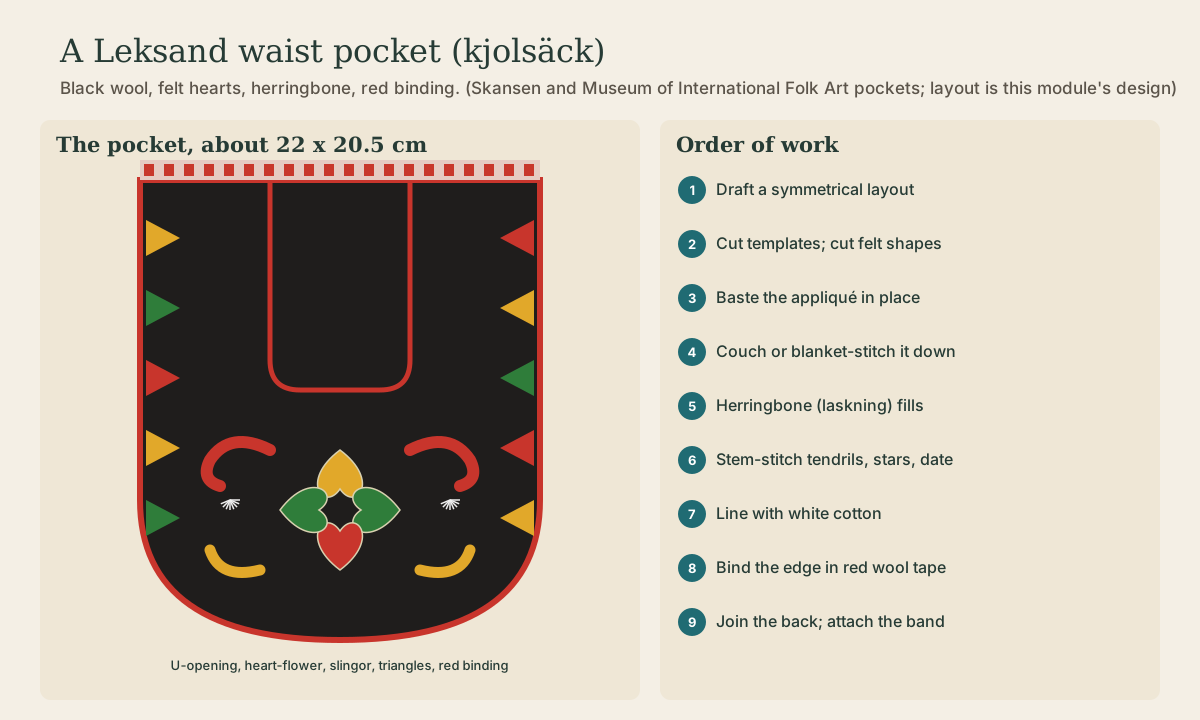
The Skansen pocket is lined with white cotton 1. Cut lining to the shape of the front, lay it behind the embroidery, wrong sides together, and baste around the edge. Cut the U-shaped opening through both layers.
Finish the opening
Bind the edges of the U-opening with a strip of red wool tape or a bias strip of red felted wool, folded over the raw edge and stitched down front and back. The Skansen pocket has green broadcloth showing in its opening 1; put a piece of green felt behind the opening if you like.
Bind the edges
Lay the front on the back, wrong sides together, and bind the curved sides and bottom with red wool tape, as on the Skansen pocket 1: fold the tape over both layers and stitch it down with small stitches through all of them. Ease the tape around the curves.
Quick check
The red edge frames the black front.
The band
Old pockets hang from a handwoven waistband; the Skansen one has a picked red-on-white pattern 1, and the MOIFA pocket is tied with red-and-white woven cotton ribbon typical of Leksand 2. Fold the top edge of the pocket over the band and stitch it, leaving the band’s ends long enough to tie around the waist.
Leksand’s other embroidery
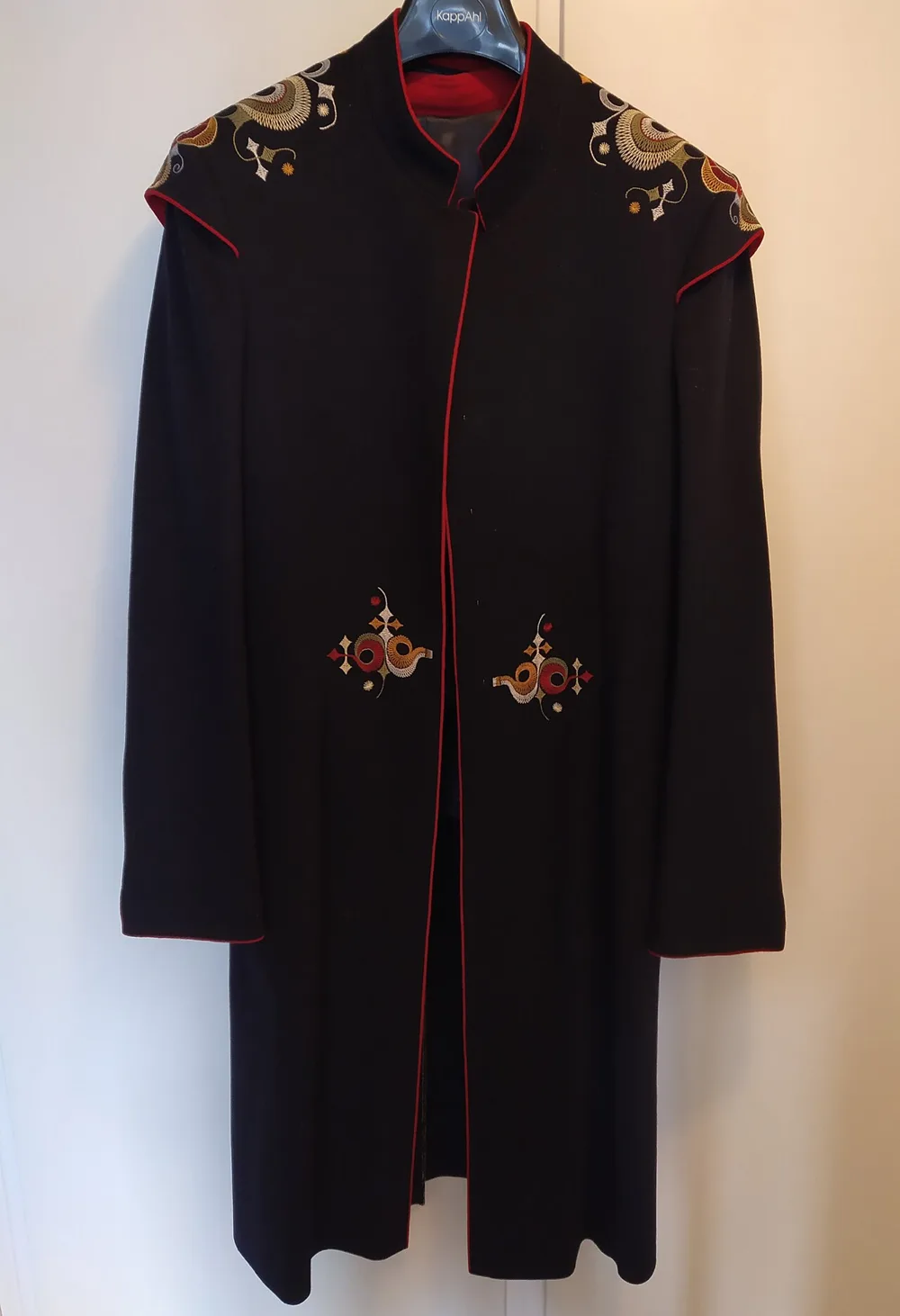
The same herringbone decorates the men’s blåtröja at the shoulders and front 5, and the women’s costume has a neck cloth of blackwork: one at Dalarnas museum, marked 1845, is white cotton worked in black silk with tassels at the corners 6. Either makes a good next project.

Playback is optional. If the player is unavailable, open the video at its source.
Try it
Bind a 6-inch curved edge on two scraps of the felted wool before binding the pocket. Easing the tape around a curve without puckers takes a little practice.
Lesson complete
Nice work.
Sources for this lesson
- 1Kjolsäck (SKAKLK.0019070). Skansen (DigitaltMuseum). verifiedLeksand waist pocket 215 x 205 mm: U-shaped opening, black wool broadcloth front; appliqué in red, green, yellow, and yellow-red broadcloth attached with blanket stitch (langettsöm); a central heart-flower with tendrils ('hjärtblomma med slingor') and small hearts; herringbone (flätsöm) in shiny multicolored yarn; white cotton lining; edged with red wool tape; handwoven waistband.
- 2Kjolsäck (waist pocket), A.2022.39.11. Museum of International Folk Art, Santa Fe. verifiedVästannor, Dalarna, 1971, by Liss Mia Dahl with materials from Leksand Hemslöjd; 25.5 x 24 cm; wool appliqué 'embroidered in couch, stem, double herringbone and whip stitches,' a date above a central heart; tied with red and white woven cotton ribbon typical of Leksand.
- 3Leksand-style Needlework Workshop with Kirsi Manni. American Swedish Institute, Minneapolis. verifiedOctober 2-4, 2026, 9-4; $340 ($320 members) including a $45 materials fee. A decorative pocket 'suitable for adding to a folk costume or adapting as a purse, or a masma sewing kit pouch'; students 'practice Laska-herringbone stitch, wool felt applique, and couching techniques' and see historic items from ASI's collection. Bring needles, fabric shears, thread scissors, thimble, magnification.
- 4Kirsi Manni. Embroidery. Art&Craft Sweden, Siljansnäs. verified'Krusa' in Dalmål means to decorate. 'Laska-herringbone stitch, appliqué and blackwork are some of the techniques used in the traditional Leksands folk costume,' on bodices, hanging pockets, scarves, mittens, breeches, and coats; her weekend course makes a Masma sewing kit with appliqué, couching, stem, and herringbone stitches.
- 5Leksandsdräkten. Swedish Wikipedia. verifiedThe men's blåtröja has silk embroidery 'i flätsöm, benämnt laskning på leksandsmål' (herringbone, called laskning in Leksand dialect); the women's costume includes a black-stitch embroidered neck cloth and a white embroidered linen one; black fulled-wool (kläde) skirts are the most common.
- 6Tupphalskläde (DM 18165). Dalarnas museum (DigitaltMuseum). verifiedLeksand neck cloth 530 x 535 mm of white cotton folded to a triangle, embroidered in black silk blackwork with satin, cross, and other stitches; tassels in the corners; marked 'K P D 1845.' CC BY.