Kroting, Chip Carving, and Finishing
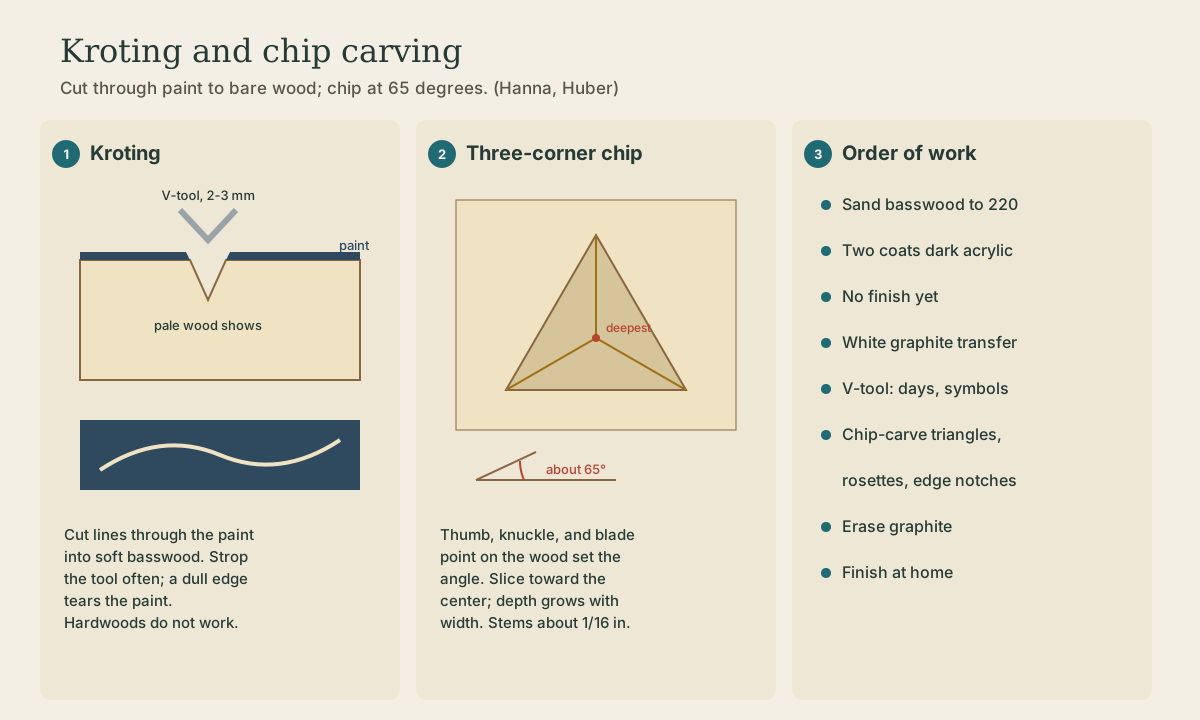
Days two and three: cut the day lines and symbols through the paint with a 2 to 3 mm V-tool, then chip-carve triangles, rosettes, and edge notches with the knife at about 65 degrees, add initials and a date as the old makers did, erase the graphite, and finish the stick at home.
- 3 min
- 5 steps
- 2 questions
- Lesson 162 of 204
In this lesson
- Kroting the lines
- Chip carving
- Letters and a date
- Finish
- Try it
Picking up where you left off.
Kroting the lines
Kroting is “cutting lines into wood after it has been painted or stained” 1. With the board painted two coats and unfinished 2:
- Lay the board on non-slip shelf liner so both hands are free 2.
- Cut the day lines first, with the 2 to 3 mm V-tool, in one steady push each. Keep them the same depth so they read the same width.
- Cut the longer weekly lines.
- Cut the symbol outlines, pushing the tool with the grain wherever you can and turning the board for curves.
- Strop the V-tool every few minutes. A sharp tool leaves clean paint edges; a dull one tears them.
Soft, fine-grained basswood is what makes this work; hardwoods do not 2.
Quick check
Hanna’s list says to paint two coats and ‘Do not put a finish on.’
Chip carving
Use chip carving for the triangles, notches, and rosettes that decorate primstavs. Norwegian chip carving, karveskurd, lays out geometric patterns with compass and ruler, six- and eight-petal rosettes and triangles, mainly in western Norway 3.
Phil Huber’s method 4:
- Grip. Rest the tip of your thumb, the knuckle of your index finger, and the point of the blade on the wood. That sets the blade at about 65 degrees; a scrap cut to 65 degrees is a gauge.
- Cuts. Each chip is two or three slicing cuts meeting at the bottom. Cut one side of every chip in a row, then turn the work and cut the other side.
- Depth. Depth grows with the chip’s width. Stems are about 1/16 inch deep.
- Sharpening. About 10 degrees a side, on a medium then an ultra-fine ceramic stone.
Use chip carving for the edge notches along the day row, a band of triangles across the handle, and a rosette laid out with the dividers on the handle or between the seasons.
Playback is optional. If the player is unavailable, open the video at its source.
Quick check
That three-point grip repeats the same angle every cut.
Letters and a date
The 1566 stick carries “symbols, numbers, and letters” 5, and the 1707 stick its maker’s name and year, “Dreng Biøn Søn ANO 1707” 6. Cut your initials and the year on the handle with the V-tool. The class suggests going on, at home, to a calendar stick of your own with birthdays, weddings, and other days that matter 7.
Finish
Erase the graphite lines with the white eraser and brush off the chips. The class leaves the final finish to be done at home 7. A wipe-on oil or a satin clear coat protects the paint and the cut lines; test it on the painted scrap first, since an oil that yellows will tint the pale lines.
Try it
On the painted scrap, cut one week of day lines with the V-tool and one row of triangle chips beside them, then finish half the scrap. Compare the finished and unfinished halves before choosing a finish for the stick.
Lesson complete
Nice work.
Sources for this lesson
- 1Introduction to Kroting. Vesterheim Folk Art School. verifiedRebecca Hanna's class; kroting defined as 'cutting lines into wood after it has been painted or stained'; kit with V-tool, brushes, paint, and practice boards.
- 2Rebecca Hanna. Kroting - a Norwegian Decorative Technique (supply list). The Sawmill Museum, Clinton, Iowa. 2023. verifiedSoft basswood with fine or no grain; 'Hardwoods do not work.' Sand, then two coats of acrylic in a dark color (dark blue, green, or red); 'Do not put a finish on.' A 2 or 3 mm (1/8 or 9/64 in) V-tool, sharpened, and a strop; tracing paper, white graphite paper, a clear ruler, soft pencil, white eraser, low-tack tape, non-slip shelf liner. Basswood blanks from the Vesterheim store or Lusk Scandia Woodworks (order 2 months ahead).
- 3Lars Mæhlum. Karveskurd. Store norske leksikon. 2020. verifiedChip carving: geometric patterns laid out with compass and ruler, six- and eight-petal rosettes and triangles; mainly a western Norwegian tradition.
- 4Phil Huber. Chip Carving. Woodsmith (from ShopNotes no. 52). 2022. verifiedThumb tip, index knuckle, and blade point all rest on the work, giving a 65-degree blade angle; a 65-degree scrap block is a gauge. Chip depth scales with width; stems about 1/16 in deep. Two slicing cuts per kernel, one side of every kernel first, then turn the work. Sharpen to 10 degrees a side on medium then ultra-fine ceramic. Basswood is the usual wood.
- 5Calendar Stick (LC0291). Vesterheim Norwegian-American Museum. verifiedDated 1566, from Jørstadmoen, Fåberg, Sør-Gudbrandsdal; Luther College Collection, gift of Norwegian museums. About 35 5/8 x 1 7/8 x 7/16 in (90.5 x 4.8 x 1.1 cm). 'Features well carved symbols, numbers, and letters.'
- 6Primstav (NF.1895-0247). Norsk Folkemuseum (DigitaltMuseum). verifiedBirch with brass screws, 80.5 x 6.6 x 1.8 cm; used in Valle, Setesdal; inscribed 'Dreng Biøn Søn ANO 1707' (Dreng Bjørnsson Brottveit). Model for a 1944 paper knife. Close-ups of Simonsmess and Helgemess, and of Andersmess to Lussi.
- 7A Matter of Time: A Revival of the Primstav. Vesterheim Folk Art School. verifiedRebecca Hanna, Nov 6-8, 2026, 9-5, beginner friendly, $290 members / $320; $25 materials, instructor provides everything except the final finish. Recreate a primstav from Vesterheim's collection (one dated 1566, or an oval primstav from 1700) or the Norsk Folkemuseum primstav dated 1707; transfer the design, then kroting and chip carving 'bring your painted or stained board to life.'