Laying Out the Year
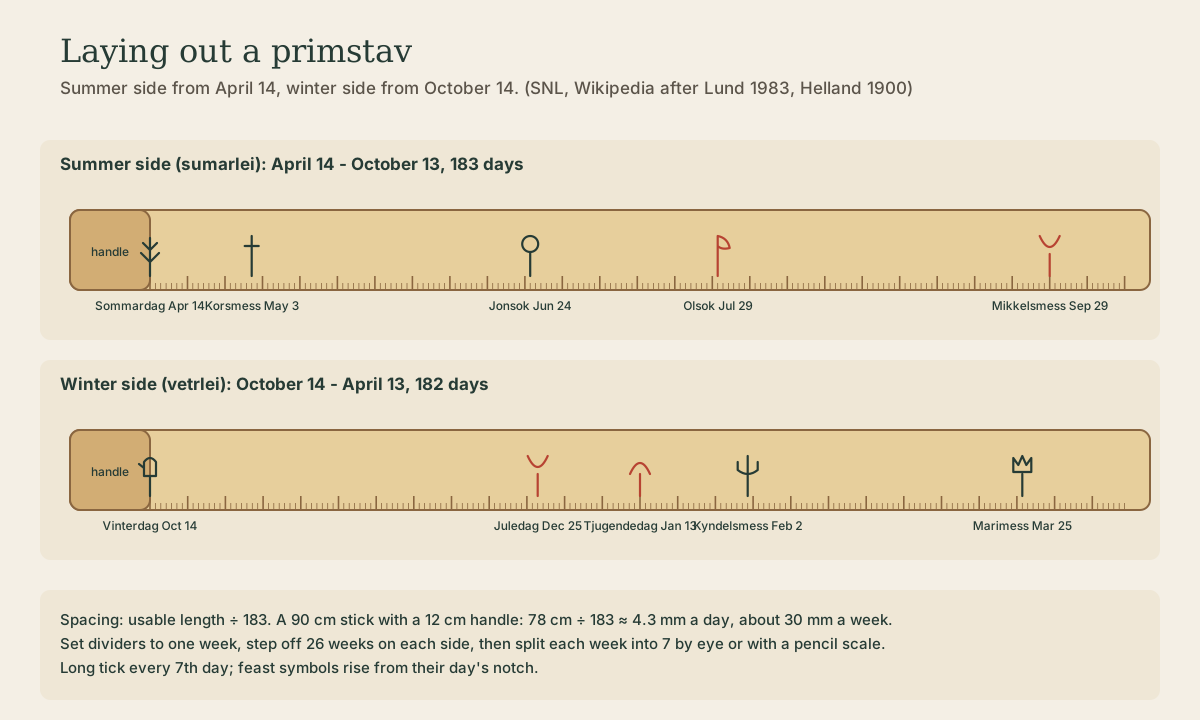
Day one: divide the board into a handle and a calendar band on each side, count the days (183 on the summer side, 182 on the winter side), step off the weeks with dividers, and place the feast-day symbols from the old tables, from Sommardag's tree to Juledag's drinking horn and Tjugendedag's horn turned upside down.
- 4 min
- 6 steps
- 2 questions
- Lesson 161 of 204
In this lesson
- Count the days
- Divide the board
- The summer side
- The winter side
- Transfer
- Try it
Picking up where you left off.
Count the days
The summer side runs from April 14 through October 13 and the winter side from October 14 through April 13 1. Counting:
- Summer: 17 days of April, then May 31, June 30, July 31, August 31, September 30, and 13 of October: 183 days, 26 weeks and a day.
- Winter: 18 days of October, then November 30, December 31, January 31, February 28, March 31, and 13 of April: 182 days, exactly 26 weeks.
So the midpoints fall at January 14 and July 14, and Norwegian tables mark mid-winter and midsummer near those dates 2. Every seventh day gets a special mark 1.
Quick check
78 cm for 183 days is about 4.3 mm a day.
Divide the board
- Mark a handle at one end, about 12 cm (4 3/4 in) long. The 1566 stick is 90.5 cm overall 3; the 1707 stick 80.5 4.
- The rest is the calendar band. Divide its length by 183: on a 90 cm stick, 78 cm ÷ 183 ≈ 4.3 mm a day, about 30 mm a week.
- Set dividers to one week and step off 26 weeks along one edge of each side. Small errors add up, so adjust the dividers until the 26th step lands at the end of the band.
- Split each week into seven by eye, or with a paper strip marked in sevenths.
- Draw a short line for each day along the edge and a longer one every seventh day.
Days were marked with a line or a notch, and some sticks also mark weeks 2.
The summer side
The symbols are stick figures, related to Norwegian house marks 2. A selection, after the tables in Norwegian Wikipedia, which follow Juel Lund’s Primstaven (1983) 2:
| Date | Day | Symbol |
|---|---|---|
| Apr 14 | Sommardag (summer day) | leafy tree or branch |
| May 1 | Gaukmess | cuckoo |
| May 3 | Korsmess | large cross |
| May 15 | Hallvardsmess | millstone |
| Jun 24 | Jonsok (midsummer) | sun |
| Jun 29 | Persok | key |
| Jul 14 | Midsommar | sun |
| Jul 29 | Olsok | axe |
| Aug 10 | Larsok | gridiron |
| Aug 24 | Barsok | axe or knife |
| Sep 29 | Mikkelsmess | horn (lur) or scales |
Olsok, the feast of St. Olaf, is marked with his axe 5.
The winter side
| Date | Day | Symbol |
|---|---|---|
| Oct 14 | Vinterdag (winter day) | leafless tree or mitten |
| Nov 1 | Helgemess (All Saints) | cross or upturned ship |
| Nov 11 | Mortensmess | goose or drinking horn |
| Nov 25 | Karimess | wheel |
| Dec 13 | Lussi | fire or candles |
| Dec 25 | Juledag (Christmas Day) | drinking horn |
| Jan 1 | Nyttår (New Year) | sun-wheel |
| Jan 6 | Trettendedag | three crosses or crowns |
| Jan 13 | Tjugendedag | axe or upturned drinking horn |
| Feb 2 | Kyndelsmess | candlestick |
| Mar 25 | Marimess | crown or woman |
“Juledagen betegnedes med et drikkehorn”: Christmas Day was marked with a drinking horn 5. Twenty days later, on Tjugendedag, the horn is turned upside down: Christmas is over 2.
When copying a museum stick, follow its symbols, not the table; the tables are a key, and sticks vary from valley to valley.
Quick check
Juledag, December 25, is the drinking horn; twenty days later it is emptied.
Transfer
Trace the design on tracing paper, then transfer it onto the painted board with white graphite paper, holding it with low-tack tape 6. Draw lightly: every line will be cut.
Playback is optional. If the player is unavailable, open the video at its source.
Try it
Before transferring, lay a strip of paper along the board and mark the 26 weeks with the dividers. Count the strip twice. A miscount is easy to fix on paper and impossible once cut.
Lesson complete
Nice work.
Sources for this lesson
- 1Audun Dybdahl, Eivind Falk. Primstav. Store norske leksikon. 2026. verifiedA wooden calendar used from about the 1300s to the 1800s; every day notched, every seventh day specially marked; summer side from April 14, winter side from October 14; about 55 symbols, mostly saints' attributes; ruler, sword, round, oval, and tablet shapes; oldest Norwegian example dated 1457; numbers rose through the 1600s and fell after 1700, when the Gregorian reform moved feasts 11-14 days earlier.
- 2Primstav. Norwegian Wikipedia (Bokmål). verifiedAbout 650 Norwegian primstavs known, late 1400s to early 1800s, typically 50-80 cm long and 4-6 cm wide; days marked by lines or notches, some with weeks; stick-figure symbols related to house marks; a day-by-day table of feast days and symbols after Juel Lund, Primstaven (1983).
- 3Calendar Stick (LC0291). Vesterheim Norwegian-American Museum. verifiedDated 1566, from Jørstadmoen, Fåberg, Sør-Gudbrandsdal; Luther College Collection, gift of Norwegian museums. About 35 5/8 x 1 7/8 x 7/16 in (90.5 x 4.8 x 1.1 cm). 'Features well carved symbols, numbers, and letters.'
- 4Primstav (NF.1895-0247). Norsk Folkemuseum (DigitaltMuseum). verifiedBirch with brass screws, 80.5 x 6.6 x 1.8 cm; used in Valle, Setesdal; inscribed 'Dreng Biøn Søn ANO 1707' (Dreng Bjørnsson Brottveit). Model for a 1944 paper knife. Close-ups of Simonsmess and Helgemess, and of Andersmess to Lussi.
- 5Amund Helland. Gammel norsk tidsregning og primstaven. Topografisk-statistisk beskrivelse over Bratsberg amt I (Aschehoug), via Wikisource. 1900. verifiedDay-by-day primstav lore: 'Juledagen betegnedes med et drikkehorn'; Olsok marked with St. Olaf's axe; a drawing of both sides, winter (vetrlei) and summer (sumarlei).
- 6Rebecca Hanna. Kroting - a Norwegian Decorative Technique (supply list). The Sawmill Museum, Clinton, Iowa. 2023. verifiedSoft basswood with fine or no grain; 'Hardwoods do not work.' Sand, then two coats of acrylic in a dark color (dark blue, green, or red); 'Do not put a finish on.' A 2 or 3 mm (1/8 or 9/64 in) V-tool, sharpened, and a strop; tracing paper, white graphite paper, a clear ruler, soft pencil, white eraser, low-tack tape, non-slip shelf liner. Basswood blanks from the Vesterheim store or Lusk Scandia Woodworks (order 2 months ahead).