Preparing the Wood and the Strokes
Thursday evening and day one: sand and seal the basswood, lay two background coats, mix the palette, and drill the strokes on a practice board: the C-stroke, the S-stroke, the teardrop or comma, scrolls, and liner work, with paint at the right consistency.
- 2 min
- 4 steps
- 2 questions
- Lesson 185 of 204
In this lesson
- Seal and base-coat
- Mix the palette
- The strokes
- Try it
Picking up where you left off.
Seal and base-coat
Fossum’s method: seal the wood with shellac, sealer, or varnish; sand lightly; wipe it clean; then paint one, two, or more coats of the background color. Red and green were the common old backgrounds 1; Os grounds are often black or white, sometimes red. Use a dark acrylic for the ground, sanding lightly between coats, as North House does for its practice boards 2. Paint the practice board at the same time.
Quick check
Sealing keeps the background paint from soaking in unevenly.
Mix the palette
Squeeze out the colors and mix the tints you’ll need with the palette knife. Fossum mixes burnt umber and burnt sienna into red for the “old rosemaling rusty reds” 1. Thin the paint with a little medium: North House’s Os class uses walnut alkyd medium 3. For transparent Telemark the paint should be “thin enough to see through” 4.
The strokes
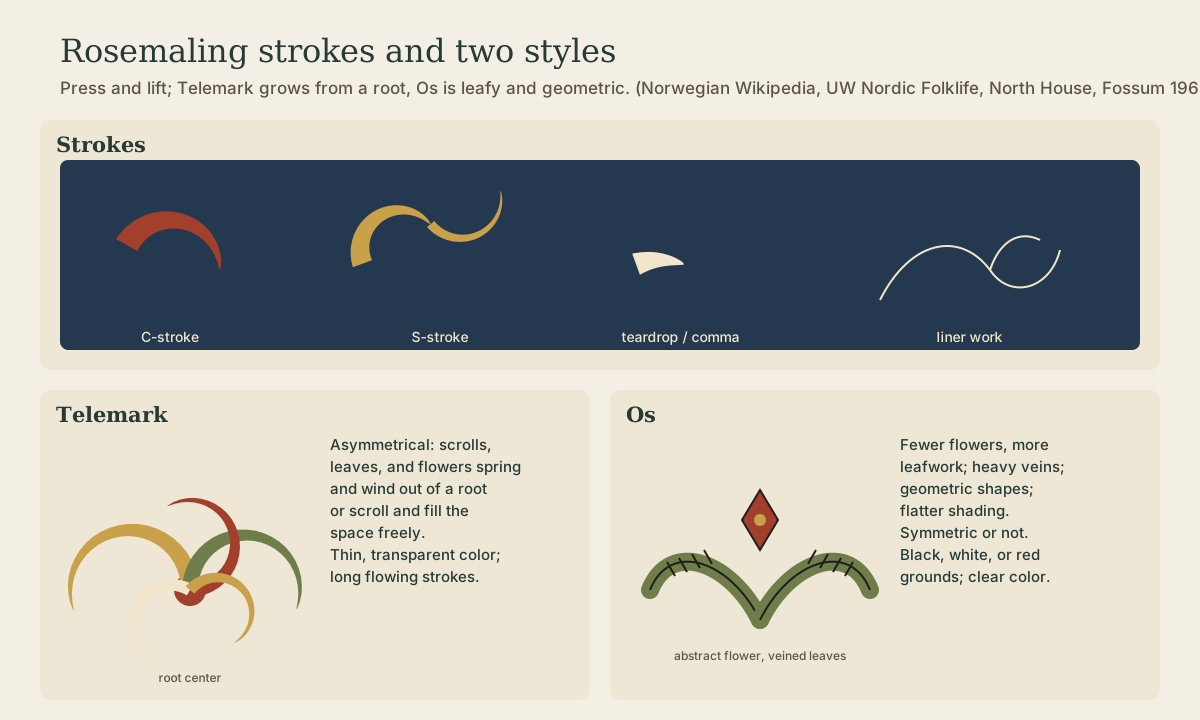
Vesterheim’s fundamentals class teaches brush control, paint consistency, and “the flowing C- and S-strokes, teardrops, scrolls, and leaves” 5. Fill the practice board:
- C-stroke: load the brush, set it down and press to spread the hairs, then pull it around the curve, lifting gradually until only the tip touches, ending in a fine tail.
- S-stroke: start on the tip, press through the middle of the curve, and lift again as the curve reverses.
- Teardrop or comma: press, then lift as you pull away: a fat head and a thin tail.
- Scrolls: chains of C-strokes, each springing from the last.
- Liner work: with a long liner brush and thinned paint, pull fine lines and tendrils in one motion.
Make rows of each until they come out alike. American Telemark painters work wet-on-wet with “whiplash movements of the brush” 4.
Playback is optional. If the player is unavailable, open the video at its source.
Quick check
The press-and-lift gives the stroke its swelling body and fine tail.
Try it
Fill one row of the board with twenty C-strokes the same size, all curving the same way, then a row curving the other way. The reverse direction is always harder; practice it until the two rows match.
Lesson complete
Nice work.
Sources for this lesson
- 1Gladys H. Fossum. Rosemaling: History, Instructions, and Designs. Gladys H. Fossum, Racine, Wisconsin. 1964. verifiedOld line work used brushes of a few squirrel-tail hairs; red, yellow, and green with black and white were the common colors. Suggested tubes: Prussian blue, vermilion, cadmium yellow, burnt umber, burnt sienna, black, white; pure sable brushes sizes 1 and 3 or 4. 'Outline one side of a leaf or petal with black, highlight the main color with white'; burnt umber and sienna in red give old rusty reds. Seal the wood with shellac, sealer, or varnish, sand, then paint one, two, or more background coats; red and green were common old grounds; transfer with carbon; varnish to finish.
- 2Rosemaling: Shaded Telemark Style Traditions. North House Folk School. verifiedMary Schliep and Kim Garrett. Brushes #2 liner and #2/#4 filberts. Palette: Ivory Black, Titanium White, Venetian Red, Prussian Blue, Burnt Sienna, Burnt Umber, Terre Verte, Raw Sienna, Caput Mortuum, Yellow Ochre, optional Cadmium Red Light. Practice board of masonite or cardboard with two coats of dark acrylic (blue, red iron oxide, black, or dark green) and matte spray varnish; tracing and transfer paper, palette knife.
- 3Rosemaling: Os Style. North House Folk School. verifiedKim Garrett, in oils. Brushes: #1 liner; #2, 4, 6 filberts (Princeton Velvetouch or Heritage, or Blick Masterstroke). M. Graham Walnut Alkyd Medium; odorless thinner. Os palette: Cadmium Yellow Light, Cadmium Yellow Deep, Thalo Blue, Crimson Lake or Alizarin Crimson, Cadmium Red Light, Titanium White, Zinc White, Ivory Black; 'These paints are not typical Rosemaling colors.' Woodenware $25-45.
- 4A Style of Their Own: Upper Midwestern Rosemalers. UW-Madison Nordic Folklife. verifiedTelemark is 'one of few asymmetrical rosemaling styles, characterized by scrolls and branches spanning out from a root center'; transparent Telemark uses paint 'thin enough to see through'; American Telemark uses 'wet-on-wet application of paint and whiplash movements of the brush'.
- 5Fundamentals of Telemark Style Rosemaling (online). Vesterheim Folk Art School. verifiedLise Lorentzen, three Thursdays Jan 21-Feb 4, 2027, on Zoom, $180-200 with a kit of paints, brushes, and bristol boards; brush control, paint consistency, and 'the flowing C- and S-strokes, teardrops, scrolls, and leaves.'