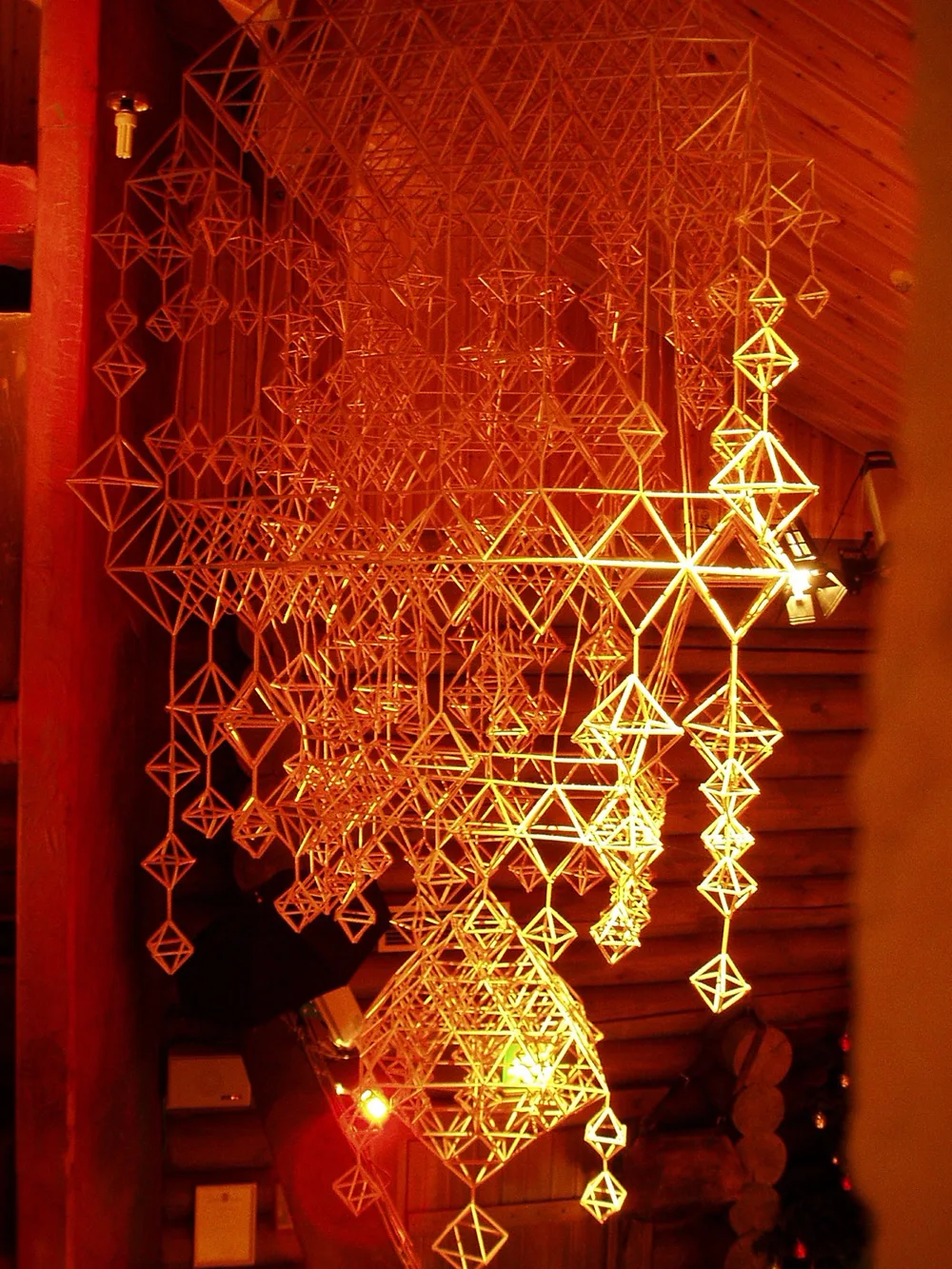
Straw Crowns, Himmeli, and What to Buy
Karin Edlund's five-day Sätergläntan class makes Swedish straw crowns from rye straw, and North House teaches the Finnish himmeli. What the two traditions are, where to get rye straw in the US or how to grow and harvest it, how to prepare it, the thread, cloth, paper, and wool for trimming, and a five-day plan.
- 4 min
- 6 steps
- 2 questions
- Lesson 166 of 204
In this lesson
- Two traditions
- Getting rye straw
- Harvest and prepare
- How much
- Try it
Picking up where you left off.
What you need
| Have it | Material | Spec | Qty | Where to get it |
|---|---|---|---|---|
| Rye strawLong hollow native grasses can stand in. | Long, hollow, unbroken stems, cut at the milky stage and dried; old long-straw rye if you can find it | A few hundred stems: a traditional himmeli alone takes 228 tubes | Grow cereal (winter) rye, or ask The Straw Shop in Sonora, California | |
| Cereal rye seed optionalSow in fall; harvest the next summer. | Winter rye, sold as cover-crop seed | A pound sows a small bed | Farm store or seed supplier | |
| Thread | Cotton or linen thread in a straw color | About 1.5 m per 12-tube form; a spool | Sewing or weaving supplier | |
| Long needles | Doll or upholstery needles, 5-7 in, with eyes that take your thread | 2-3 | Sewing or craft store | |
| Wool yarn for tassels | Red wool, plus other colors you like | 1 skein | Yarn shop | |
| Trimmings | Red and other cloth scraps, ribbon, beads, tissue or colored paper, card | A handful of each | Scrap bag and craft store |
Tools
Checkmarks are saved on this device.
The plan
-
Before class
Harvest and prepare the straw
- Cut rye at the milky stage; dry it standing
- Strip the leaf sheaths; cut between the nodes
- Sort the tubes by thickness and store them dry
-
Day 1
The basic form
- Soak and cut tubes
- Thread single 12-tube forms at 20, 10, and 5 cm
- Practice the knots and hiding the tails
-
Day 2
Geometric forms and the himmeli
- Diamonds and squares; nested forms
- Build the 20-10-5 himmeli: 1 large, 6 medium, 12 small, joined with necks
-
Day 3
Panels, rings, and garlands
- Straw diamonds on a cross
- Plaited and twisted rings
- Garlands of straw lengths and cloth squares
-
Day 4
Trimmings and design
- Paper flowers and stars; wool tassels
- Sketch your own crown: roof, tiers, and hangers
-
Day 5
Assemble and balance
- Build the roof and hang the pieces
- Balance it so it hangs level and turns freely
This module reconstructs two straw classes. Karin Edlund’s five-day Halmkronor at Sätergläntan in Dalarna, Sweden, starts with small samples, “geometric forms, plaited panels, garlands, and hangers,” then tassels and flowers of paper and cloth, and ends with a crown of your own design, covering composition, sketching, and assembly. All tools, straw, and basic materials are provided 1. North House Folk School teaches the Finnish himmeli, with students bringing a soaking container for 7-inch straw, towels, scissors, and a ruler 2. Neither class plan is published; this follows the sources cited.
Two traditions
Swedish straw crowns (halmkronor, takkronor) were made for festivals such as Christmas and weddings, and are sometimes called oro, unrest, because they move at the slightest draught 1. In Sollerö and Orsa in Dalarna, crowns and wreaths marked weddings, funerals, midsummer, and Christmas; in winter, straw and birch-bark crowns took the place of summer’s leaf garlands. In Orsa in 1848 a bride hung a straw crown she had made herself above her seat, with silk tassels at every corner 3. One crown in Småland, copied from an old pattern before 1927, is straws 9 to 19 cm long threaded on linen with a red wool tassel at every junction 4.
The Finnish himmeli, from Swedish and German himmel, sky or heaven, hangs over the table from Christmas to midsummer: “the larger the himmeli the larger the rye crop” 5. Some families kept the best ones in the attic from year to year, and a well-kept himmeli can last a century 6. In the Upper Midwest, Finnish Americans keep making them; Alana Maijala of Virginia, Minnesota, says finished himmelis were burned in the midsummer bonfire 7.
.jpg)
Quick check
A balanced crown turns on its thread whenever the air moves.
Getting rye straw
Rye has the longest, sturdiest stems 6. Modern wheat is thick-walled and pithy, with a short top section, and good rye is hard to buy 8. Your options:
- Buy. The Guild of Straw Craftsmen lists The Straw Shop in Sonora, California, as a US supplier 9; call to ask what rye they have.
- Grow. Sow cereal (winter) rye, sold as a cover crop, in the fall, and cut it the next summer. An older, long-strawed variety gives longer tubes than a short modern one.
- Substitute. Maijala notes that long, hollow native grasses can stand in 7.
Quick check
Straw cut slightly green is tougher and more flexible than dead-ripe straw.
Harvest and prepare
The Guild’s method 8:
- Cut before the grain is fully ripe, at the milky stage, with a little green still at the first joint.
- Dry the sheaves standing upright in the sun for a couple of days, bringing them in at night. Store them dry and airy in boxes, never in plastic.
- Use the straw from the head down to the first node. Straws taper, thinner at the head, so sort by diameter.
- Soak at least 30 minutes in room-temperature water before working, until the butt end bends without cracking, and keep the straw wrapped in a damp towel.
Finnish practice cuts rye about 2 m long, dries it for weeks from green to gold, then cuts it at the joints and sorts it by thickness 5. Cleaning straw takes time 7; do it in the evenings before the project.
How much
Eija Koski’s traditional himmeli takes 12 tubes of 20 cm, 72 of 10 cm, and 144 of 5 cm, with 1.5 m of thread for each 12-tube form 10. A crown takes more for its roof and hangers.
Try it
Cut twenty tubes from your straw and sort them into three piles by thickness. If one pile is much bigger, that’s the size to design around: each form should use tubes of one thickness.
Lesson complete
Nice work.
Sources for this lesson
- 1Halmkronor 2026. Sätergläntan Institutet för slöjd och hantverk. verifiedKarin Edlund, July 6-10, 2026, 8:40-16:00, ending at lunch on day 5, Insjön, Dalarna; base materials about 250 SEK. Straw crowns were made for festivals such as Christmas and weddings and are sometimes called 'oro' because they move at the slightest draught. Rye straw; small samples of geometric forms, plaited panels, garlands, and hangers; tassels and flowers of paper and cloth; then a crown of one's own design: composition, spatial sketching, assembly. All tools, straw, and basic materials provided; bring cloth scraps, ribbon, beads, paper, birch bark, dried flowers. No experience needed.
- 2Geometric Straw Mobiles: The Traditional Craft of Himmeli. North House Folk School. verifiedStudents bring a non-food soaking container for 7-inch straw, towels, scissors, and a ruler.
- 3Inga-Lill Eliasson. Krona och krans vid bröllop och fest. Sollerö hembygdsförening. verifiedCrowns and wreaths for weddings, funerals, midsummer, and Christmas, of field and forest materials trimmed with leftover cloth, yarn, paper, and glitter; in winter, straw and birch-bark crowns replaced summer garlands. Orsa, 1848: a straw crown the bride made herself hung over her seat, with silk tassels at every corner and a large multicolored silk tassel at the bottom. Cites Bondjers and Danielsson Hamss, Oro, himmel, spindel... takkronor av halm (Dalarnas museum, 1989).
- 4Halmkrona (M 3995). Kulturparken Småland (DigitaltMuseum). verifiedCopy of an old pattern made before 1927 by Anna Danielsson, Buskahult, Lekaryd: straws 9-19 cm long threaded on linen thread, a red wool tassel at every junction; 250 x 250 x 150 mm.
- 5Straw mobile (Himmeli). Wikipedia. verifiedHimmeli from Swedish/German himmel, sky or heaven. Rye cut about 2 m long and dried from green to gold over weeks, then cut at the joints and sorted by thickness. Hung over the table at Christmas and left until midsummer; 'the larger the himmeli the larger the rye crop.' Related to the Polish pająk and Lithuanian sodai.
- 6The Science and Art of the Traditional Finnish Christmas Decoration. KIKS project, University of Cantabria. 2017. verifiedFinnish school report: himmelis hung over the table at the harvest festival to ensure next year's crop, the best stored in the attic from one Christmas to the next; rye has the longest, sturdiest stems; a well-kept himmeli can last up to 100 years.
- 7Mirva Johnson. Alana Maijala. Traveling Traditions, UW-Madison Nordic Folklife. verifiedHimmeli maker in Virginia, Minnesota: rye straw gathered in fall, long hollow native grasses as a substitute; cleaning straw takes time; knots tied too tight split the straw; finished himmelis were burned in the midsummer bonfire.
- 8Straw FAQ. The Guild of Straw Craftsmen. verifiedHarvest before the grain is fully ripe, at the milky stage, with a little green at the first joint; stand sheaves upright in sun for a couple of days, in at night; store dry and airy in boxes, never plastic. Use straw from the head to the first node; straws taper, so grade by diameter. Rye is excellent but hard to get; modern wheat is thick-walled with a short top section. Soak at least 30 minutes in room-temperature water until the butt bends without cracking; keep in a damp towel.
- 9Suppliers. The Guild of Straw Craftsmen. verifiedLists The Straw Shop in Sonora, California, as a US straw supplier.
- 10Traditionell himmel (Strömsö). Yle Svenska. 2013. verifiedEija Koski's traditional himmeli: 12 tubes of 20 cm (one large base form), 72 of 10 cm (six medium), 144 or 288 of 5 cm (12 or 24 small); each form takes 12 tubes, 1.5 m of matching cotton thread, and a large needle. Thread three tubes and double-knot into a triangle; thread two and wind twice round the corner; continue to five triangles; thread the twelfth and wind round the corner with the other tail; knot and hide the tails in a tube. Tie small forms to medium and medium to large; 'necks' between forms let them move. Himmelis hung over the table or a child's bed on a woman's hair so they moved in the slightest draught, said to snare evil spirits; trimmed with feathers, eggshell, cloth scraps, today also sweet wrappers, foil, newspaper. The demonstration used drinking straws.