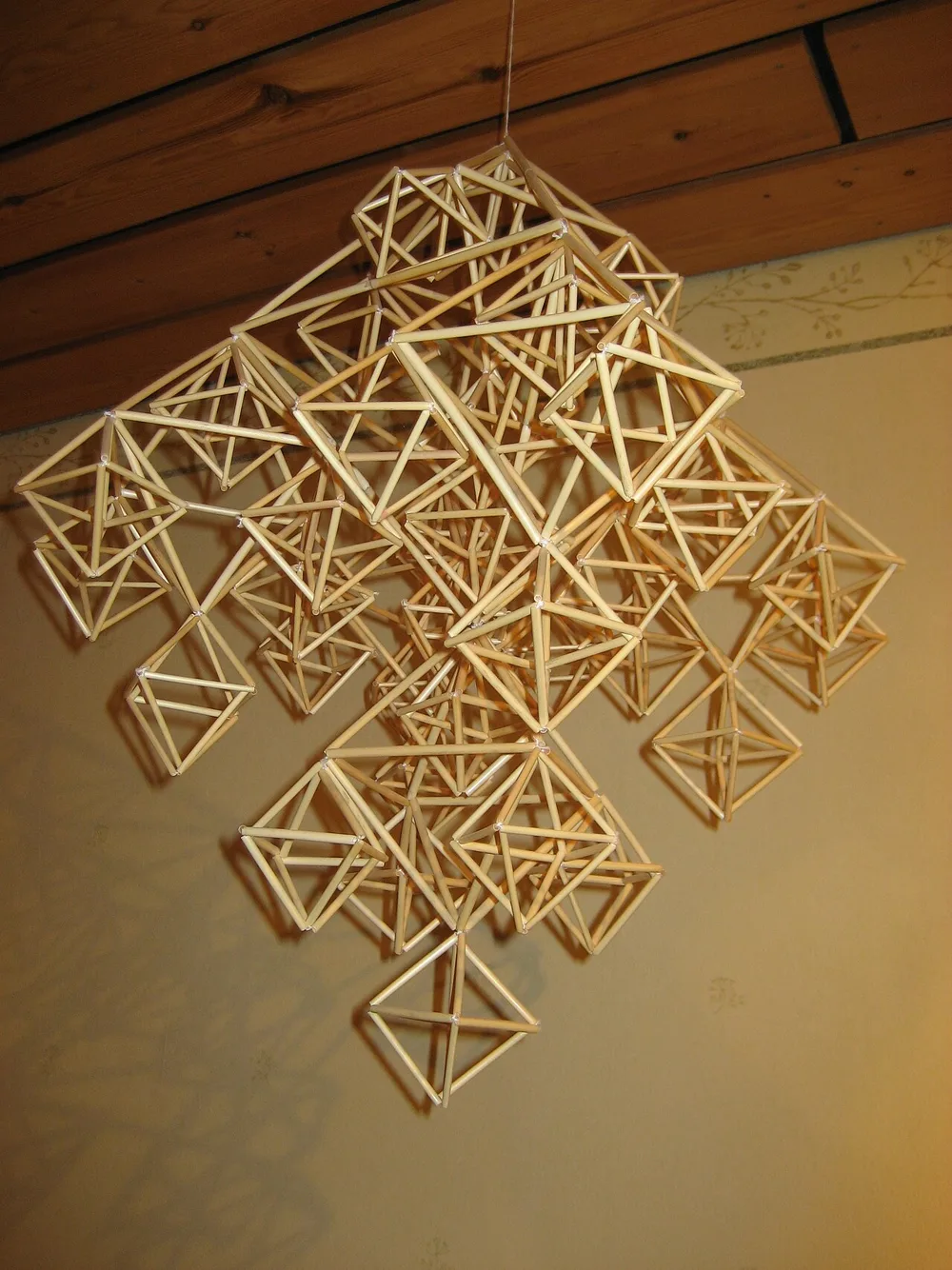
Threading a Himmeli
Days one and two: thread the twelve-tube octahedron that every himmeli is built from, then build Eija Koski's traditional himmeli of one 20 cm form, six 10 cm forms, and twelve 5 cm forms, joined with short necks so the parts move, and hang it on a single thread.
- 3 min
- 5 steps
- 2 questions
- Lesson 167 of 204
In this lesson
- The basic form
- Build the traditional himmeli
- Other shapes
- Hanging
- Try it
Picking up where you left off.
The basic form
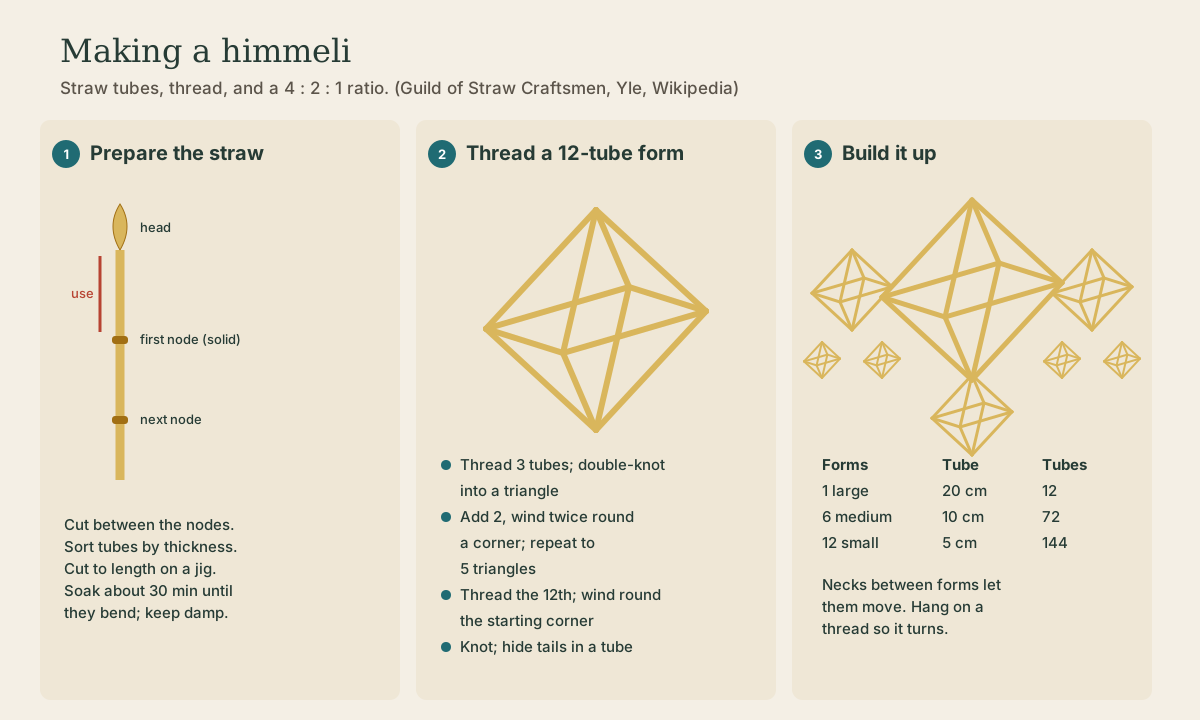
Every traditional himmeli is built from one shape: twelve tubes threaded into an octahedron, two four-sided pyramids base to base. Yle’s instructions with the craft artist Eija Koski, demonstrated with drinking straws but the same for rye 1:
- Thread three tubes onto about 1.5 m of thread and tie a double knot to close them into a triangle.
- Thread two more tubes and wind the thread twice around a corner to make the next triangle.
- Keep adding two tubes at a time until you have five triangles in a row.
- Thread the twelfth tube and wind it around the corner where the starting tail hangs.
- Knot the two ends together and pass the tails into a tube with the needle to hide them.
Use tubes of one thickness for each form 2, soaked so they don’t split 3, and don’t pull the knots too tight: tight knots split the straw 4.
Playback is optional. If the player is unavailable, open the video at its source.
Quick check
Twelve edges make an octahedron: two pyramids base to base.
Build the traditional himmeli
Koski’s traditional himmeli has three sizes, each half the one before 1:
| Forms | Tube length | Tubes |
|---|---|---|
| 1 large | 20 cm | 12 |
| 6 medium | 10 cm | 72 |
| 12 small | 5 cm | 144 |
Tie each small form to a medium one, and the medium forms to the corners of the large one. Add short necks, a piece of tube on the thread between forms, so the forms can move a little 1. Koski’s list allows 24 small forms instead of 12 for a fuller piece.
Quick check
Short pieces of tube between forms let each part swing a little.
Other shapes
The same twelve-tube form builds bigger designs. A himmeli at the Keski-Suomen museum, made in 1987, builds a pyramid from one form at the top to five per side, all of 7 cm straws, with 2 cm necks down to a row of smaller forms of 6 cm tubes; it is 47 cm tall 5.

Hanging
Himmelis were hung over the table or over a child’s bed, on a woman’s hair so they moved at the slightest draught, and the movement was said to snare evil spirits. Trim, if any, was feathers, eggshell, or cloth scraps; today people also use sweet wrappers, foil, and newspaper 1.
Try it
Thread three basic forms, one at each size, before cutting all 228 tubes. If the 5 cm form is fiddly, make it from thinner straws; if the 20 cm form sags, use thicker ones.
Lesson complete
Nice work.
Sources for this lesson
- 1Traditionell himmel (Strömsö). Yle Svenska. 2013. verifiedEija Koski's traditional himmeli: 12 tubes of 20 cm (one large base form), 72 of 10 cm (six medium), 144 or 288 of 5 cm (12 or 24 small); each form takes 12 tubes, 1.5 m of matching cotton thread, and a large needle. Thread three tubes and double-knot into a triangle; thread two and wind twice round the corner; continue to five triangles; thread the twelfth and wind round the corner with the other tail; knot and hide the tails in a tube. Tie small forms to medium and medium to large; 'necks' between forms let them move. Himmelis hung over the table or a child's bed on a woman's hair so they moved in the slightest draught, said to snare evil spirits; trimmed with feathers, eggshell, cloth scraps, today also sweet wrappers, foil, newspaper. The demonstration used drinking straws.
- 2Straw mobile (Himmeli). Wikipedia. verifiedHimmeli from Swedish/German himmel, sky or heaven. Rye cut about 2 m long and dried from green to gold over weeks, then cut at the joints and sorted by thickness. Hung over the table at Christmas and left until midsummer; 'the larger the himmeli the larger the rye crop.' Related to the Polish pająk and Lithuanian sodai.
- 3Straw FAQ. The Guild of Straw Craftsmen. verifiedHarvest before the grain is fully ripe, at the milky stage, with a little green at the first joint; stand sheaves upright in sun for a couple of days, in at night; store dry and airy in boxes, never plastic. Use straw from the head to the first node; straws taper, so grade by diameter. Rye is excellent but hard to get; modern wheat is thick-walled with a short top section. Soak at least 30 minutes in room-temperature water until the butt bends without cracking; keep in a damp towel.
- 4Mirva Johnson. Alana Maijala. Traveling Traditions, UW-Madison Nordic Folklife. verifiedHimmeli maker in Virginia, Minnesota: rye straw gathered in fall, long hollow native grasses as a substitute; cleaning straw takes time; knots tied too tight split the straw; finished himmelis were burned in the midsummer bonfire.
- 5Himmeli (1987). Keski-Suomen museo (Finna). verifiedBuilt from 7 cm straws of equal thickness: a pyramid from one form at the top to five per side, with 2 cm neck pieces down to a row of smaller forms of 6 cm tubes; 47 x 36 x 36 cm.