Making and Balancing a Straw Crown
Days three through five: look at old Dalarna crowns, then make their parts: a straw roof in one or two tiers, diamonds of straw on a cross, threaded straw garlands with cloth squares, plaited rings, paper flowers and stars, and wool tassels. Sketch your own crown, assemble it, and balance it until it hangs level and turns.
- 3 min
- 6 steps
- 2 questions
- Lesson 168 of 204
In this lesson
- The old crowns
- Make the parts
- The roof
- Design
- Assemble and balance
- Try it
Picking up where you left off.
The old crowns
Dalarnas museum’s crowns show what to make:
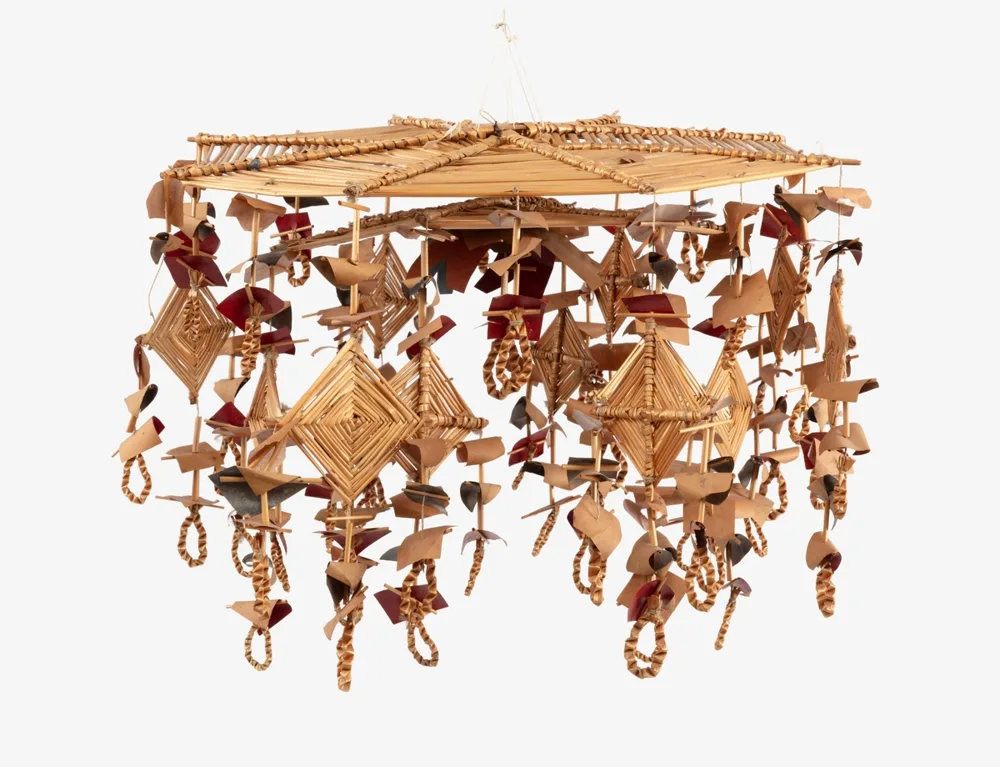
- Mockfjärd: an octagonal roof in two storeys, hangers of cross-set straw panels in four sections, plaited straw rings, and pieces of paper; about 30 cm high and 37 across 1.
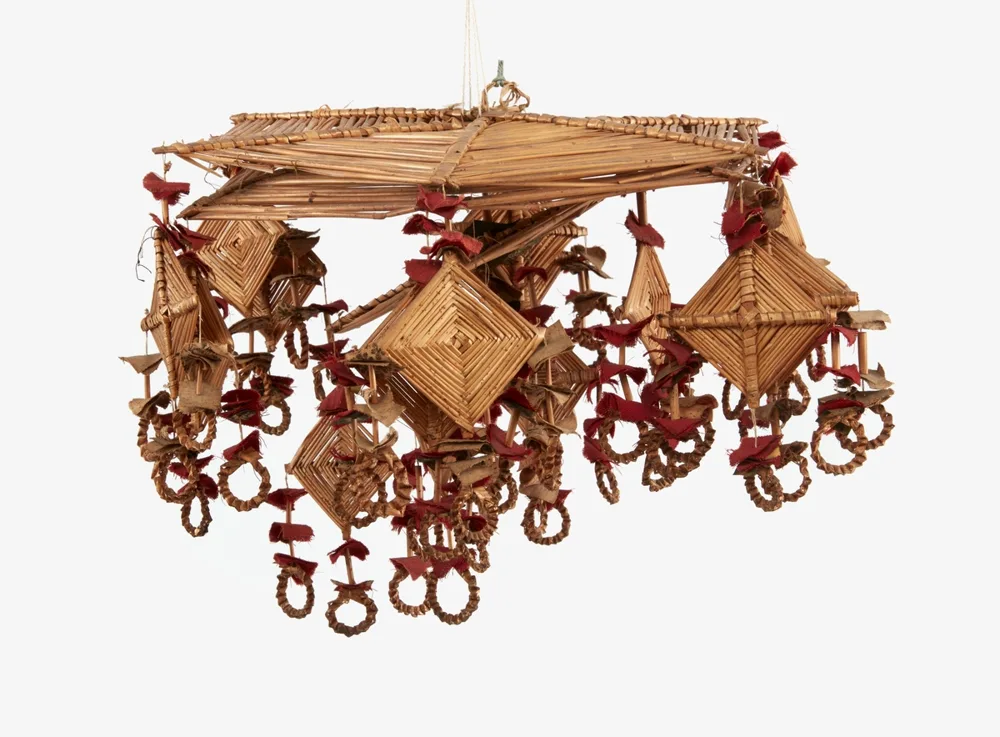
- DM 29009: a roof with a smaller roof beneath trimmed with sewn-on cloth; from the corners hang diamonds and threaded straw pieces with cloth patches between them, and twisted straw wreaths at the bottom; 22 cm high and 40 wide 2.
- Lekaryd, Småland: straws 9 to 19 cm long threaded on linen thread with a red wool tassel at every junction 3.
The Orsa bride’s crown of 1848 had silk tassels in every corner and a large multicolored silk tassel at the bottom 4. Sätergläntan’s class asks students to bring cloth scraps, ribbon, beads, paper, birch bark, and dried flowers 5.
Quick check
Straws threaded on linen, with red wool tassels where they meet.
Make the parts
Keep the straw soaked and wrapped in a damp towel as you work 6.
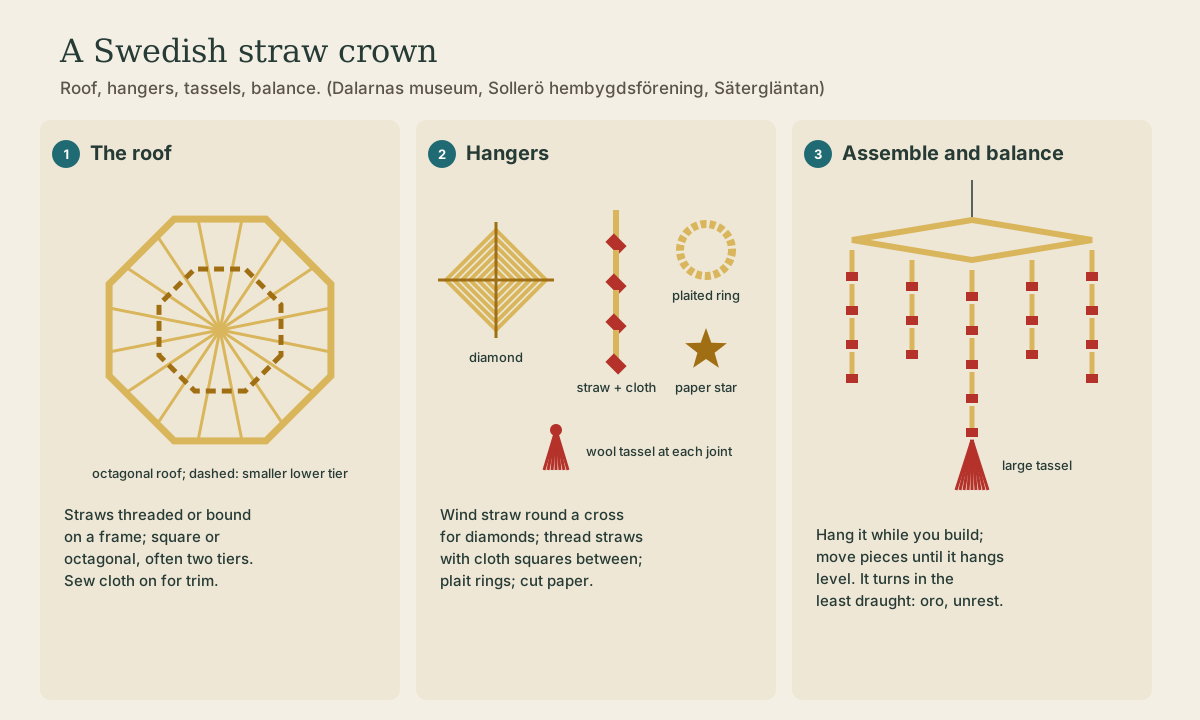
- Diamonds. The museum diamonds are concentric squares of straw on a cross of two straws, hung by one point. Tie two straws in a cross, then lay rounds of straw around it, each round tied to the arms, working outward.
- Garlands. Thread straw lengths on linen thread with a small square of cloth between each pair, as on DM 29009 2.
- Rings. Plait three straws into a band, or twist a bundle, and bend it into a ring tied shut 1.
- Paper. Sätergläntan teaches tassels and flowers of paper and cloth 5; cut stars and small flowers from colored paper or card.
- Tassels. Wind wool around a card, tie at the top, cut the bottom, and wrap a neck. Make one large tassel for the bottom center.
Design
Sätergläntan’s class covers composition and spatial sketching before assembly 5. Sketch the crown from the side: roof width, how many strings from each corner and from the lower tier, and how long each hangs. Keep the design symmetrical about the center so it balances, and plan the big tassel at the bottom center.
Assemble and balance
Hang the roof from a thread at eye level and build on it there:
- Tie on the corner strings first, opposite pairs together, so it never tips far.
- Add the lower tier and its strings.
- Add the bottom tassel last.
- Watch it hang. Where it dips, shorten that side’s strings or move a heavy piece inward; where it rises, add a tassel.
When it hangs level it will turn at the slightest draught 5.
Playback is optional. If the player is unavailable, open the video at its source.
Quick check
A crown that hangs level turns freely, the oro the old name describes.
Try it
Hang a single diamond and a single garland from a pencil on two threads and slide them until the pencil balances. That small exercise is the whole skill of balancing a crown.
Lesson complete
Nice work.
Sources for this lesson
- 1Takkrona (DM 18331). Dalarnas museum (DigitaltMuseum). verifiedStraw crown from Mockfjärd: octagonal roof in two storeys; hangers of cross-set straw panels in four sections, plaited straw rings, and pieces of paper; about 300 mm high and 370 mm across. Photo Per Eriksson, CC BY.
- 2Takkrona (DM 29009). Dalarnas museum (DigitaltMuseum). verifiedStraw crown with a roof and a smaller roof beneath trimmed with sewn-on cloth; diamonds and threaded straw pieces with cloth patches between them hang from the corners; twisted straw wreaths at the bottom; 220 mm high, 400 mm wide. Photo CC BY.
- 3Halmkrona (M 3995). Kulturparken Småland (DigitaltMuseum). verifiedCopy of an old pattern made before 1927 by Anna Danielsson, Buskahult, Lekaryd: straws 9-19 cm long threaded on linen thread, a red wool tassel at every junction; 250 x 250 x 150 mm.
- 4Inga-Lill Eliasson. Krona och krans vid bröllop och fest. Sollerö hembygdsförening. verifiedCrowns and wreaths for weddings, funerals, midsummer, and Christmas, of field and forest materials trimmed with leftover cloth, yarn, paper, and glitter; in winter, straw and birch-bark crowns replaced summer garlands. Orsa, 1848: a straw crown the bride made herself hung over her seat, with silk tassels at every corner and a large multicolored silk tassel at the bottom. Cites Bondjers and Danielsson Hamss, Oro, himmel, spindel... takkronor av halm (Dalarnas museum, 1989).
- 5Halmkronor 2026. Sätergläntan Institutet för slöjd och hantverk. verifiedKarin Edlund, July 6-10, 2026, 8:40-16:00, ending at lunch on day 5, Insjön, Dalarna; base materials about 250 SEK. Straw crowns were made for festivals such as Christmas and weddings and are sometimes called 'oro' because they move at the slightest draught. Rye straw; small samples of geometric forms, plaited panels, garlands, and hangers; tassels and flowers of paper and cloth; then a crown of one's own design: composition, spatial sketching, assembly. All tools, straw, and basic materials provided; bring cloth scraps, ribbon, beads, paper, birch bark, dried flowers. No experience needed.
- 6Straw FAQ. The Guild of Straw Craftsmen. verifiedHarvest before the grain is fully ripe, at the milky stage, with a little green at the first joint; stand sheaves upright in sun for a couple of days, in at night; store dry and airy in boxes, never plastic. Use straw from the head to the first node; straws taper, so grade by diameter. Rye is excellent but hard to get; modern wheat is thick-walled with a short top section. Soak at least 30 minutes in room-temperature water until the butt bends without cracking; keep in a damp towel.