The Warp-Weighted Loom and What to Buy
Vesterheim's five-day boat-rug class on the oppstadgogn and North House's build-and-weave class, rebuilt for home. The loom in Norway, the Norwegian boat rug, a simple two-post loom to build from 2x4s, weights from stones, cement, or sandbags and how heavy they must be, wool warp and pile yarn, and a seven-day plan.
- 4 min
- 6 steps
- 2 questions
- Lesson 181 of 204
In this lesson
- The loom
- A loom to build
- Weights
- Yarn
- Try it
Picking up where you left off.
What you need
| Have it | Material | Spec | Qty | Where to get it |
|---|---|---|---|---|
| Uprights | Two 2x4 x 8 ft, cut to 72 in | 2 | Dark Ages Re-Creation Company | |
| Braces | One 1x4 x 8 ft, cut into two braces about 4 ft | 1 | Dark Ages Re-Creation Company | |
| Cloth beam | 1.5 in hardwood dowel, about 5 ft, drilled every inch | 1 | Lumberyard | |
| Heddle rod and shed rod | 2x2 or 1 in dowel, about 5 ft; plus two 6 in 2x4 blocks for heddle-rod rests | 1 each | Dark Ages Re-Creation Company | |
| Hardware | Four U-hooks and eight 3/8 x 3 in carriage bolts with nuts and washers | 1 set | Dark Ages Re-Creation Company | |
| Weights | Nearly equal weights, about 1/2-1 kg each: flat beach stones, cast cement, or sand in cloth bags | About 12 kg for a 40 cm sample | Garden, or cast your own | |
| Warp yarn | Firm wool warp, such as Möbelåtta 8/2 or a Spelsau single | About 300 g for a 40 cm x 1 m sample | Vävstuga Weaving School (store) | |
| Pile yarn | Rauma Ryegarn or another rug wool, in several colors | About 500 g | The Woolery | |
| Tablet-weaving cards optionalOr make a four-strand twisted cord heading instead. | For the starting border | 1 pack | Icon Fiber Arts | |
| Heddle string | Strong cotton or linen twine | 1 ball | Hardware or weaving store |
Tools
Checkmarks are saved on this device.
The plan
-
Day 1
Build the loom
- Cut the uprights, braces, and blocks
- Bolt the frame; fit the U-hooks and beam
-
Day 2
Weights and border
- Collect, cast, or bag weights; match them on a scale
- Weave or twist the starting border with the warp
-
Day 3
Hang the warp
- Sew or lash the border to the beam
- Tie warp bundles to weights in two rows, level
- Chain the warp to space it
-
Day 4
Heddles
- Set the shed rod; knit string heddles to the heddle rod
- Test both sheds
-
Day 5
Ground and first knots
- Weave a band of ground, beating up with the sword
- First rows of pile knots
-
Day 6
Weave
- Alternate ground and knot rows
- Roll the cloth onto the beam as it grows
-
Day 7
Finish
- Last rows; cut off
- Secure the warp ends and the border
This module reconstructs two classes. Vesterheim’s five-day Weaving a Boat Rug on a Warp-Weighted Loom, taught by Monika Sunnanå Ravnanger, weaves on the oppstadgogn, the loom that “stands up against the wall” with “warp threads… knotted to the stone or ceramic weights,” and knots in pile of wool, thread, or textile scraps in the manner of the Norwegian boat rug, “the most documented and preserved floss textile in Norway” 1. North House’s five-day class builds a tabletop loom in two days, warps it with stone weights, and weaves a small rya 2. Neither plan is published; this follows the sources cited, and the sample’s numbers are estimates.
The loom
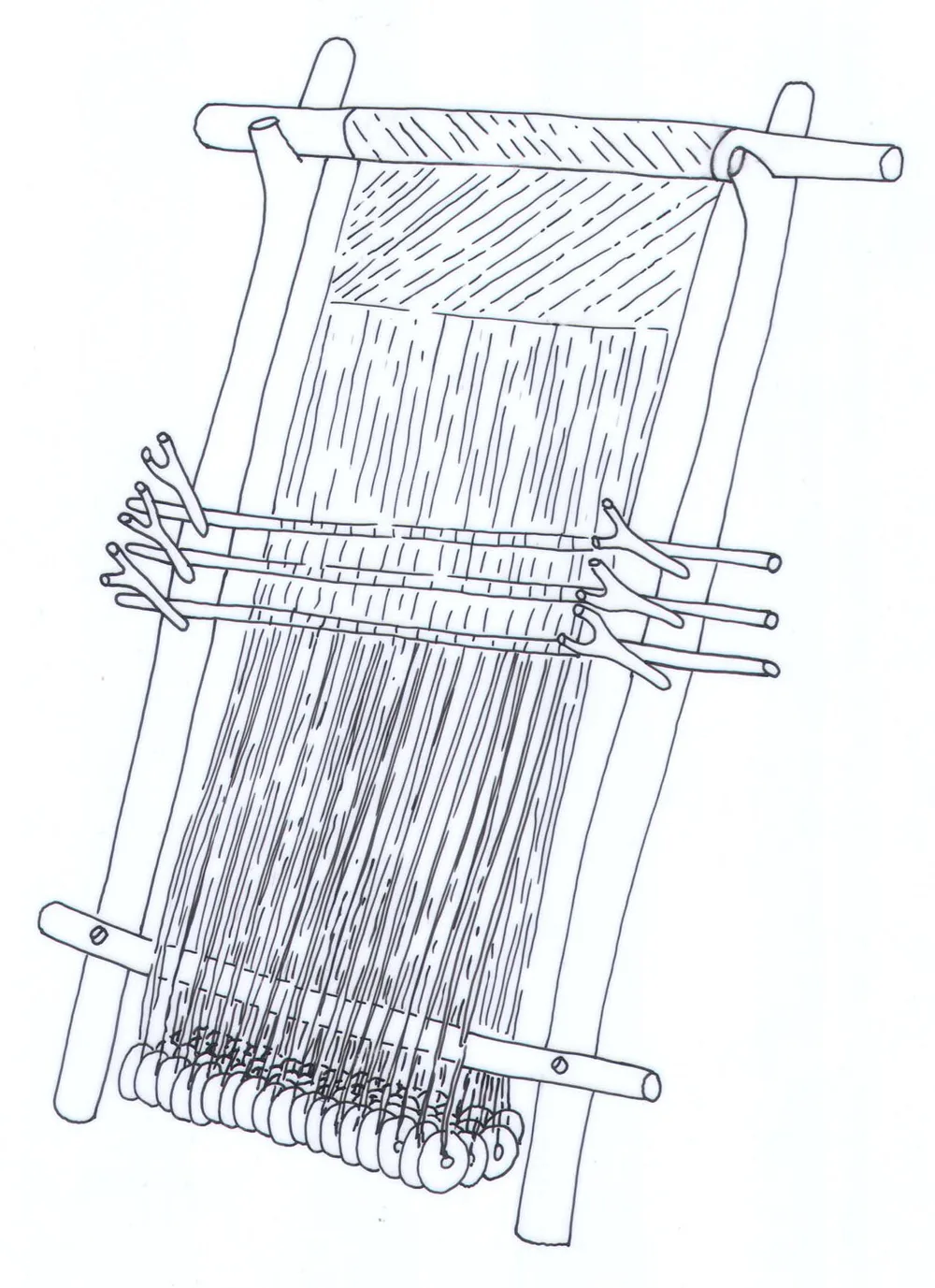
The Norwegian oppstadvev has two heavy side posts leaning against a wall, carrying a cloth beam with a row of holes for sewing on the warp. The warps hang down to weights; a heddle rod gives the second shed; and weaving goes from the top down, the weft beaten upward and the cloth rolled onto the beam while the weaver stands 3. Marta Hoffmann’s The Warp-Weighted Loom (1964) is the standard study 4.
The pile that Vesterheim’s class knots in keeps you warm worn against the body and sheds rain facing out 1. Museum boat rugs are 135 to 160 cm wide, woven in two widths sewn together, on a ground of point twill with Smyrna knots, at about 4 to 8 warp ends per centimeter 5.

Quick check
The cloth starts at the beam and is rolled up onto it as it grows.
A loom to build
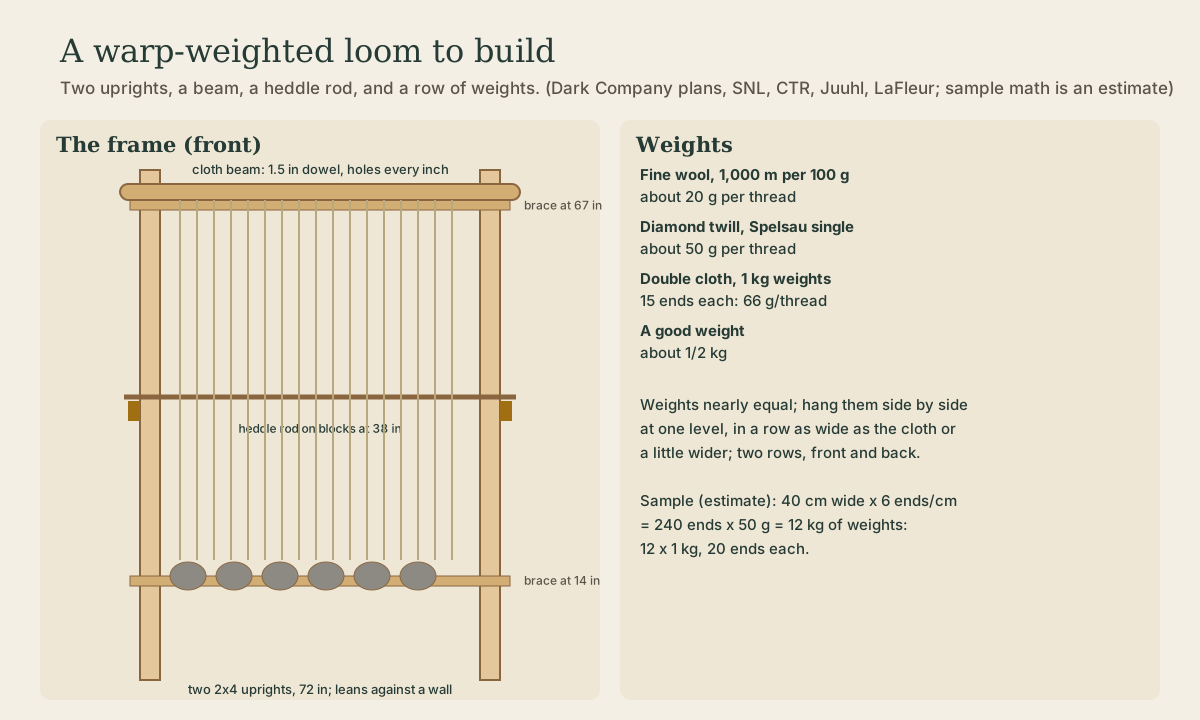
The Dark Ages Re-Creation Company’s plans need two 2x4 uprights cut to 72 inches, two braces from a 1x4 bolted at 14 and 67 inches, 6-inch blocks at 38 inches to carry the heddle rod, a header beam and heddle rod, four U-hooks, and eight carriage bolts, about $20 in all. Their improved loom used a 1.5-inch dowel beam with holes every inch, a header lowered 4 inches, and a bottom brace raised 4 inches 6. That frame weaves cloth up to about 90 cm wide, leaving room at the uprights; a double-cloth experiment kept its warp about 15 cm clear of each upright 7.
Weights
Loom weights were soapstone, grooved beach stones, elongated stones, or fired clay with holes, and they “should weigh about the same”; today people use cast weights or sandbags 8. How much they must pull depends on the yarn:
- About 20 g per thread for fine wool of about 1,000 m per 100 g, in experiments with 275 g ceramic weights 9.
- 50 g per warp end for Marta Kløve Juuhl’s diamond twill in Spelsau single yarn 10.
- 1 kg weights with 15 ends each, about 66 g per thread, for double cloth 7.
“A good warp-weighted loom weight is half a kilo”; Robbie LaFleur cast 40 cement weights in paper cups, most 485 to 520 g 11. Hang them side by side at one level, in a row as wide as the cloth or a little wider 9. At a 2013 Vesterheim class, uneven stones made a weaving draw in: “be sure you have enough rocks!” 12
A sample (estimate): 40 cm wide at 6 ends per cm is 240 ends; at about 50 g each that’s about 12 kg of weights, such as twelve 1 kg weights of 20 ends each, or twenty-four half-kilo weights of 10.
Quick check
Juuhl used 50 g per end for a Spelsau twill; uneven stones make the cloth draw in.
Try it
Before building, weigh a dozen flat stones from the garden on a kitchen scale and sort them into groups within 10 percent of each other. If you can’t make a full set, plan to cast cement weights or sew sandbags.
Lesson complete
Nice work.
Sources for this lesson
- 1Weaving a Boat Rug on a Warp-Weighted Loom. Vesterheim Folk Art School. verifiedMonika Sunnanå Ravnanger, July 28-August 1, 2026, intermediate and advanced. The warp-weighted loom, oppstadgogn, stands against the wall with warps knotted to stone or ceramic weights. Pile (floss, rag, or napp) of wool, thread, or scraps knotted in; worn against the body it keeps you warm, facing out it sheds rain. The boat rug is 'the most documented and preserved floss textile in Norway,' used on fishing boats and coastal trips.
- 2Warp-Weighted Tabletop Loom: Build and Weave. North House Folk School. verifiedFive days: build the loom in two days, warp it with stone weights, and weave a small rya; 2020 tuition $475, materials $120.
- 3Eli Wendelbo, Audun Dybdahl. Oppstadvev. Store norske leksikon. verifiedTwo heavy side posts lean against a wall, carrying a rotating cloth beam with a row of holes for sewing on the warp; the warp's top loops are threaded on a cord, spread to width, and sewn to the beam; warps tied to weights; a finger-crochet chain over pairs of warps spaces them; heddling with thick thread; tabby from heddling every other warp, three- and four-shaft twill from more heddle rods. Weaving goes from the top down: weft laid in arcs, pushed up with the fingers, beaten with a sword or weaving spoon; the cloth rolls onto the beam; the weaver stands.
- 4Marta Hoffmann. The Warp-Weighted Loom: Studies in the History and Technology of an Ancient Implement. Universitetsforlaget, Oslo (Studia Norvegica 14). 1964. verifiedThe standard study of the warp-weighted loom in Norway and beyond; 425 pages, 137 illustrations.
- 5Båtrye (NSM.12060-62 and others). DigitaltMuseum. verifiedNorwegian boat rugs 135-160 cm wide, woven in two widths ('vevd i to deler'), ground of point twill with Smyrna knots ('spisskypert og smyrnaknuter'), about 4-8 warp ends and 3-6 picks per cm.
- 6Neil Peterson, Karen Peterson. Warp Weighted Loom. Dark Ages Re-Creation Company. verifiedTwo 2x4x8 uprights cut to 72 in; a 1x4 cut into two braces about 4 ft long bolted at 14 and 67 in; 6 in 2x4 blocks at 38 in as heddle-rod rests; a 5 ft 2x3 header and 5 ft 2x2 heddle rod; four U-hooks and eight 3/8 x 3 in carriage bolts, about $20. Later revisions: header lowered 4 in, bottom brace raised 4 in; the better loom used a 1.5 in dowel beam with holes every inch.
- 7Jan Larson, Marta Kløve Juuhl. Norwegian double-cloth: warp-weighted loom experiments. Archaeological Textiles Review 64. verified1 kg weights with 15 warps per bundle (about 66 g per thread); warp 125 cm wide at 6 ends per cm per layer, about 15 cm clear of each upright; coin-bag weights 4-6 cm thick.
- 8Kljåstein. Store norske leksikon. verifiedLoom weights of soapstone, grooved beach stones, elongated stones, or fired clay with holes; they should weigh about the same; today cast weights or sandbags are used.
- 9Linda Mårtensson, Eva Andersson, Marie-Louise Nosch, Anne Batzer. Technical Report Experimental Archaeology Part 3: Loom Weights. Centre for Textile Research, University of Copenhagen. 2007. verifiedExperiments with 22 ceramic weights of about 275 g, 11 per row; wool of about 1,000 m per 100 g needed about 20 g per thread, so 14 threads per weight. Weights should hang side by side at one level; the row of weights should be the same as or slightly wider than the fabric; flat-sided weights work best.
- 10Marta Kløve Juuhl. Diamond Twill Woven on a Warp-weighted Loom. Norwegian Textile Letter. verifiedSpelsau single yarn at 10 ends per cm, 600 ends over 60 cm; a heading cord as in weaving åkler; '50 grams per warp end'; '3 heddle rods and a 4th natural shed'; threading took 3 days.
- 11Robbie LaFleur. Warp-Weighted Loom Weights. Robbie LaFleur. 2016. verified'A good warp-weighted loom weight is half a kilo'; she cast 40 cement weights in Dixie cups, most 485-520 g.
- 12Melba Granlund. Warp-Weighted Loom Classes at Vesterheim, July 2013. Norwegian Textile Letter. 2013. verifiedMarta Kløve Juuhl taught a Sámi grene in handspun wool, then an åkle or rya. The heading is a four-strand twisted cord lashed to the beam; warps are inserted at so many threads per centimeter, then weighted, heddled, and chained; weft carried up the selvedge at color changes; 'be sure you have enough rocks!' Uneven stones made a weaving draw in.
- 13Bockens Möbelåtta 8/2 Wool. Vävstuga Weaving School (store). verifiedFirm 8/2 wool, 1,984 yd/lb, $18 per 100 g; Sätergläntan's rya class uses it as a wool warp.
- 14Rauma Ryegarn; Klippan Fårö 6/1; Belgian 12/4 Linen Rug Warp. The Woolery. verifiedRauma Ryegarn Norwegian spælsau rug wool, about 80 yd per 100 g, $17.75, 78 colors. Klippan Fårö 6/1, 656 yd per 100 g, $20.80 (woolery.com/products/klippan-faro-wool-yarn). Belgian 12/4 linen rug warp, about 450 yd per 8 oz, $18.30 (woolery.com/products/natural-linen-rug-warp-yarn-12-4). Prices 2026.
- 15