Weaving a Boat-Rug Sample
Days five through seven: weave the ground from the top down, laying the weft in arcs and beating it up with the sword; knot rows of pile into it the way Norwegian boat rugs were made; manage the edges; roll the cloth onto the beam; and cut off and finish the sample.
- 3 min
- 6 steps
- 2 questions
- Lesson 183 of 204
In this lesson
- Weave the ground
- The boat rug
- Knot the pile
- Roll the cloth
- Finish
- Try it
Picking up where you left off.
Weave the ground
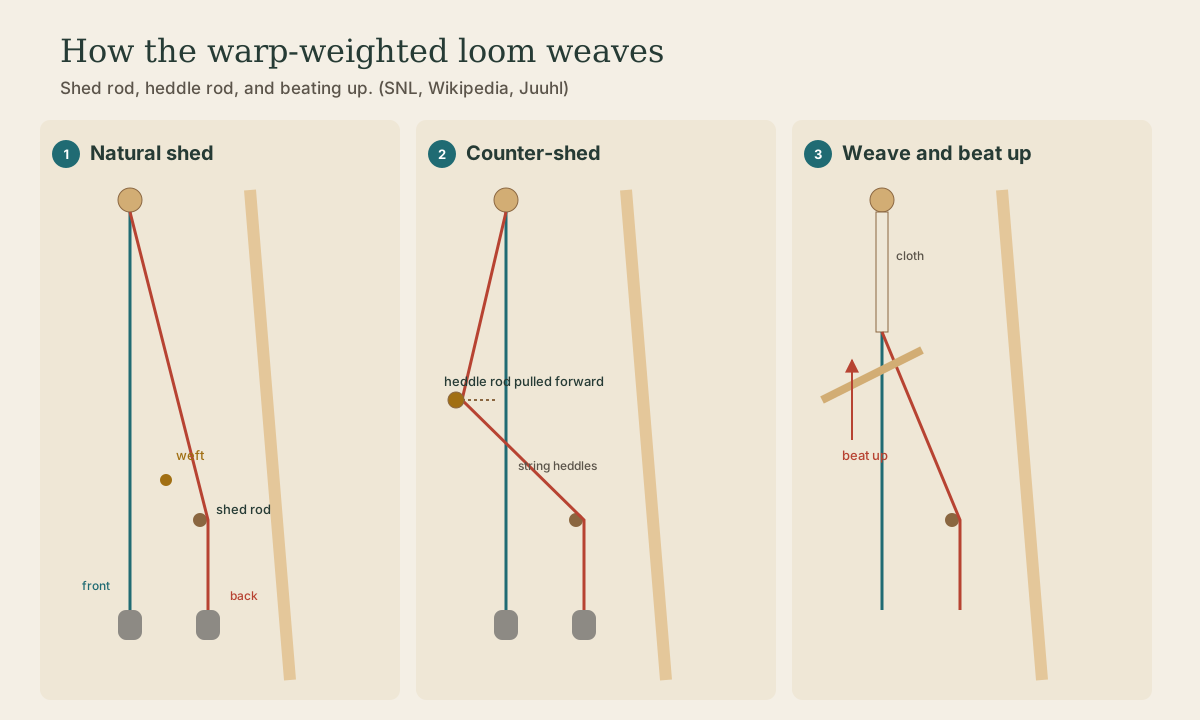
Weaving goes from the top down. Lay the weft through the shed in roomy arcs, push it up with your fingers, and beat it upward with the weaving sword or a weaving spoon; the weaver stands 1.
- Open the natural shed and pass the weft from one side.
- Push it up in an arc, then beat up with the sword.
- Pull the heddle rod forward for the counter-shed and pass the weft back.
- Beat up, release the rod, and repeat.
At color changes, carry the weft up the selvedge rather than cutting it 2. Check the width often; if the cloth draws in, the weights may be uneven.
Playback is optional. If the player is unavailable, open the video at its source.
Quick check
The arc gives the weft enough length to bend around the warps without pulling the edges in.
The boat rug
The boat rug was standard equipment on Norway’s coastal boats 3 and could use a farm’s whole season of wool 4. Museum examples are woven in two widths of 135 to 160 cm overall, in point twill with Smyrna knots, at about 4 to 8 warp ends and 3 to 6 picks per centimeter 5. The pile can be wool, thread, or textile scraps 3.
Quick check
A two-post loom of manageable width wove each half.
Knot the pile
The Smyrna knot is the same knot as the Finnish ryijy’s Ghiordes knot 6 (ryijy module, lesson 2):
- Weave a band of ground first, 5 cm or so.
- Open a shed so the warps are clear, then tie a row of knots across, each bundle wrapped around two warps with both tails coming out between them.
- Lay every knot’s tails the same way, so the pile lies in one direction across the whole piece.
- Weave several picks of ground and beat up, then tie the next row.
Pile of rag strips or rug wool cut to about twice the pile length works well; mix rags and wool for a boat-rug look 3.
Roll the cloth
As the woven part grows down toward the shed rod, the weaving space shrinks. Unhook the beam, turn it to roll the cloth onto it, and rehang it; the cloth is rolled up onto the beam as it grows 1. Spare warp can be wound around the weights and let out as the cloth is rolled up 7.
Playback is optional. If the player is unavailable, open the video at its source.
Finish
Weave a band of ground below the last knot row, cut the warps above the weights, and tie them in pairs or bundles against the cloth. Unlace the border from the beam; it stays on as a finished edge.
Try it
Weave 5 cm of plain ground before the first knots, and measure the width at the top and at the bottom of that band. If it lost more than a centimeter, even up the weights before you go on.
Lesson complete
Nice work.
Sources for this lesson
- 1Eli Wendelbo, Audun Dybdahl. Oppstadvev. Store norske leksikon. verifiedTwo heavy side posts lean against a wall, carrying a rotating cloth beam with a row of holes for sewing on the warp; the warp's top loops are threaded on a cord, spread to width, and sewn to the beam; warps tied to weights; a finger-crochet chain over pairs of warps spaces them; heddling with thick thread; tabby from heddling every other warp, three- and four-shaft twill from more heddle rods. Weaving goes from the top down: weft laid in arcs, pushed up with the fingers, beaten with a sword or weaving spoon; the cloth rolls onto the beam; the weaver stands.
- 2Melba Granlund. Warp-Weighted Loom Classes at Vesterheim, July 2013. Norwegian Textile Letter. 2013. verifiedMarta Kløve Juuhl taught a Sámi grene in handspun wool, then an åkle or rya. The heading is a four-strand twisted cord lashed to the beam; warps are inserted at so many threads per centimeter, then weighted, heddled, and chained; weft carried up the selvedge at color changes; 'be sure you have enough rocks!' Uneven stones made a weaving draw in.
- 3Weaving a Boat Rug on a Warp-Weighted Loom. Vesterheim Folk Art School. verifiedMonika Sunnanå Ravnanger, July 28-August 1, 2026, intermediate and advanced. The warp-weighted loom, oppstadgogn, stands against the wall with warps knotted to stone or ceramic weights. Pile (floss, rag, or napp) of wool, thread, or scraps knotted in; worn against the body it keeps you warm, facing out it sheds rain. The boat rug is 'the most documented and preserved floss textile in Norway,' used on fishing boats and coastal trips.
- 4Robbie LaFleur. What is Norwegian Weaving?. Vesterheim Norwegian-American Museum and Norwegian Textile Letter. 2020. verifiedNorwegian rya pile faced down on beds; the boat rya (båtrye) was essential in open North Sea boats, could use a farm's whole season of wool, and weighed over 20 lb; the smooth side often twill stripes or squares. Krokbragd, 'crooked pattern', coverlets dense and warm, called tjukk-åkle in parts of Gudbrandsdal; Vesterheim has over 150 historic coverlets.
- 5Båtrye (NSM.12060-62 and others). DigitaltMuseum. verifiedNorwegian boat rugs 135-160 cm wide, woven in two widths ('vevd i to deler'), ground of point twill with Smyrna knots ('spisskypert og smyrnaknuter'), about 4-8 warp ends and 3-6 picks per cm.
- 6Ryijy tradition. Wiki-inventory for Living Heritage, Finnish Heritage Agency. verifiedName from Old Scandinavian 'ry'; first Finnish record a Häme Castle official's ryijy in the mid-15th century; cotton blankets nearly displaced ryijy after the 1850s and national romanticism revived it (Gallen-Kallela's Liekki for the 1900 Paris Exposition). Knot: 'Smyrna knot, also known as the Ghiordes knot or Turkish knot'; typically 3-4 yarns per pile. Friends of Finnish Handicraft founded 1879.
- 7Warp-weighted loom. Wikipedia. verifiedTwo posts; a cylindrical beam onto which cloth can be rolled; a shed rod for the natural shed; a heddle bar tied to warps by string leashes, pulled forward to give the counter-shed; extra warp can be wound around the weights.