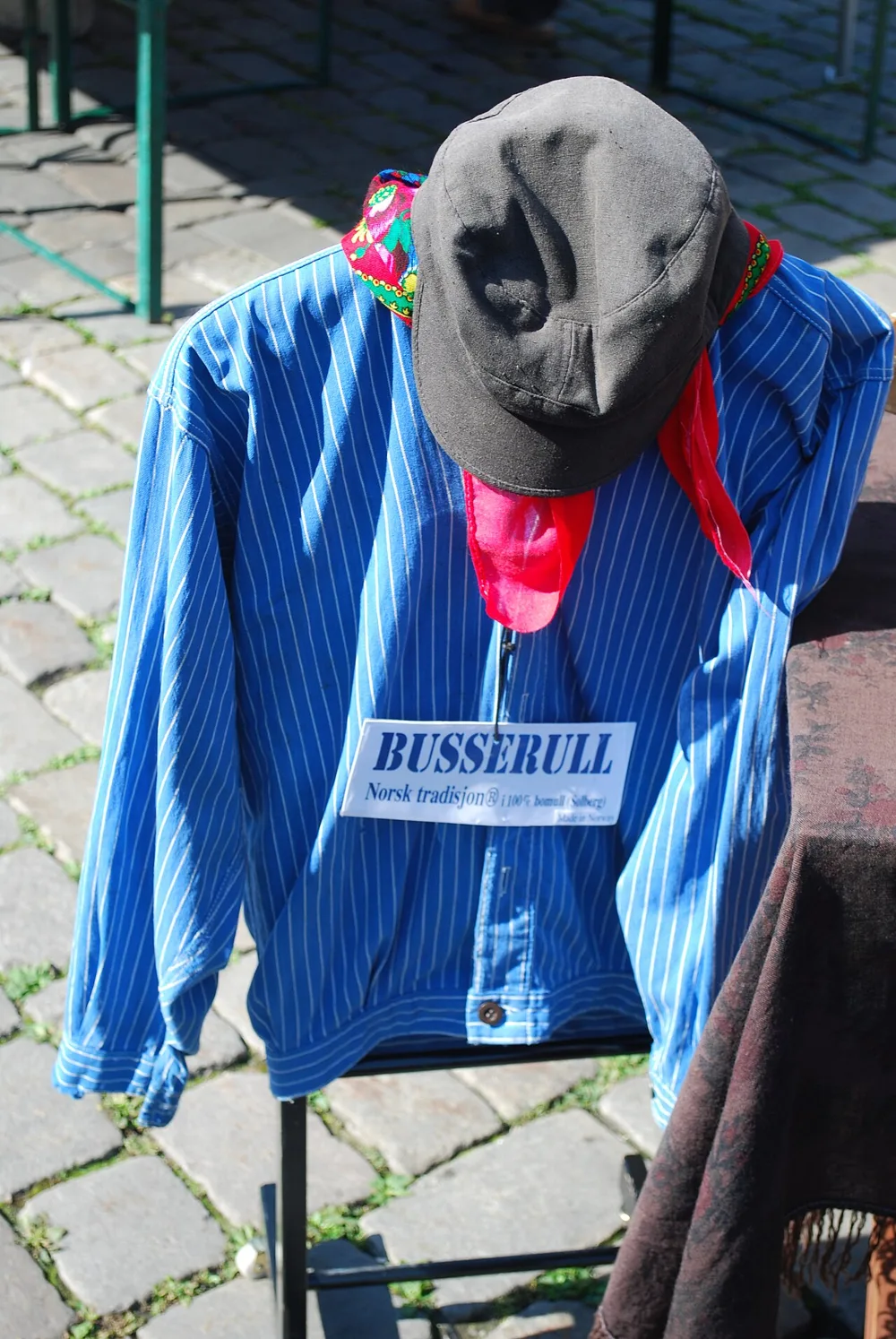
The Busserull and What to Buy
The busserull is the Norwegian work shirt of fishermen, loggers, railroad men, and Norwegian-American farmers in Wisconsin, cut entirely from rectangles. Its history, what North House's five-day class asks students to bring, the fabric and pattern choices with where to buy them, how to size a rectangle pattern from your own measurements, and a five-day plan.
- 4 min
- 6 steps
- 2 questions
- Lesson 132 of 204
In this lesson
- What a busserull is
- Real measurements
- Fabric
- Pattern and sizing
- Try it
Picking up where you left off.
What you need
| Have it | Material | Spec | Qty | Where to get it |
|---|---|---|---|---|
| Busserull fabricThe traditional Solberg cloth; about $175 for one shirt’s worth. | Striped cotton twill, 54 in wide, navy or red stripe | 3-yard cut | Vesterheim Store | |
| Cotton/linen stripe shirting optionalA lighter alternative; North House allows cotton or cotton/linen. | Yarn-dyed stripe, about 45% cotton / 55% linen, 59 in wide | 1 3/4-2 1/4 yd on 60-in fabric | Fabricsight | |
| Pattern | Folkwear #149 Norwegian Busserull, sizes XS-3XL; or draft your own rectangles | 1 | Folkwear | |
| Buttons | About 1/2 in, metal, bone, shell, or pewter | 6 | Fabric store or button supplier | |
| Thread | All-purpose cotton or polyester to match | 1-2 spools | Fabric store | |
| Lightweight interfacing optional | Woven fusible or sew-in, for one half of the collar band | A scrap, about 4 x 20 in | Fabric store | |
| D-rings optional | 1 in, metal, for an optional back half-belt | 2 | Fabric store |
Tools
Checkmarks are saved on this device.
The plan
-
Day 1
History, measuring, pattern, cutting
- Take measurements; choose a size and adjust length, sleeve, and ease
- Plan the stripes so yoke and body run the same way
- Cut and mark every piece
-
Day 2
Yoke, placket, pocket
- Sew the lined yoke to front and back
- Slash the center front and sew the placket
- Make and place a pocket
-
Day 3
Sleeves and gussets
- Pleat the sleeve ends
- Sew gussets to sleeves, sleeves to body
- Sew the side seams through the gussets; finish seams
-
Day 4
Collar, cuffs, slits
- Interface, sew, and hand-finish the collar band
- Sleeve slits and cuffs
- Side slits and optional back belt
-
Day 5
Hem, buttons, press
- Hem the shirt
- Buttonholes and buttons
- Final press; note fitting changes for the next shirt
This module rebuilds North House Folk School’s five-day class Sew Your Own Scandinavian Work Shirt, taught by Caroline Feyling and, before her, Carol Colburn. Students bring about 3 yards of all-natural woven cotton or cotton/linen, 5 or 6 buttons, thread, and a hand-sewing kit, and choose among six pattern sizes; it’s suited to advanced beginners 1. North House doesn’t publish its lesson plan, so this is a reconstruction from the description, museum shirts, and a published pattern.
What a busserull is
Busserull has been the Nordic name since the 1700s for an overgarment “of simple cut sewn from rectangular pieces,” first a seaman’s work shirt and later everyday workwear 2. The word came through Low German from the French bourgeron 2. In the late 1800s it was worn by railroad workers, loggers, builders, farmhands, harbor workers, and fishermen. Near 1900 the red or blue with white stripes became a national symbol, and Norwegian-Americans in rural Wisconsin wore busserulls from the 1870s until overalls replaced them in the 1920s 3.
The construction is consistent across museum shirts 3 4:
- A band collar.
- A shoulder yoke (akslaug) that extends over the upper arm.
- A placket at the neck, buttoned partway down the chest, or a full-length opening.
- Straight-set sleeves with square underarm gussets, pleated into a buttoned cuff.
- Side slits at the hem, and sometimes a half belt across the back.

Quick check
That’s why it fits any size with simple measurements.
Quick check
Museum examples have gussets about 9 cm square.
Real measurements
Three museum shirts give working numbers:
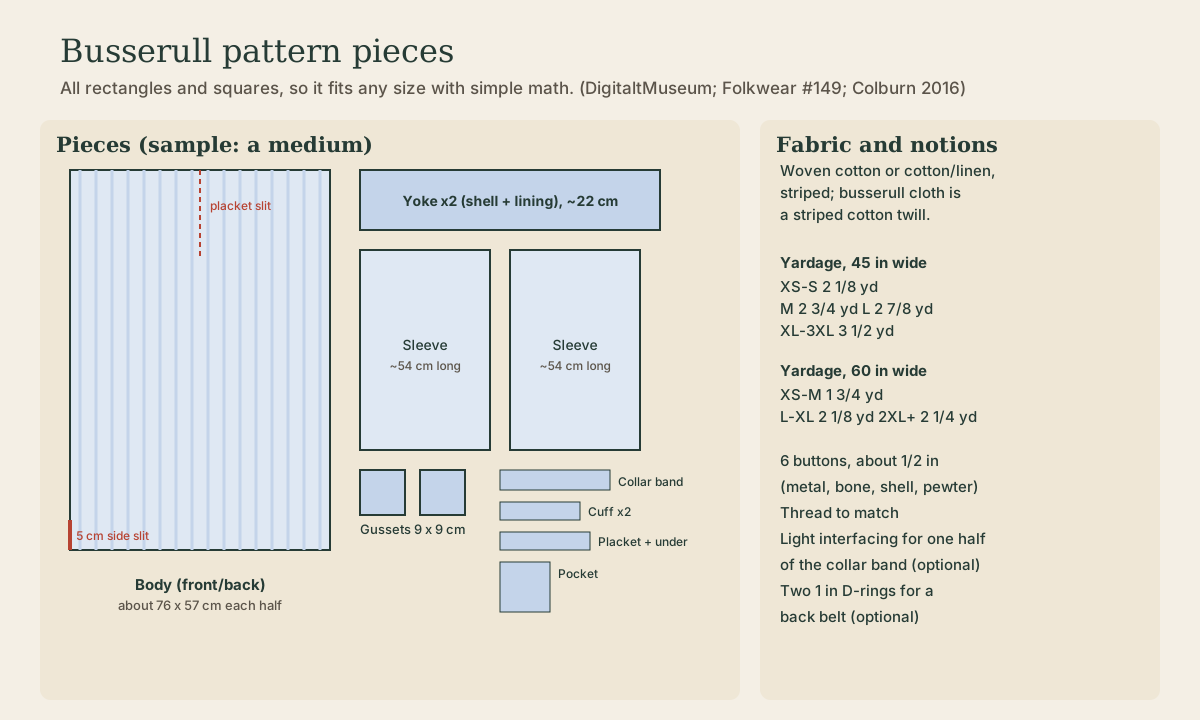
- A shirt at the Arctic University Museum in Tromsø has a back length of about 76 cm, back width 57 cm, sleeve about 54 cm, a doubled yoke, a three-button placket, sleeves pleated 2 front and 2 back at the top and 6 at the wrist, and the gusset cut in one with the sleeve front 5.
- A Lands Museum shirt has a 9 x 9 cm gusset and 5 cm side slits 6.
- A Hadeland Folkemuseum shirt is a poncho cut, the body from one length of cloth folded at the shoulder, with a 22 cm yoke whose stripes run the same way as the body 4.
Fabric
Traditional busserull cloth is a striped cotton twill. Vesterheim’s store in Decorah, Iowa, sells Solberg busserull fabric, 54 inches wide, in a 3-yard cut for one shirt, navy or red 7. For a lighter shirt, a yarn-dyed cotton/linen stripe works well; Fabricsight sells a 55% linen, 45% cotton blue-and-white stripe, about 59 inches wide 8. Prewash any cotton or linen before cutting.
Pattern and sizing
Folkwear’s #149 Norwegian Busserull comes in sizes XS to 3XL, with a finished chest from 48 3/4 to 72 inches and a back length from 26 1/2 to 29 inches. On 45-inch fabric it takes 2 1/8 yards (XS-S) to 3 1/2 yards (XL-3XL); on 60-inch fabric, 1 3/4 to 2 1/4 yards. Notions: six 1/2-inch buttons, plus two 1-inch D-rings if you add the back belt 9.
To draft your own, measure an old, comfortable work shirt: its chest width, back length, and sleeve length from the shoulder point. Each body half is a rectangle that wide and that long plus hem; each sleeve is a rectangle the sleeve length by a generous width (try about 1 1/2 times your upper-arm circumference as a starting point), pleated down to the cuff; the yoke is a strip across the shoulders. Make a quick muslin from an old sheet before cutting good cloth.
Try it
Lay out the paper pattern, or your drafted rectangles, on your fabric before cutting, and check the stripes: the museum shirts run them up and down on both body and yoke 4. Decide now which way they’ll run on the cuffs and collar band.
Lesson complete
Nice work.
Sources for this lesson
- 1Sew Your Own Scandinavian Work Shirt. North House Folk School. verified5 days; instructor Caroline Feyling (earlier Carol Colburn). The busserull cut has been tried and true for close to 200 years, designed for full movement in blacksmithing, gardening, fishing, forestry. Bring about 3 yards of all-natural woven cotton or cotton/linen, 5-6 buttons, thread, hand-sewing kit; six pattern sizes; suited to advanced beginners.
- 2Veronika Svensson Glitsch. busserull. Store norske leksikon. verifiedName used in the Nordic countries since the 1700s for an overgarment of simple cut sewn from rectangular pieces; originally a seaman's work shirt, later general work wear, fashionable for both sexes in the 1970s. The word comes via Low German from French bourgeron.
- 3Carol Ann Colburn. The Busserull (Norwegian Work Shirt) Tradition. Norwegian Textile Letter. 2016. verifiedMarch 31, 2016. Worn in the late 1800s by railroad workers, loggers, builders, farm and harbor workers, and fishermen; near 1900 the red or blue with white stripes became a national symbol; Norwegian-Americans in rural Wisconsin wore it from the 1870s until overalls displaced it by the 1920s. Band collar; yoke extending over the upper arm; mid-chest placket or full-length opening; square underarm gussets; optional half back belt. Buttons plain metal, bone, or shell, later pewter.
- 4Busserull (Hadeland Folkemuseum). Hadeland Folkemuseum, DigitaltMuseum. verifiedTwill-woven striped cotton; poncho cut with the body from one length of cloth; shoulder piece (akslaug) about 22 cm wide with stripes the same way as the body; straight-set sleeves with underarm gusset, pleated into a one-button cuff; neck placket; side slits; back strap.
- 5busserull (UMUIT-E N2646). UiT Norges arktiske universitetsmuseum, DigitaltMuseum. verifiedDoubled yoke, neckband, wide placket with 3 buttons; sleeves pleated 2 front and 2 back at the top and 6 at the wrist into a narrow one-button cuff; gusset cut in one with the sleeve front; short side slits; back length about 76 cm, back width 57 cm, sleeve about 54 cm.
- 6Busserull (Lands Museum). Lands Museum, DigitaltMuseum. verifiedPlain-woven cotton, warp 4 blue threads to 2 white; underarm gusset 9 x 9 cm; side slit 5 cm.
- 7Solberg Busserull Fabric. Vesterheim Store. verifiedCotton busserull fabric from Solberg, 54 inches wide, sold as a 3-yard cut for one shirt, $175, navy or red stripe.
- 8Linen Cotton Yarn-Dyed Stripe Shirting, Light Blue/White. Fabricsight. verified45% cotton, 55% linen yarn-dyed stripe shirting, 148-150 cm wide, 138 g/m2.
- 9149 Norwegian Busserull (pattern) and Making the Norwegian Busserull, parts one and two. Folkwear. 2026. verifiedSizes XS-3XL; rectangles and squares, underarm gussets, buttoned placket, optional half belt. Yardage on 45-inch fabric: XS-S 2 1/8 yd, M 2 3/4, L 2 7/8, XL-3XL 3 1/2; on 60-inch: XS-M 1 3/4, L-XL 2 1/8, 2XL-3XL 2 1/4. Finished chest 48 3/4 to 72 in; back length 26 1/2 to 29 in. Six 1/2-inch buttons; optional two 1-inch D-rings. Blog (folkwear.com/blogs/news/making-the-149-norwegian-busserull and .../making-the-norwegian-busserull-part-two): lined yoke with lining edges pressed under 1/2 inch and edge-stitched; neck stay-stitched at 3/8 inch; slash center front, underplacket and placket at 3/4 inch with box-stitched tab; collar band interfaced on one half, inside slipstitched by hand; four pleats at each sleeve's cuff end; gussets to sleeves, sleeves to body; optional back belt; side seams through the gussets; narrow-hemmed sleeve slits; cuffs whipstitched inside; hem 1/4 inch turned twice; buttonholes and buttons.